Chin Dawn, Huebbe Patricia, Frank Jan, Rimbach Gerald, Pallauf Kathrin
Institute of Human Nutrition and Food Science, Christian-Albrechts-University Kiel, Hermann-Rodewald-Strasse 6-8, D-24118 Kiel, Germany.
Institute of Biological Chemistry and Nutrition, University of Hohenheim, Garbenstrasse 28, D-70599 Stuttgart, Germany.
Redox Biol. 2014 Feb 28;2:563-9. doi: 10.1016/j.redox.2014.01.018. eCollection 2014.
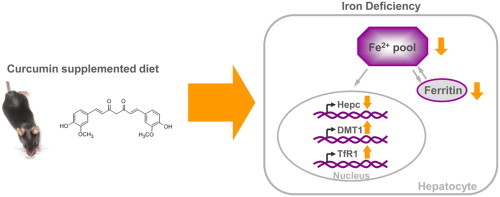
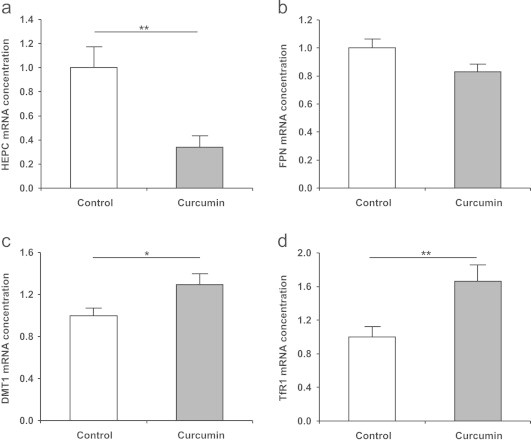
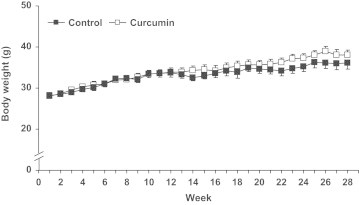
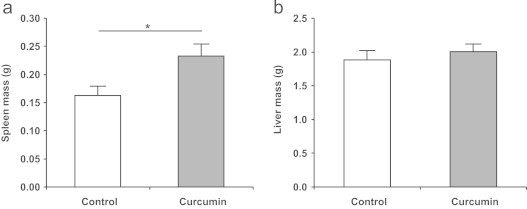
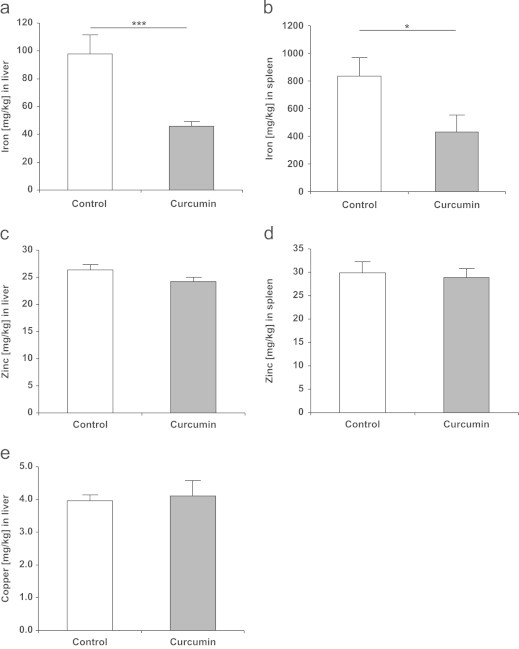
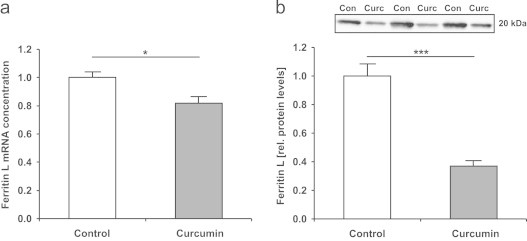
Curcumin has been shown to have many potentially health beneficial properties in vitro and in animal models with clinical studies on the toxicity of curcumin reporting no major side effects. However, curcumin may chelate dietary trace elements and could thus potentially exert adverse effects. Here, we investigated the effects of a 6 month dietary supplementation with 0.2% curcumin on iron, zinc, and copper status in C57BL/6J mice. Compared to non-supplemented control mice, we observed a significant reduction in iron, but not zinc and copper stores, in the liver and the spleen, as well as strongly suppressed liver hepcidin and ferritin expression in the curcumin-supplemented mice. The expression of the iron-importing transport proteins divalent metal transporter 1 and transferrin receptor 1 was induced, while hepatic and splenic inflammatory markers were not affected in the curcumin-fed mice. The mRNA expression of other putative target genes of curcumin, including the nuclear factor (erythroid-derived 2)-like 2 and haem oxygenase 1 did not differ between the groups. Most of the published animal trials with curcumin-feeding have not reported adverse effects on iron status or the spleen. However, it is possible that long-term curcumin supplementation and a Western-type diet may aggravate iron deficiency. Therefore, our findings show that further studies are needed to evaluate the effect of curcumin supplementation on iron status.
姜黄素在体外和动物模型中已显示出许多潜在的有益健康特性,关于姜黄素毒性的临床研究报告称无重大副作用。然而,姜黄素可能会螯合膳食中的微量元素,因此可能产生不利影响。在此,我们研究了在C57BL/6J小鼠的饮食中补充0.2%姜黄素6个月对铁、锌和铜状态的影响。与未补充姜黄素的对照小鼠相比,我们观察到补充姜黄素的小鼠肝脏和脾脏中的铁储存显著减少,但锌和铜储存未减少,同时肝脏中的铁调素和铁蛋白表达也受到强烈抑制。铁导入转运蛋白二价金属转运体1和转铁蛋白受体1的表达被诱导,而喂食姜黄素的小鼠肝脏和脾脏中的炎症标志物未受影响。姜黄素其他假定靶基因的mRNA表达,包括核因子(红细胞衍生2)样2和血红素加氧酶1,在两组之间没有差异。大多数已发表的喂食姜黄素的动物试验未报告对铁状态或脾脏有不利影响。然而,长期补充姜黄素和西式饮食可能会加重缺铁。因此,我们的研究结果表明,需要进一步研究来评估补充姜黄素对铁状态的影响。