Li Guifen, Serba Desalegn D, Saha Malay C, Bouton Joseph H, Lanzatella Christina L, Tobias Christian M
Samuel Roberts Noble Foundation, Forage Improvement Division, Ardmore, Oklahoma 73401.
United States Department of Agriculture-Agricultural Research Service, Western Regional Research Center, Albany, California 94710.
G3 (Bethesda). 2014 Mar 17;4(5):913-23. doi: 10.1534/g3.113.010165.
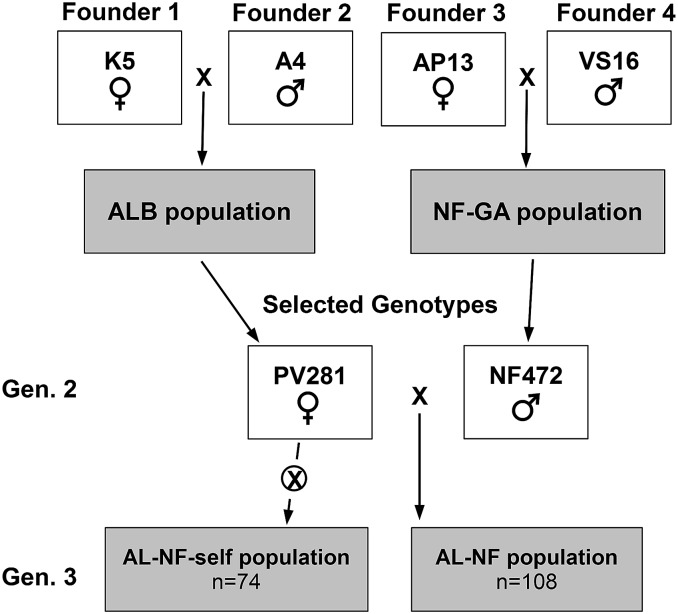
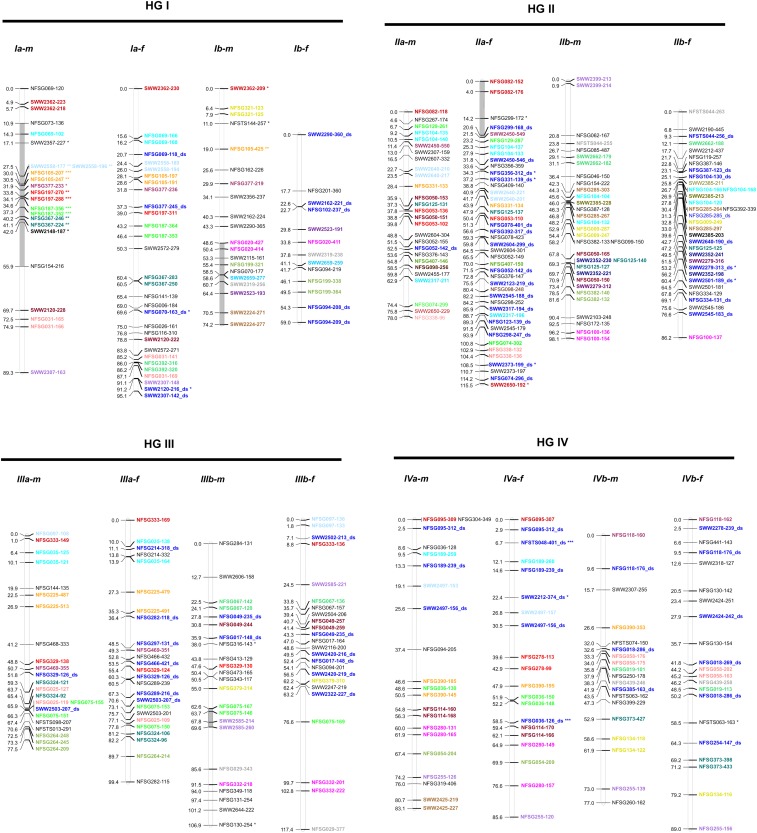
Switchgrass (Panicum virgatum L.), a warm season, C4, perennial grass, is one of the predominant grass species of the North American tall grass prairies. It is viewed as a high-potential bioenergy feedstock species because it can produce large amounts of lignocellulosic material with relatively few inputs. The objectives of this project were to develop an advanced switchgrass population and use it for the construction of genetic linkage maps and trait characterization. A three-generation, four-founder population was created and a total of 182 progeny of this advanced population were genotyped, including a mixture of self-pollinated and hybrid individuals. The female map integrated both subpopulations and covered 1629 cM of the switchgrass genome, with an average map length of 91 cM per linkage group. The male map of the hybrid progeny covered 1462 cM, with an average map length of 81 cM per linkage group. Average marker density of the female and male maps was 3.9 and 3.5 cM per marker interval, respectively. Based on the parental maps, the genome length of switchgrass was estimated to be 1776 cM and 1596 cM for the female map and male map, respectively. The proportion of the genome within 5 cM of a mapped locus was estimated to be 92% and 93% for the female map and male map, respectively. Thus, the linkage maps have covered most of the switchgrass genome. The assessment of marker transmission ratio distortion found that 26% of the genotyped markers were distorted from either 1:1 or 3:1 ratios expected for segregation of single dose markers in one or both parents, respectively. Several regions affected by transmission ratio distortion were found, with linkage groups Ib-m and VIIIa-f most affected.
柳枝稷(Panicum virgatum L.)是一种暖季型、C4多年生草本植物,是北美高草草原的主要草种之一。它被视为一种具有高潜力的生物能源原料物种,因为它能够以相对较少的投入生产大量木质纤维素材料。本项目的目标是培育一个先进的柳枝稷群体,并将其用于构建遗传连锁图谱和性状表征。创建了一个三代、四个亲本的群体,并对这个先进群体的总共182个后代进行了基因分型,包括自花授粉和杂交个体的混合。雌性图谱整合了两个亚群体,覆盖了柳枝稷基因组的1629厘摩,每个连锁群的平均图谱长度为91厘摩。杂交后代的雄性图谱覆盖了1462厘摩,每个连锁群的平均图谱长度为81厘摩。雌性和雄性图谱的平均标记密度分别为每个标记区间3.9厘摩和3.5厘摩。基于亲本图谱,柳枝稷的基因组长度估计雌性图谱为1776厘摩,雄性图谱为1596厘摩。估计在已定位基因座5厘摩范围内的基因组比例,雌性图谱和雄性图谱分别为92%和93%。因此,连锁图谱覆盖了大部分柳枝稷基因组。对标记传递率扭曲的评估发现,26%的基因分型标记偏离了单剂量标记在一个或两个亲本中分离预期的1:1或3:1比例。发现了几个受传递率扭曲影响的区域,其中连锁群Ib-m和VIIIa-f受影响最大。