Asakawa Haruhiko, Yang Hui-Ju, Yamamoto Takaharu G, Ohtsuki Chizuru, Chikashige Yuji, Sakata-Sogawa Kumiko, Tokunaga Makio, Iwamoto Masaaki, Hiraoka Yasushi, Haraguchi Tokuko
Graduate School of Frontier Biosciences; Osaka University; Suita, Japan.
Advanced ICT Research Institute Kobe; National Institute of Information and Communications Technology; Kobe, Japan.
Nucleus. 2014 Mar-Apr;5(2):149-62. doi: 10.4161/nucl.28487. Epub 2014 Mar 12.
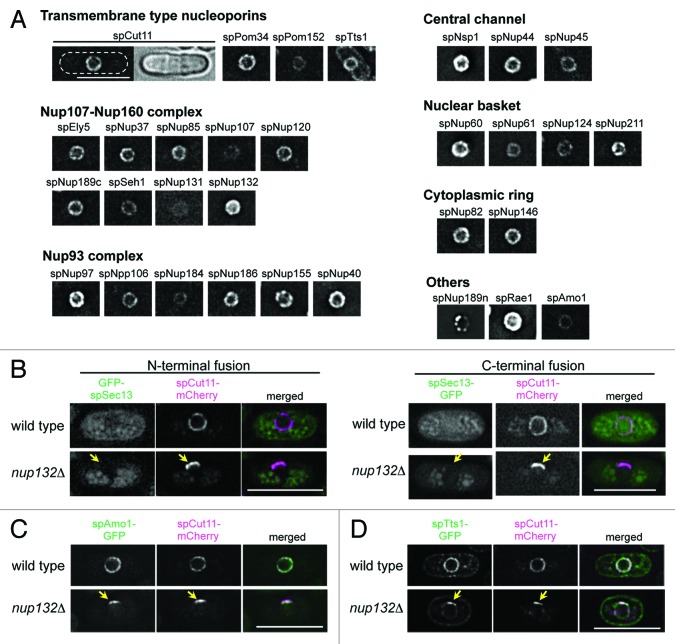
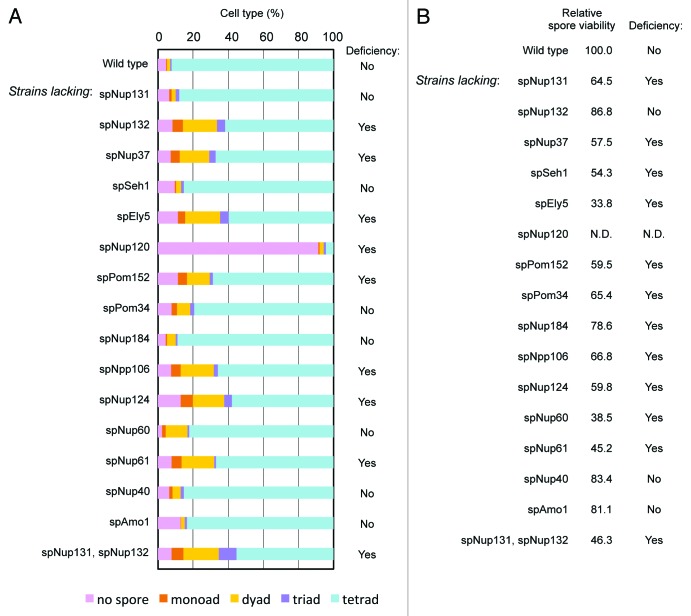
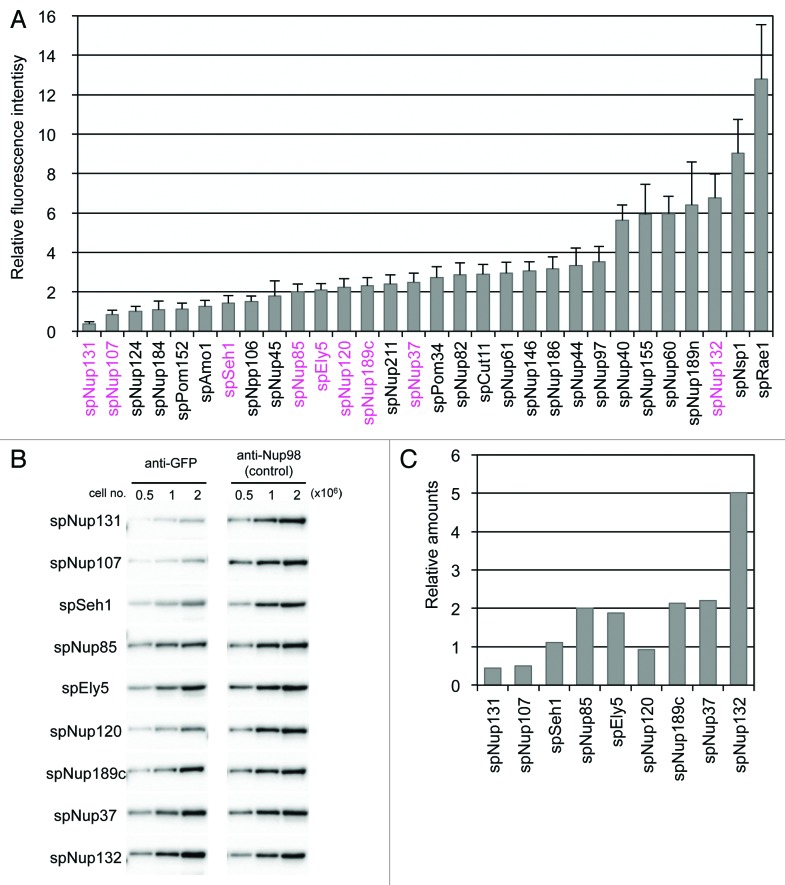
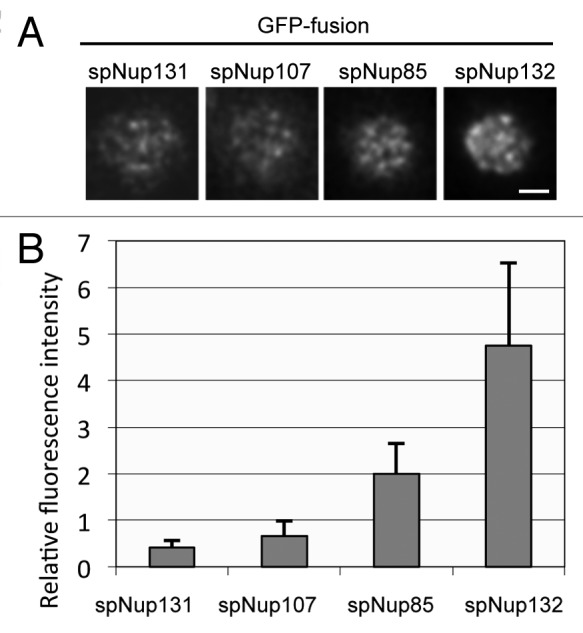
The nuclear pore complex (NPC) is an enormous proteinaceous complex composed of multiple copies of about 30 different proteins called nucleoporins. In this study, we analyzed the composition of the NPC in the model organism Schizosaccharomyces pombe using strains in which individual nucleoporins were tagged with GFP. We identified 31 proteins as nucleoporins by their localization to the nuclear periphery. Gene disruption analysis in previous studies coupled with gene disruption analysis in the present study indicates that 15 of these nucleoporins are essential for vegetative cell growth and the other 16 nucleoporins are non-essential. Among the 16 non-essential nucleoporins, 11 are required for normal progression through meiosis and their disruption caused abnormal spore formation or poor spore viability. Based on fluorescence measurements of GFP-fused nucleoporins, we estimated the composition of the NPC in S. pombe and found that the organization of the S. pombe NPC is largely similar to that of other organisms; a single NPC was estimated as being 45.8-47.8 MDa in size. We also used fluorescence measurements of single NPCs and quantitative western blotting to analyze the composition of the Nup107-Nup160 subcomplex, which plays an indispensable role in NPC organization and function. Our analysis revealed low amounts of Nup107 and Nup131 and high amounts of Nup132 in the Nup107-Nup160 subcomplex, suggesting that the composition of this complex in S. pombe may differ from that in S. cerevisiae and humans. Comparative analysis of NPCs in various organisms will lead to a comprehensive understanding of the functional architecture of the NPC.
核孔复合体(NPC)是一种巨大的蛋白质复合体,由约30种不同蛋白质(称为核孔蛋白)的多个拷贝组成。在本研究中,我们使用单个核孔蛋白用绿色荧光蛋白(GFP)标记的菌株,分析了模式生物粟酒裂殖酵母中NPC的组成。我们通过它们在核周的定位鉴定出31种蛋白质为核孔蛋白。先前研究中的基因破坏分析以及本研究中的基因破坏分析表明,这些核孔蛋白中有15种对于营养细胞生长是必需的,另外16种核孔蛋白是非必需的。在这16种非必需核孔蛋白中,有11种是减数分裂正常进行所必需的,它们的破坏会导致异常的孢子形成或孢子活力低下。基于对GFP融合核孔蛋白的荧光测量,我们估计了粟酒裂殖酵母中NPC的组成,发现粟酒裂殖酵母NPC的组织结构与其他生物体的组织结构基本相似;估计单个NPC的大小为45.8 - 47.8兆道尔顿。我们还使用单个NPC的荧光测量和定量蛋白质免疫印迹分析了在NPC组织和功能中起不可或缺作用的Nup107 - Nup160亚复合体的组成。我们的分析揭示了Nup107 - Nup160亚复合体中Nup107和Nup131的含量较低,而Nup132的含量较高,这表明粟酒裂殖酵母中该复合体的组成可能与酿酒酵母和人类中的不同。对各种生物体中NPC的比较分析将有助于全面了解NPC的功能结构。