Department of Radiology, University of Texas Southwestern Medical Center, Dallas, Texas.
J Nucl Med. 2014 Apr;55(4):622-8. doi: 10.2967/jnumed.113.126979. Epub 2014 Mar 17.
Copper is an element required for cell proliferation and angiogenesis. Human prostate cancer xenografts with increased (64)Cu radioactivity were visualized previously by PET using (64)CuCl2 as a radiotracer ((64)CuCl2 PET). This study aimed to determine whether the increased tumor (64)Cu radioactivity was due to increased cellular uptake of (64)Cu mediated by human copper transporter 1 (hCtr1) or simply due to nonspecific binding of ionic (64)CuCl2 to tumor tissue. In addition, the functional role of hCtr1 in proliferation of prostate cancer cells and tumor growth was also assessed.
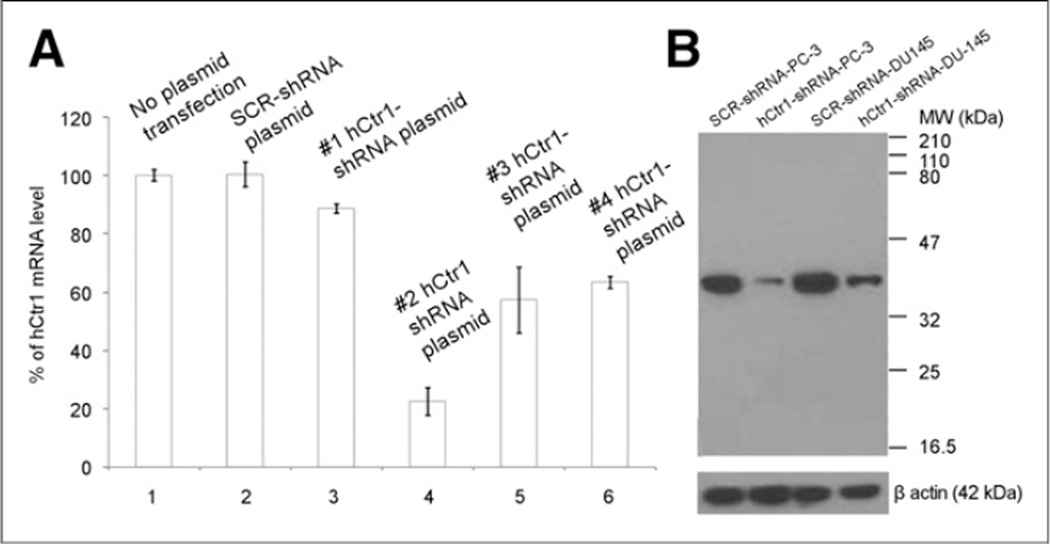
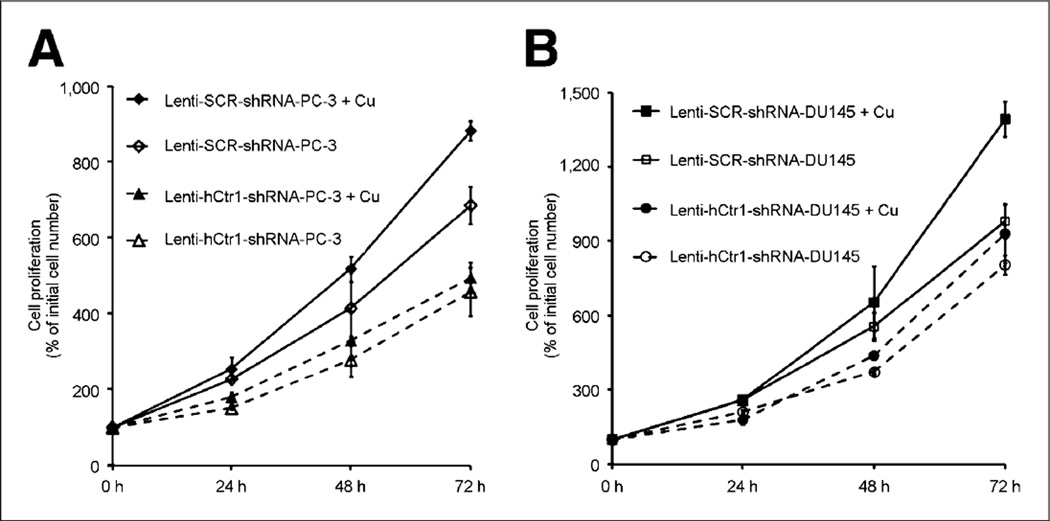
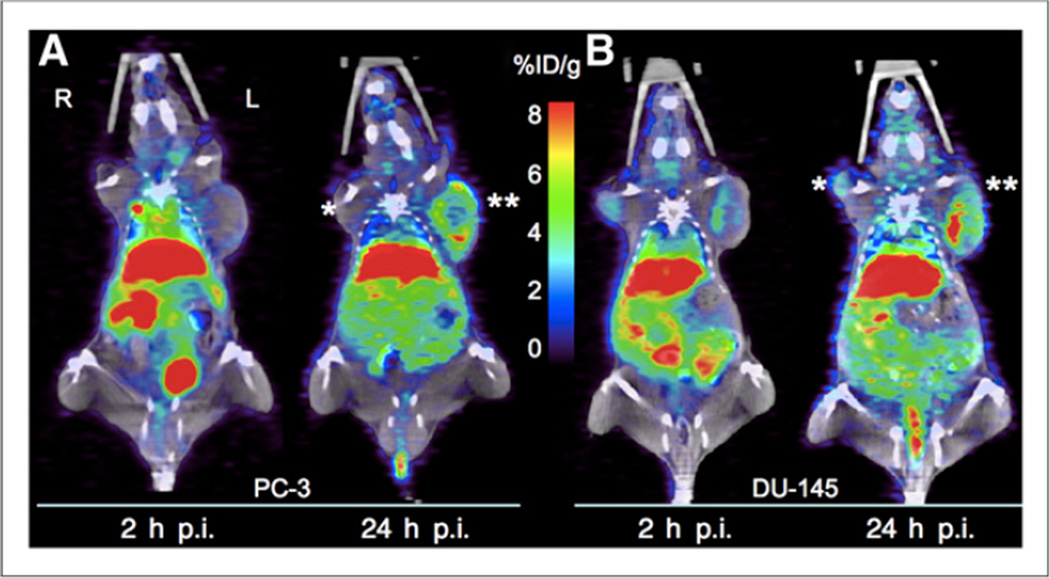
A lentiviral vector encoding short-hairpin RNA specific for hCtr1 (Lenti-hCtr1-shRNA) was constructed for RNA interference-mediated knockdown of hCtr1 expression in prostate cancer cells. The degree of hCtr1 knockdown was determined by Western blot, and the effect of hCtr1 knockdown on copper uptake and proliferation were examined in vitro by cellular (64)Cu uptake and cell proliferation assays. The effects of hCtr1 knockdown on tumor uptake of (64)Cu were determined by PET quantification and tissue radioactivity assay. The effects of hCtr1 knockdown on tumor growth were assessed by PET/CT and tumor size measurement with a caliper.
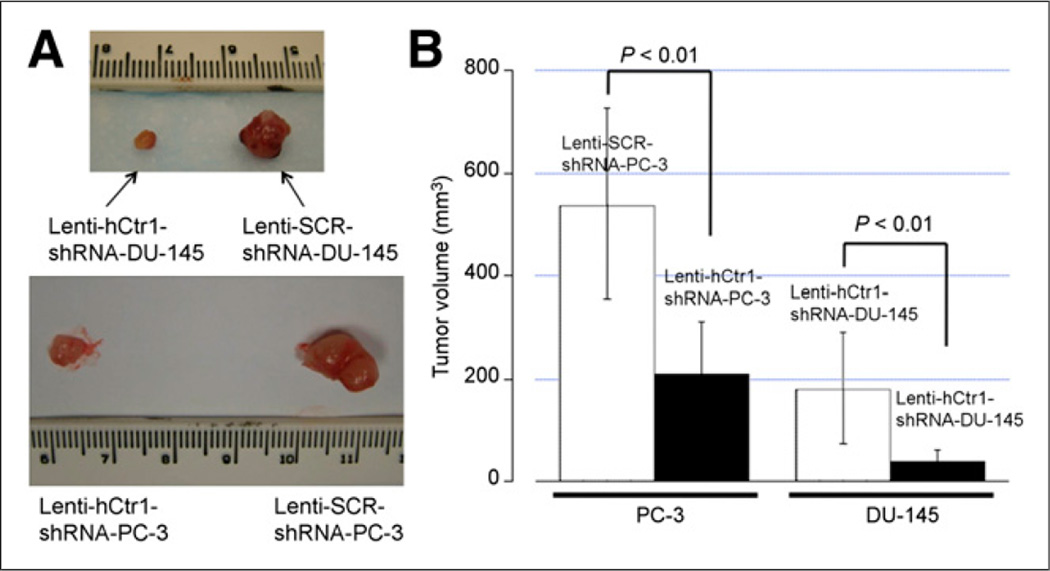
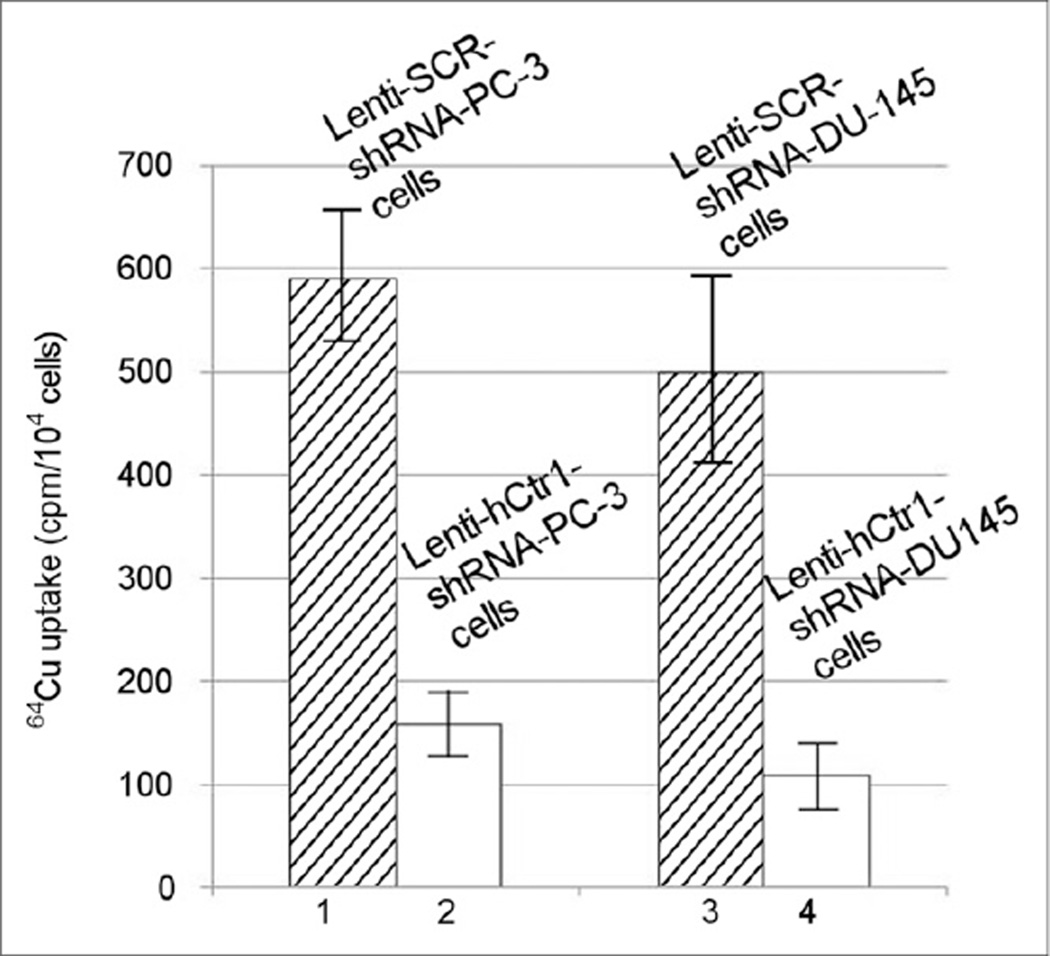
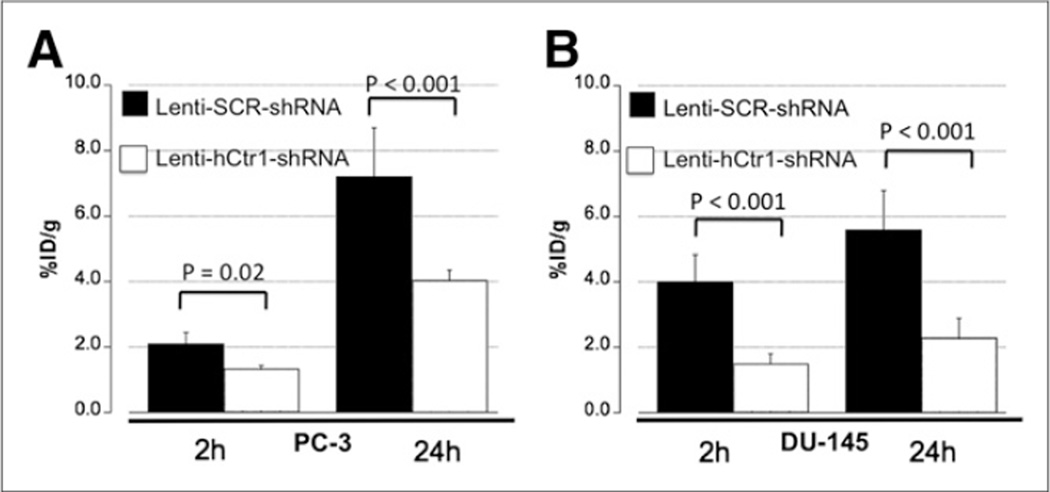
RNA interference-mediated knockdown of hCtr1 was associated with the reduced cellular uptake of (64)Cu and the suppression of prostate cancer cell proliferation in vitro. At 24 h after intravenous injection of the tracer (64)CuCl2, the (64)Cu uptake by the tumors with knockdown of hCtr1 (4.02 ± 0.31 percentage injected dose per gram [%ID/g] in Lenti-hCtr1-shRNA-PC-3 and 2.30 ± 0.59 %ID/g in Lenti-hCtr1-shRNA-DU-145) was significantly lower than the (64)Cu uptake by the control tumors without knockdown of hCtr1 (7.21 ± 1.48 %ID/g in Lenti-SCR-shRNA-PC-3 and 5.57 ± 1.20 %ID/g in Lenti-SCR-shRNA-DU-145, P < 0.001) by PET quantification. Moreover, the volumes of prostate cancer xenograft tumors with knockdown of hCtr1 (179 ± 111 mm(3) for Lenti-hCtr1-shRNA-PC-3 or 39 ± 22 mm(3) for Lenti-hCtr1-shRNA-DU-145) were significantly smaller than those without knockdown of hCtr1 (536 ± 191 mm(3) for Lenti- SCR-shRNA-PC-3 or 208 ± 104 mm(3) for Lenti-SCR-shRNA-DU-145, P < 0.01).
Overall, data indicated that hCtr1 is a promising theranostic target, which can be further developed for metabolic imaging of prostate cancer using (64)CuCl2 PET/CT and personalized cancer therapy targeting copper metabolism.
构建针对人铜转运蛋白 1(hCtr1)的短发夹 RNA(shRNA)慢病毒载体,用于 RNA 干扰介导的 hCtr1 表达下调,探讨 hCtr1 表达下调对前列腺癌细胞摄取放射性铜[64Cu]和增殖的影响及其在前列腺癌 [(64)Cu]CuCl2 PET/CT 显像中的作用。
构建针对 hCtr1 的短发夹 RNA(shRNA)慢病毒载体,用于 RNA 干扰介导的 hCtr1 表达下调,采用 Western blot 检测 hCtr1 下调程度,采用细胞摄取 [(64)Cu]Cu 实验和细胞增殖实验检测 hCtr1 下调对铜摄取和增殖的影响,采用 PET 定量和组织放射性测定检测 hCtr1 下调对肿瘤 [(64)Cu]Cu 摄取的影响,采用 PET/CT 和卡尺测量肿瘤大小检测 hCtr1 下调对肿瘤生长的影响。
RNA 干扰介导的 hCtr1 下调与体外前列腺癌细胞摄取 [(64)Cu]Cu 减少和增殖抑制有关。在静脉注射示踪剂 [(64)Cu]CuCl2 后 24 h,hCtr1 下调的肿瘤 [(64)Cu]Cu 摄取(PC-3 中 Lenti-hCtr1-shRNA 的摄取为 4.02±0.31%注入剂量/克[ID/g],DU-145 中 Lenti-hCtr1-shRNA 的摄取为 2.30±0.59%ID/g)明显低于未下调 hCtr1 的肿瘤 [(64)Cu]Cu 摄取(PC-3 中 Lenti-SCR-shRNA 的摄取为 7.21±1.48%ID/g,DU-145 中 Lenti-SCR-shRNA 的摄取为 5.57±1.20%ID/g,P<0.001)。此外,hCtr1 下调的前列腺癌异种移植肿瘤体积(PC-3 中 Lenti-hCtr1-shRNA 的体积为 179±111 mm3,DU-145 中 Lenti-hCtr1-shRNA 的体积为 39±22 mm3)明显小于未下调 hCtr1 的肿瘤体积(PC-3 中 Lenti-SCR-shRNA 的体积为 536±191 mm3,DU-145 中 Lenti-SCR-shRNA 的体积为 208±104 mm3,P<0.01)。
hCtr1 是一种有前途的治疗性靶点,可进一步用于使用 [(64)Cu]CuCl2 PET/CT 进行前列腺癌代谢成像和针对铜代谢的个体化癌症治疗。