Moohebati Mohsen, Kabirirad Vahid, Ghayour-Mobarhan Majid, Esmaily Habibollah, Tavallaie Shima, Akhavan Rezayat Amir, Pourghadamyari Hossein, Sahebkar Amirhossein
Cardiovascular Research Center, Mashhad University of Medical Sciences, Mashhad, Iran ; Department of Cardiology, Mashhad University of Medical Sciences, Mashhad, Iran.
Student Research Committee, Biochemistry of Nutrition Research Center, School of Medicine, Mashhad University of Medical Sciences, Mashhad, Iran.
Int J Vasc Med. 2014;2014:845960. doi: 10.1155/2014/845960. Epub 2014 Feb 3.
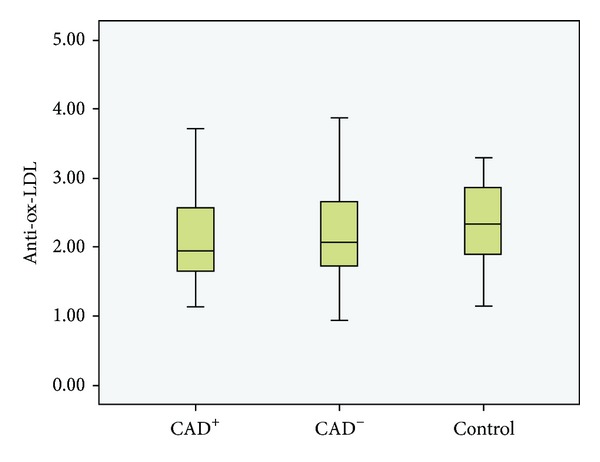
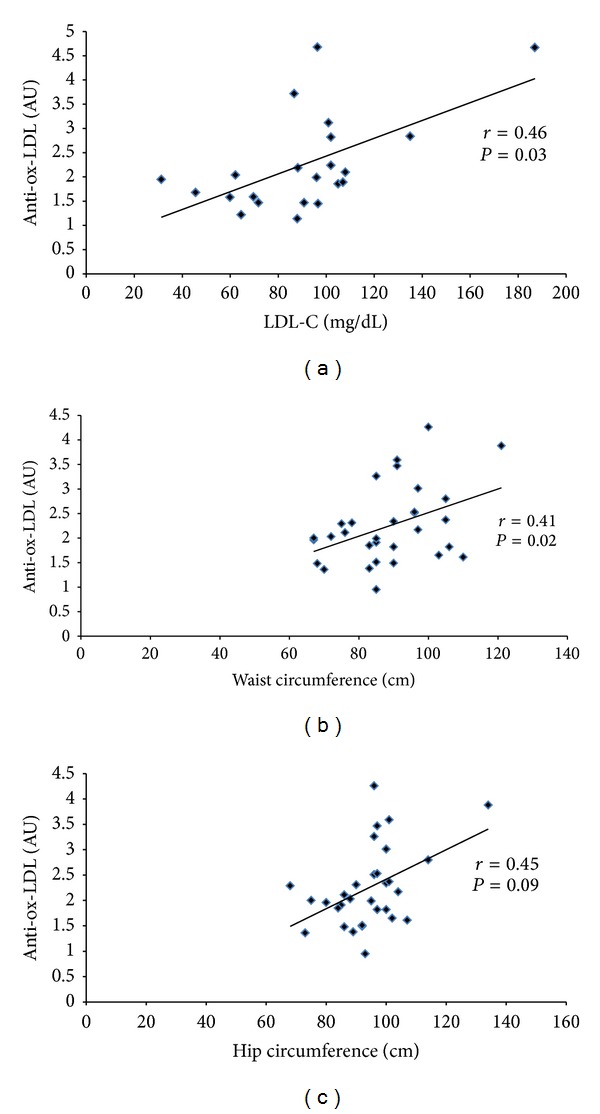
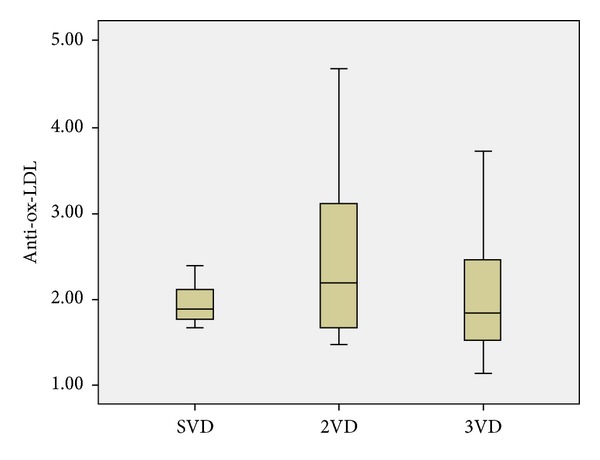
It has been suggested that antioxidized low-density lipoprotein (anti-oxLDL) antibodies play a role in the pathogenesis of atherosclerosis. The aim of this study was to measure serum ox-LDL IgG levels in 31 patients with angiographically defined coronary artery disease (CAD) (≥50% stenosis in at least one major coronary artery; CAD(+) group) and compare these levels with those of 32 subjects with <50% coronary stenosis (CAD(-) group) and 24 healthy age- and sex-matched controls using ELISA. We did not find any significant difference between CAD(+), CAD(-), and control groups in regard to oxLDL IgG levels (P = 0.83). Serum oxLDL IgG levels did not differ between 1VD (one vessel disease), 2VD (2 vessels disease), and 3VD (3 vessels disease) subgroups of CAD(+) patients (P = 0.20). Serum anti-oxLDL titers were only significantly correlated with LDL-C in the CAD(+) group (P < 0.05) and waist and hip circumference (P < 0.05 and P < 0.01, resp.) in the CAD(-) group. In stepwise regression analysis, none of the conventional cardiovascular risk factors was associated with serum ox-LDL IgG levels. The present results suggest that serum levels of ox-LDL IgG are neither associated with the presence and severity of CAD nor with the conventional cardiovascular risk factors.
有人提出抗氧化低密度脂蛋白(anti-oxLDL)抗体在动脉粥样硬化的发病机制中起作用。本研究的目的是使用酶联免疫吸附测定法(ELISA)测量31例经血管造影确诊为冠状动脉疾病(CAD)(至少一支主要冠状动脉狭窄≥50%;CAD阳性组)患者的血清氧化型低密度脂蛋白IgG水平,并将这些水平与32例冠状动脉狭窄<50%的受试者(CAD阴性组)以及24例年龄和性别匹配的健康对照者的水平进行比较。我们发现CAD阳性组、CAD阴性组和对照组在氧化型低密度脂蛋白IgG水平方面没有任何显著差异(P = 0.83)。CAD阳性患者的单支血管病变(1VD)、双支血管病变(2VD)和三支血管病变(3VD)亚组之间的血清氧化型低密度脂蛋白IgG水平没有差异(P = 0.20)。血清抗氧化型低密度脂蛋白滴度仅在CAD阳性组中与低密度脂蛋白胆固醇显著相关(P < 0.05),在CAD阴性组中与腰围和臀围显著相关(分别为P < 0.05和P < 0.01)。在逐步回归分析中,没有任何传统心血管危险因素与血清氧化型低密度脂蛋白IgG水平相关。目前的结果表明,血清氧化型低密度脂蛋白IgG水平既与CAD的存在和严重程度无关,也与传统心血管危险因素无关。