College of Medicine, Seoul National University, Seoul 110-744, Korea.
Department of Radiology, Seoul National University Hospital, Seoul 110-744, Korea. ; Research Institute of Radiation Medicine, Seoul National University College of Medicine, Seoul 110-744, Korea.
Korean J Radiol. 2014 Mar-Apr;15(2):195-204. doi: 10.3348/kjr.2014.15.2.195. Epub 2014 Mar 7.
To evaluate the impact of the adaptive iterative dose reduction (AIDR) three-dimensional (3D) algorithm in CT on noise reduction and the image quality compared to the filtered back projection (FBP) algorithm and to compare the effectiveness of AIDR 3D on noise reduction according to the body habitus using phantoms with different sizes.
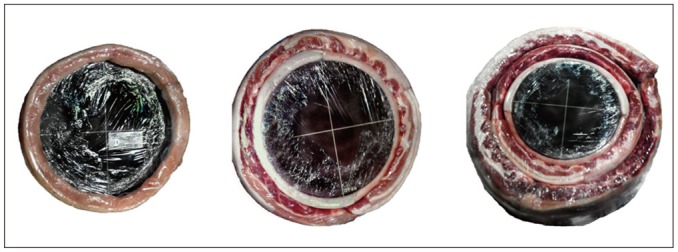
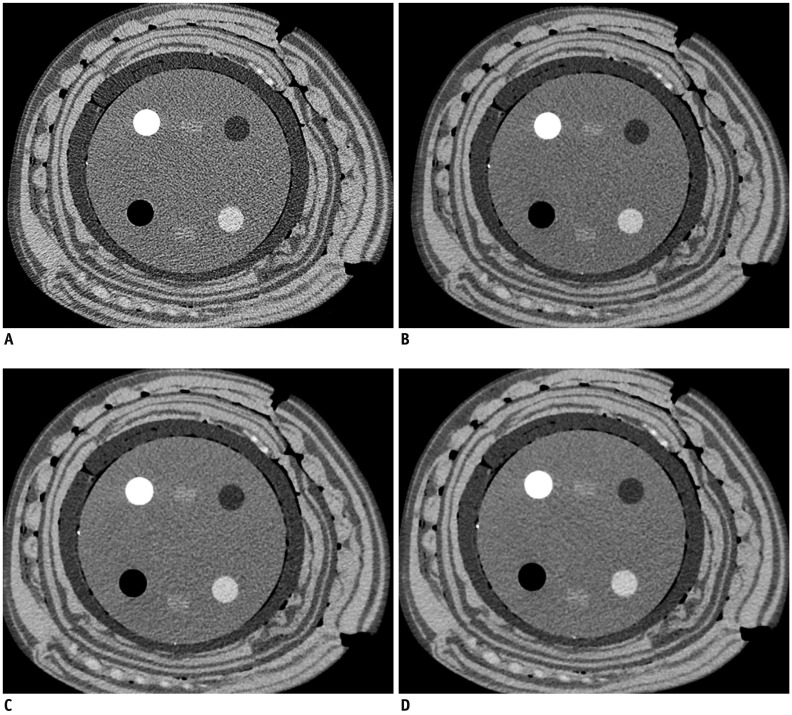
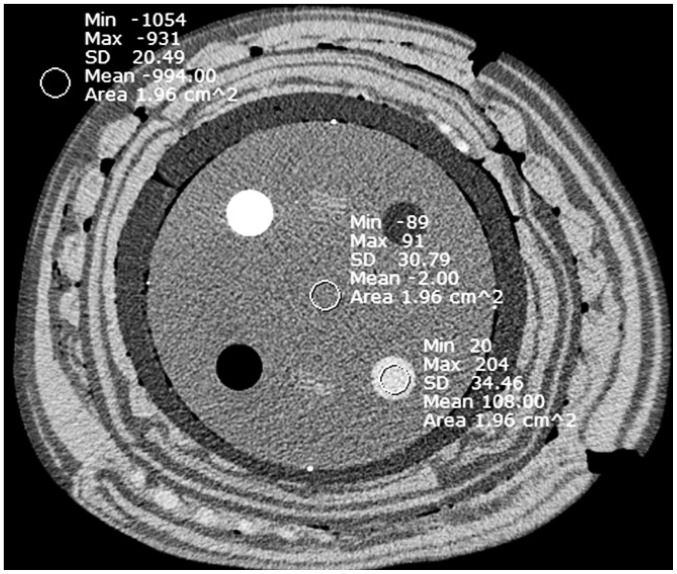
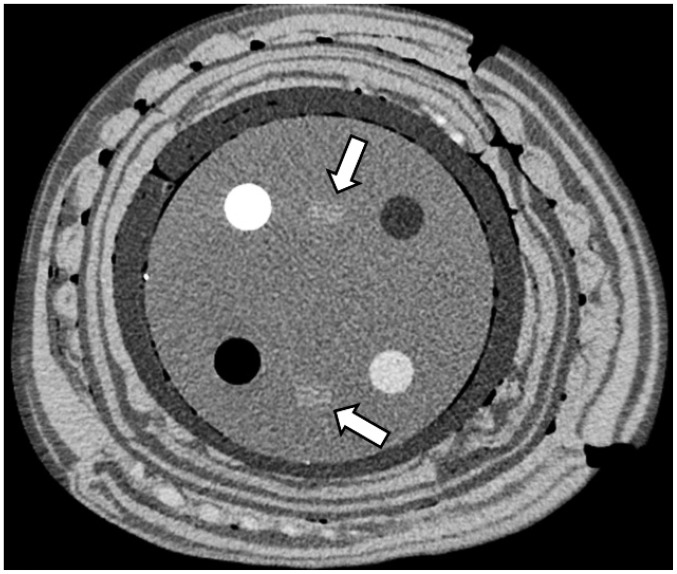
Three different-sized phantoms with diameters of 24 cm, 30 cm, and 40 cm were built up using the American College of Radiology CT accreditation phantom and layers of pork belly fat. Each phantom was scanned eight times using different mAs. Images were reconstructed using the FBP and three different strengths of the AIDR 3D. The image noise, the contrast-to-noise ratio (CNR) and the signal-to-noise ratio (SNR) of the phantom were assessed. Two radiologists assessed the image quality of the 4 image sets in consensus. The effectiveness of AIDR 3D on noise reduction compared with FBP were also compared according to the phantom sizes.
Adaptive iterative dose reduction 3D significantly reduced the image noise compared with FBP and enhanced the SNR and CNR (p < 0.05) with improved image quality (p < 0.05). When a stronger reconstruction algorithm was used, greater increase of SNR and CNR as well as noise reduction was achieved (p < 0.05). The noise reduction effect of AIDR 3D was significantly greater in the 40-cm phantom than in the 24-cm or 30-cm phantoms (p < 0.05).
The AIDR 3D algorithm is effective to reduce the image noise as well as to improve the image-quality parameters compared by FBP algorithm, and its effectiveness may increase as the phantom size increases.
评估自适应迭代剂量降低(AIDR)三维(3D)算法在 CT 中与滤波反投影(FBP)算法相比在降低噪声和图像质量方面的影响,并通过不同大小的体模比较 AIDR 3D 在降低噪声方面的有效性。
使用美国放射学院 CT 认证体模和猪腹脂肪层构建直径为 24cm、30cm 和 40cm 的三个不同大小的体模。每个体模使用不同的 mAs 扫描 8 次。使用 FBP 和三种不同强度的 AIDR 3D 进行图像重建。评估体模的图像噪声、对比噪声比(CNR)和信噪比(SNR)。两名放射科医生对 4 组图像的质量进行了共识评估。还根据体模的大小比较了 AIDR 3D 与 FBP 相比降低噪声的效果。
与 FBP 相比,AIDR 3D 显著降低了图像噪声,提高了 SNR 和 CNR(p < 0.05),改善了图像质量(p < 0.05)。使用更强的重建算法时,可实现更大的 SNR 和 CNR 增加以及噪声降低(p < 0.05)。与 24cm 或 30cm 体模相比,AIDR 3D 的噪声降低效果在 40cm 体模中更为显著(p < 0.05)。
与 FBP 算法相比,AIDR 3D 算法可有效降低图像噪声,提高图像质量参数,且随着体模尺寸的增加,其有效性可能增加。