NICU, Department of Clinical Sciences and Community Health, Fondazione IRCCS Cà Granda Ospedale Maggiore Policlinico, Università degli Studi di Milano, Via Commenda 12, 20122 Milano, Italy.
BMC Pediatr. 2014 Mar 19;14:74. doi: 10.1186/1471-2431-14-74.
Preterm infants are at risk for adverse neurodevelopment. Furthermore, nutrition may play a key role in supporting neurodevelopment. The aim of this study was to evaluate whether a nutrient-enriched formula fed to preterm infants after hospital discharge could improve their neurodevelopment at 24 months (term-corrected age).
We conducted an observer-blinded, single-center, randomized controlled trial in infants admitted to the Fondazione IRCCS Cà Granda Ospedale Maggiore Policlinico, University of Milan, Italy between 2009 and 2011. Inclusion criteria were gestational age < 32 weeks and/or birth weight < 1500 g, and being fed human milk for < 20% of the total milk intake. Exclusion criteria were congenital malformations or conditions that could interfere with growth or body composition. Included infants were randomized to receive a standard full-term formula or a nutrient-enriched formula up until 6 months of corrected age, using two computer-generated randomization lists; one appropriate for gestational age (AGA) and one for small for gestational age (SGA) infants. We assessed neurodevelopment at 24 months of corrected age using the Griffiths Mental Development Scale and related subscales (locomotor, personal-social, hearing and speech, hand and eye coordination, and performance).
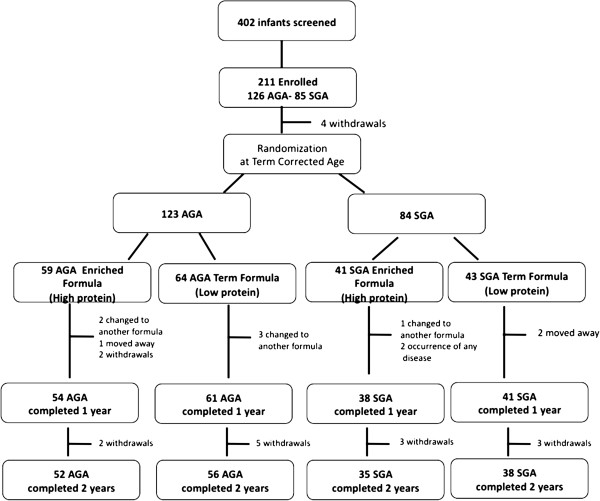
Of the 207 randomized infants, 181 completed the study. 52 AGA and 35 SGA infants were fed a nutrient-enriched formula, whereas 56 AGA and 38 SGA infants were fed a standard full-term formula. The general quotient at 24 months of corrected age was not significantly different between infants randomized to receive a nutrient-enriched formula compared with a standard term formula up until 6 months of corrected age (AGA infants: 93.8 ± 12.6 vs. 92.4 ± 10.4, respectively; SGA infants: 96.1 ± 9.9 vs. 98.2 ± 9, respectively). The scores of related subscales were also similar among groups.
This study found that feeding preterm infants a nutrient-enriched formula after discharge does not affect neurodevelopment at 24 months of corrected age, in either AGA or SGA infants, free from major comorbidities.
Current Controlled Trials (http://www.controlled-trials.com/ISRCTN30189842) London, UK.
早产儿存在神经发育不良的风险。此外,营养可能在支持神经发育方面发挥关键作用。本研究旨在评估出院后给早产儿喂食富含营养的配方奶是否能改善他们在 24 个月(校正胎龄)时的神经发育。
我们在意大利米兰大学米兰综合医院 Fondazione IRCCS Cà Granda 进行了一项单中心、观察者设盲、随机对照试验。纳入标准为胎龄<32 周且/或出生体重<1500g,且人乳喂养量<总奶量的 20%。排除标准为先天性畸形或可能影响生长或身体成分的疾病。纳入的婴儿被随机分为接受标准足月配方奶或富含营养的配方奶,直至校正年龄 6 个月,使用两个计算机生成的随机分组列表;一个适用于胎龄(AGA)婴儿,另一个适用于小于胎龄(SGA)婴儿。我们使用 Griffiths 精神发育量表及其相关分量表(运动、个人社交、听力和言语、手眼协调、表现)在校正年龄 24 个月时评估神经发育。
在 207 名随机婴儿中,有 181 名完成了研究。52 名 AGA 和 35 名 SGA 婴儿接受富含营养的配方奶,而 56 名 AGA 和 38 名 SGA 婴儿接受标准足月配方奶。在 6 个月校正年龄时,接受富含营养配方奶与标准足月配方奶的婴儿的一般智商在 24 个月校正年龄时没有显著差异(AGA 婴儿:93.8±12.6 与 92.4±10.4,分别;SGA 婴儿:96.1±9.9 与 98.2±9,分别)。各组相关分量表的评分也相似。
本研究发现,在没有重大合并症的情况下,出院后给早产儿喂食富含营养的配方奶并不会影响 AGA 或 SGA 婴儿在 24 个月校正年龄时的神经发育。
当前对照试验(http://www.controlled-trials.com/ISRCTN30189842),英国伦敦。