IUF - Leibniz Research Institute for Environmental Medicine, Auf'm Hennekamp 50, Düsseldorf 40225, Germany.
Immun Ageing. 2014 Mar 19;11(1):5. doi: 10.1186/1742-4933-11-5.
The association between long-term exposure to air pollution and local inflammation in the lung has rarely been investigated in the general population of elderly subjects before. We investigated this association in a population-based cohort of elderly women from Germany.
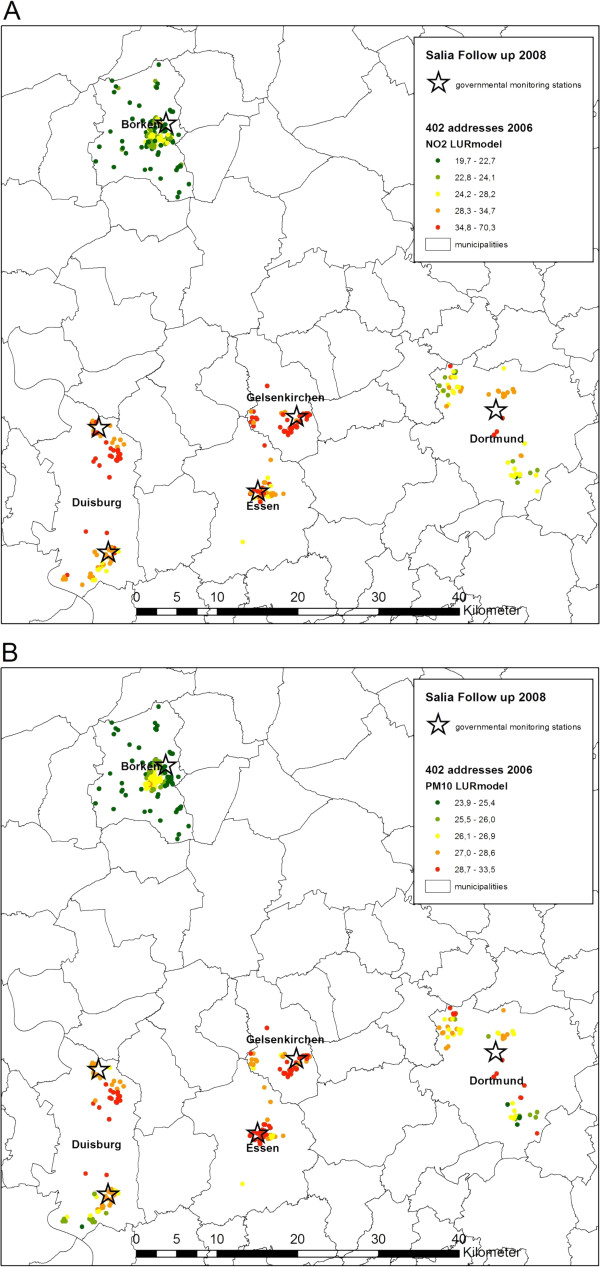
In a follow-up examination of the SALIA cohort study in 2008/2009, 402 women aged 68 to 79 years from the Ruhr Area and Borken (Germany) were clinically examined. Inflammatory markers were determined in exhaled breath condensate (EBC) and in induced sputum (IS). We used traffic indicators and measured air pollutants at single monitoring stations in the study area to assess individual traffic exposure and long-term air pollution background exposure. Additionally long-term residential exposure to air pollution was estimated using land-use regression (LUR) models. We applied multiple logistic and linear regression analyses adjusted for age, indoor mould, smoking, passive smoking and socio-economic status and additionally conducted sensitivity analyses.
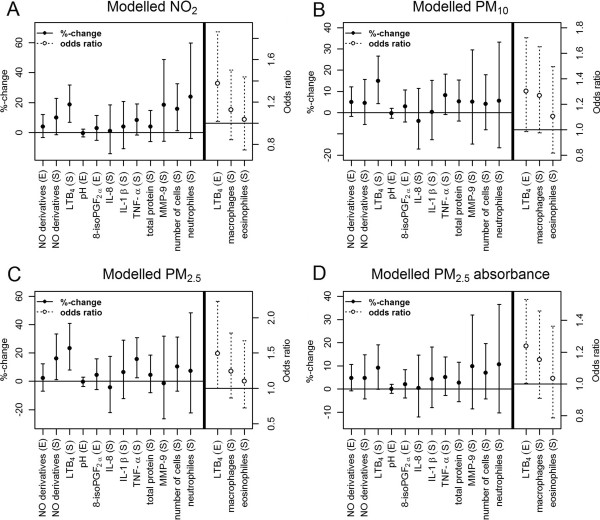
Inflammatory markers showed a high variability between the individuals and were higher with higher exposure to air pollution. NO derivatives, leukotriene (LT) B4 and tumour necrosis factor-α (TNF-α) showed the strongest associations. An increase of 9.42 μg/m3 (interquartile range) in LUR modelled NO2 was associated with measureable LTB4 level (level with values above the detection limit) in EBC (odds ratio: 1.38, 95% CI: 1.02 -1.86) as well as with LTB4 in IS (%-change: 19%, 95% CI: 7% - 32%). The results remained consistent after exclusion of subpopulations with risk factors for inflammation (smoking, respiratory diseases, mould infestation) and after extension of models with additional adjustment for season of examination, mass of IS and urban/rural living as sensitivity analyses.
In this analysis of the SALIA study we found that long-term exposure to air pollutants from traffic and industrial sources was associated with an increase of several inflammatory markers in EBC and in IS. We conclude that long-term exposure to air pollution might lead to changes in the inflammatory marker profile in the lower airways in an elderly female population.
长期暴露于空气污染与肺部局部炎症之间的关联在老年人群体中的研究较少。我们在德国的一个基于人群的老年女性队列中对此进行了研究。
在 SALIA 队列研究的 2008/2009 年随访检查中,来自德国鲁尔区和博肯的 402 名年龄在 68 至 79 岁的女性进行了临床检查。在呼出气冷凝物(EBC)和诱导痰(IS)中测定了炎症标志物。我们使用交通指标,并在研究区域的单个监测站测量了空气污染物,以评估个体交通暴露和长期空气污染背景暴露。此外,还使用基于土地利用的回归(LUR)模型估算了长期居住的空气污染暴露。我们应用了多元逻辑和线性回归分析,并进行了年龄、室内霉菌、吸烟、被动吸烟和社会经济地位的调整,并进行了敏感性分析。
炎症标志物在个体之间具有很高的变异性,并且随着空气污染暴露的增加而升高。NO 衍生物、白三烯(LT)B4 和肿瘤坏死因子-α(TNF-α)显示出最强的关联。LUR 模型中 NO2 每增加 9.42μg/m3(四分位距),EBC 中可测量的 LTB4 水平(高于检测限的水平)(比值比:1.38,95%置信区间:1.02-1.86)以及 IS 中的 LTB4(%变化:19%,95%置信区间:7%-32%)也会升高。在排除具有炎症风险因素(吸烟、呼吸道疾病、霉菌滋生)的亚组后,以及在将模型扩展为检查季节、IS 质量和城乡生活的额外调整后,结果仍然一致,作为敏感性分析。
在 SALIA 研究的这项分析中,我们发现长期暴露于交通和工业来源的空气污染物与 EBC 和 IS 中几种炎症标志物的增加有关。我们得出结论,长期暴露于空气污染可能会导致老年女性人群下呼吸道炎症标志物谱的变化。