Department of Epidemiology, Rollins School of Public Health, Emory University, Atlanta, GA 30322, USA.
Gangarosa Department of Environmental Health, Rollins School of Public Health, Emory University, Atlanta, GA 30322, USA.
Int J Environ Res Public Health. 2021 Jan 19;18(2):795. doi: 10.3390/ijerph18020795.
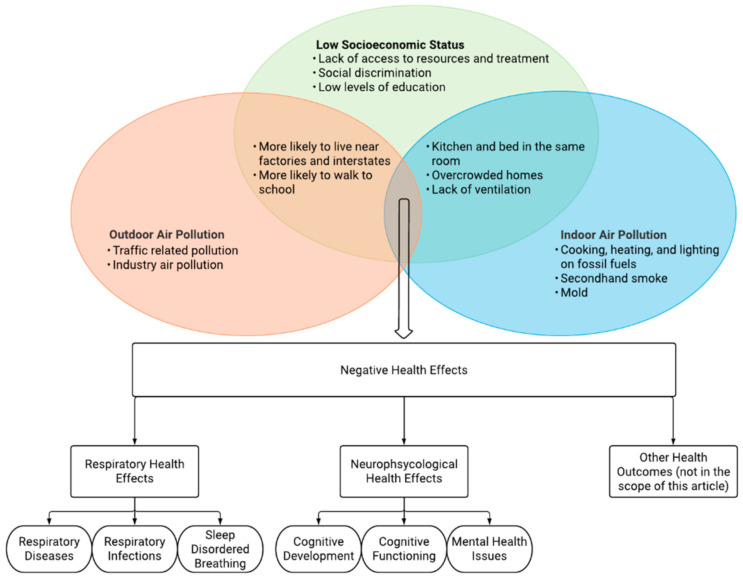
Air pollution disproportionately affects marginalized populations of lower socioeconomic status. There is little literature on how socioeconomic status affects the risk of exposure to air pollution and associated health outcomes, particularly for children's health. The objective of this article was to review the existing literature on air pollution and children's health and discern how socioeconomic status affects this association. The concept of environmental injustice recognizes how underserved communities often suffer from higher air pollution concentrations in addition to other underlying risk factors for impaired health. This exposure then exerts larger effects on their health than it does in the average population, affecting the whole body, including the lungs and the brain. Children, whose organs and mind are still developing and who do not have the means of protecting themselves or creating change, are the most vulnerable to the detrimental effects of air pollution and environmental injustice. The adverse health effects of air pollution and environmental injustice can harm children well into adulthood and may even have transgenerational effects. There is an urgent need for action in order to ensure the health and safety of future generations, as social disparities are continuously increasing, due to social discrimination and climate change.
空气污染对社会经济地位较低的边缘化人群的影响更大。关于社会经济地位如何影响接触空气污染的风险和相关健康结果的文献很少,特别是关于儿童健康的文献。本文的目的是回顾现有的关于空气污染和儿童健康的文献,并探讨社会经济地位如何影响这种关联。环境不公平的概念认识到,服务不足的社区除了其他健康受损的潜在风险因素外,往往还会遭受更高的空气污染浓度。这种暴露对他们的健康的影响比在普通人群中更大,影响全身,包括肺部和大脑。儿童的器官和思维仍在发育中,他们没有自我保护或改变的手段,因此最容易受到空气污染和环境不公的不利影响。空气污染和环境不公的不良健康影响会在儿童成年后持续存在,甚至可能产生代际影响。由于社会歧视和气候变化,社会差距不断扩大,为了确保子孙后代的健康和安全,迫切需要采取行动。