Medical Statistics Group, School of Health and Related Research (ScHARR), University of Sheffield, 30 Regent Street, Sheffield S1 4DA, UK.
BMC Med Res Methodol. 2014 Mar 20;14:41. doi: 10.1186/1471-2288-14-41.
In an evaluation of a new health technology, a pilot trial may be undertaken prior to a trial that makes a definitive assessment of benefit. The objective of pilot studies is to provide sufficient evidence that a larger definitive trial can be undertaken and, at times, to provide a preliminary assessment of benefit.
We describe significance thresholds, confidence intervals and surrogate markers in the context of pilot studies and how Bayesian methods can be used in pilot trials. We use a worked example to illustrate the issues raised.
We show how significance levels other than the traditional 5% should be considered to provide preliminary evidence for efficacy and how estimation and confidence intervals should be the focus to provide an estimated range of possible treatment effects. We also illustrate how Bayesian methods could also assist in the early assessment of a health technology.
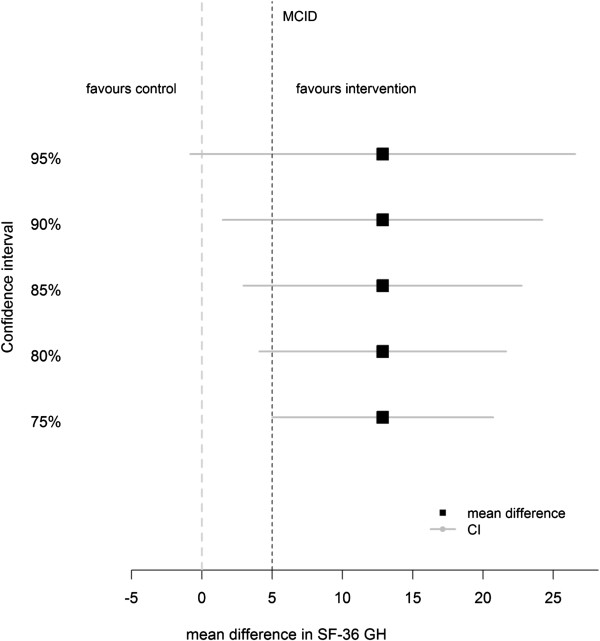
We recommend that in pilot trials the focus should be on descriptive statistics and estimation, using confidence intervals, rather than formal hypothesis testing and that confidence intervals other than 95% confidence intervals, such as 85% or 75%, be used for the estimation. The confidence interval should then be interpreted with regards to the minimum clinically important difference. We also recommend that Bayesian methods be used to assist in the interpretation of pilot trials. Surrogate endpoints can also be used in pilot trials but they must reliably predict the overall effect on the clinical outcome.
在评估一项新的卫生技术时,可能会在进行明确评估效益的试验之前进行试点研究。试点研究的目的是提供足够的证据,证明可以进行更大规模的确定性试验,有时还可以对效益进行初步评估。
我们在试点研究的背景下描述了显著性阈值、置信区间和替代指标,以及贝叶斯方法如何在试点试验中使用。我们使用一个实例来说明所提出的问题。
我们展示了如何考虑传统的 5%以外的显著性水平来提供疗效的初步证据,以及如何将估计和置信区间作为重点,提供可能的治疗效果的估计范围。我们还说明了贝叶斯方法如何有助于早期评估卫生技术。
我们建议在试点研究中,重点应放在描述性统计和估计上,使用置信区间,而不是正式的假设检验,并且应该使用 85%或 75%等除 95%置信区间以外的置信区间进行估计。然后,应根据最小临床重要差异来解释置信区间。我们还建议使用贝叶斯方法来协助解释试点研究。替代终点也可以在试点研究中使用,但它们必须可靠地预测对临床结局的总体影响。