Department of Medical Education, Dongguk University School of Medicine, 32 Dongguk-ro, Ilsandong-gu, Goyang-si, Gyeonggi-do 410-820, South Korea.
BMC Med Educ. 2014 Mar 21;14:56. doi: 10.1186/1472-6920-14-56.
Multimedia learning has been shown effective in clinical skills training. Yet, use of technology presents both opportunities and challenges to learners. The present study investigated student use and perceptions of online clinical videos for learning clinical skills and in preparing for OSCE (Objective Structured Clinical Examination). This study aims to inform us how to make more effective us of these resources.
A mixed-methods study was conducted for this study. A 30-items questionnaire was administered to investigate student use and perceptions of OSCE videos. Year 3 and 4 students from 34 Korean medical schools who had access to OSCE videos participated in the online survey. Additionally, a semi-structured interview of a group of Year 3 medical students was conducted for an in-depth understanding of student experience with OSCE videos.
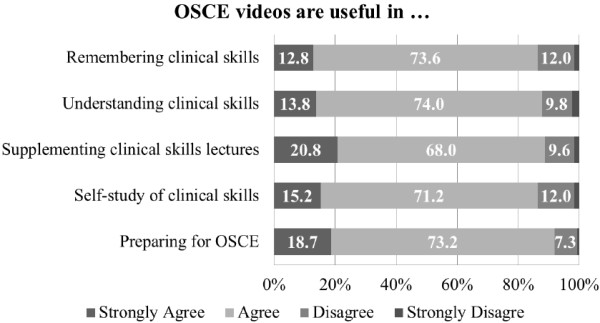
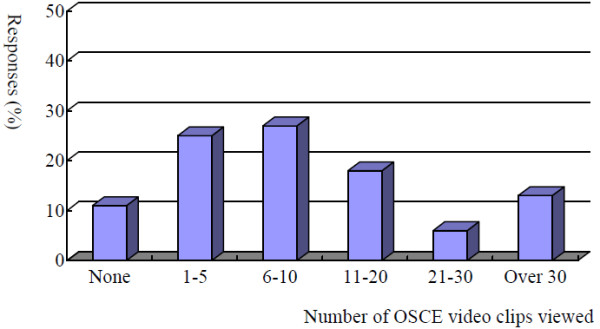
411 students from 31 medical schools returned the questionnaires; a majority of them found OSCE videos effective for their learning of clinical skills and in preparing for OSCE. The number of OSCE videos that the students viewed was moderately associated with their self-efficacy and preparedness for OSCE (p < 0.05). One-thirds of those surveyed accessed the video clips using mobile devices; they agreed more with the statement that it was convenient to access the video clips than their peers who accessed the videos using computers (p < 0.05). Still, students reported lack of integration into the curriculum and lack of interaction as barriers to more effective use of OSCE videos.
The present study confirms the overall positive impact of OSCE videos on student learning of clinical skills. Having faculty integrate these learning resources into their teaching, integrating interactive tools into this e-learning environment to foster interactions, and using mobile devices for convenient access are recommended to help students make more effective use of these resources.
多媒体学习已被证明在临床技能培训中是有效的。然而,技术的使用给学习者带来了机遇和挑战。本研究调查了学生使用和感知在线临床视频学习临床技能和为 OSCE(客观结构化临床考试)做准备的情况。本研究旨在为我们如何更有效地利用这些资源提供信息。
本研究采用混合方法进行。我们设计了一个 30 个问题的问卷来调查学生对 OSCE 视频的使用和看法。来自 34 所韩国医学院的 3 年级和 4 年级学生可以访问 OSCE 视频,他们参与了在线调查。此外,我们对一组 3 年级医学生进行了半结构化访谈,以更深入地了解学生对 OSCE 视频的体验。
来自 31 所医学院的 411 名学生返回了问卷;他们大多数认为 OSCE 视频对他们学习临床技能和为 OSCE 做准备很有效。学生观看 OSCE 视频的数量与他们的自我效能感和 OSCE 准备程度呈中度相关(p<0.05)。三分之一的受访者使用移动设备访问视频片段;他们比使用计算机访问视频的同龄人更同意“访问视频片段方便”这一说法(p<0.05)。尽管如此,学生们报告说,将视频整合到课程中以及缺乏互动是他们无法更有效地使用 OSCE 视频的障碍。
本研究证实了 OSCE 视频对学生学习临床技能的总体积极影响。建议教师将这些学习资源整合到教学中,在这个电子学习环境中整合互动工具以促进互动,以及使用移动设备进行方便的访问,以帮助学生更有效地利用这些资源。