Department of Hematology, Nephrology, and Rheumatology, Akita University Graduate School of Medicine, 1-1-1 Hondo, 010-8543 Akita, Japan.
Biomark Res. 2014 Mar 20;2(1):6. doi: 10.1186/2050-7771-2-6.
Nilotinib is a second-generation tyrosine kinase inhibitor that exhibits significant efficacy as first- or second-line treatment in patients with chronic myeloid leukemia (CML). We conducted a multicenter Phase II Clinical Trial to evaluate the safety and efficacy of nilotinib among Japanese patients with imatinib-resistant or -intolerant CML-chronic phase (CP) or accelerated phase (AP).
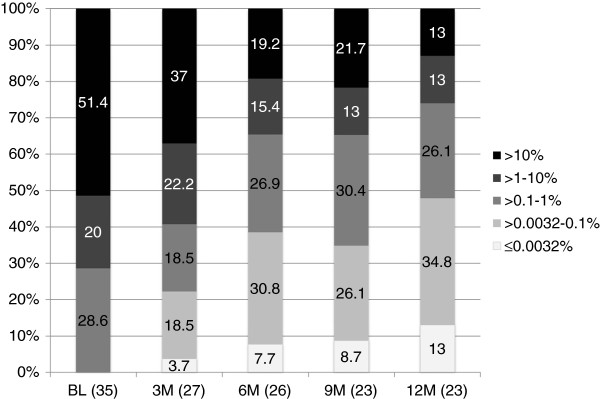
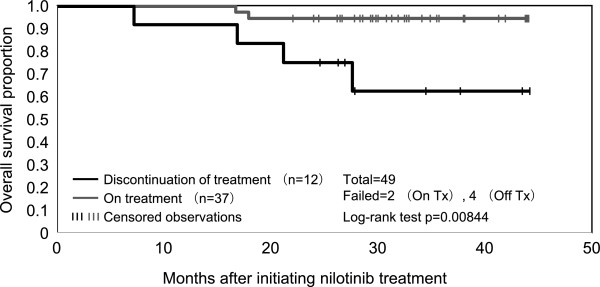
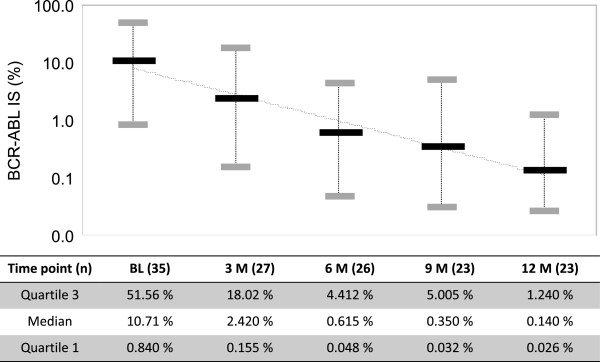
We analyzed 49 patients (33 imatinib-resistant and 16 imatinib-intolerant) treated with nilotinib 400 mg twice daily. The major molecular response (MMR) rate was 47.8% at 12 months among 35 patients who did not demonstrate an MMR at study entry. Somatic BCR-ABL1 mutations (Y253H, I418V, and exon 8/9 35-bp insertion [35INS]) were detected in 3 patients at 12 months or upon discontinuation of nilotinib. Although 75.5% of patients were still being treated at 12 months, nilotinib treatment was discontinued because of progressing disease in 1 patient, insufficient effect in 2, and adverse events in 9. There was no statistically significant correlation between MMR and trough concentrations of nilotinib. Similarly, no correlation was observed between trough concentrations and adverse events, except for pruritus and hypokalemia. Hyperbilirubinemia was frequently observed (all grades, 51.0%; grades 2-4, 29%; grades 3-4, 4.1%). Hyperbilirubinemia higher than grade 2 was significantly associated with the uridine diphosphate glucuronosyltransferase (UGT)1A9 I399C/C genotype (P = 0.0086; Odds Ratio, 21.2; 95% Confidence Interval 2.2-208.0).
Nilotinib was efficacious and well tolerated by patients with imatinib-resistant or -intolerant CML-CP/AP. Hyperbilirubinemia may be predicted before nilotinib treatment, and may be controlled by reducing the daily dose of nilotinib in patients with UGT1A9 polymorphisms.
clinicaltrials.gov: UMIN000002201.
尼洛替尼是一种第二代酪氨酸激酶抑制剂,作为慢性髓性白血病(CML)患者的一线或二线治疗药物,具有显著疗效。我们进行了一项多中心 II 期临床试验,以评估尼洛替尼在日本对伊马替尼耐药或不耐受的 CML-慢性期(CP)或加速期(AP)患者的安全性和疗效。
我们分析了 49 例接受尼洛替尼 400mg 每日两次治疗的患者(33 例伊马替尼耐药,16 例伊马替尼不耐受)。在未达到主要分子反应(MMR)的 35 例患者中,有 47.8%在 12 个月时达到 MMR。3 例患者在 12 个月或停止尼洛替尼治疗时出现体细胞 BCR-ABL1 突变(Y253H、I418V 和外显子 8/9 35 个碱基对插入[35INS])。尽管 75.5%的患者在 12 个月时仍在接受治疗,但由于疾病进展 1 例、疗效不足 2 例和不良反应 9 例,停止了尼洛替尼治疗。未发现 MMR 与尼洛替尼的谷浓度之间存在统计学显著相关性。同样,除瘙痒和低钾血症外,也未观察到谷浓度与不良反应之间存在相关性。高胆红素血症(所有等级,51.0%;等级 2-4,29%;等级 3-4,4.1%)经常发生。胆红素升高高于 2 级与尿苷二磷酸葡萄糖醛酸转移酶(UGT)1A9 I399C/C 基因型显著相关(P=0.0086;优势比,21.2;95%置信区间 2.2-208.0)。
尼洛替尼对伊马替尼耐药或不耐受的 CML-CP/AP 患者有效且耐受性良好。在开始尼洛替尼治疗之前,可能可以预测高胆红素血症,并通过减少 UGT1A9 多态性患者的尼洛替尼日剂量来控制高胆红素血症。
clinicaltrials.gov:UMIN000002201。