Gonçalves-Souza Thiago, Diniz-Filho José Alexandre Felizola, Romero Gustavo Quevedo
Programa de Pós-Graduação em Biologia Animal, Departamento de Zoologia e Botânica, Universidade Estadual Paulista, São José do Rio Preto, SP, Brasil.
Departamento de Ecologia, Instituto de Ciências Biológicas, Universidade Federal de Goiás, Goiânia, GO, Brasil.
PLoS One. 2014 Feb 19;9(2):e89314. doi: 10.1371/journal.pone.0089314. eCollection 2014.
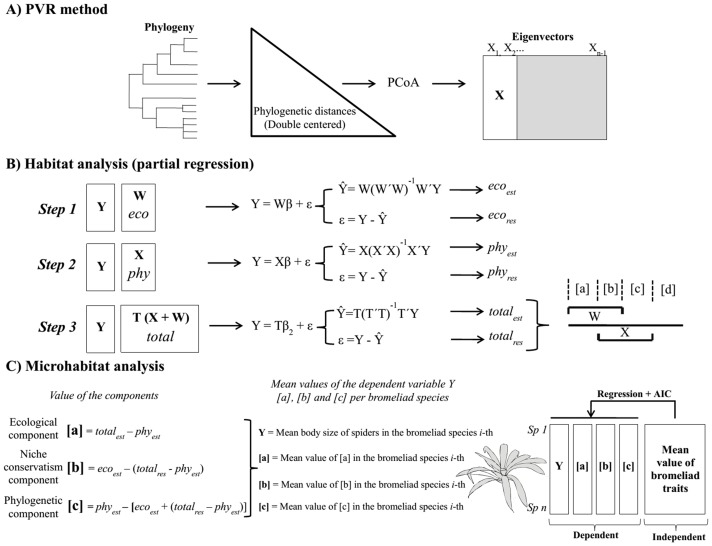
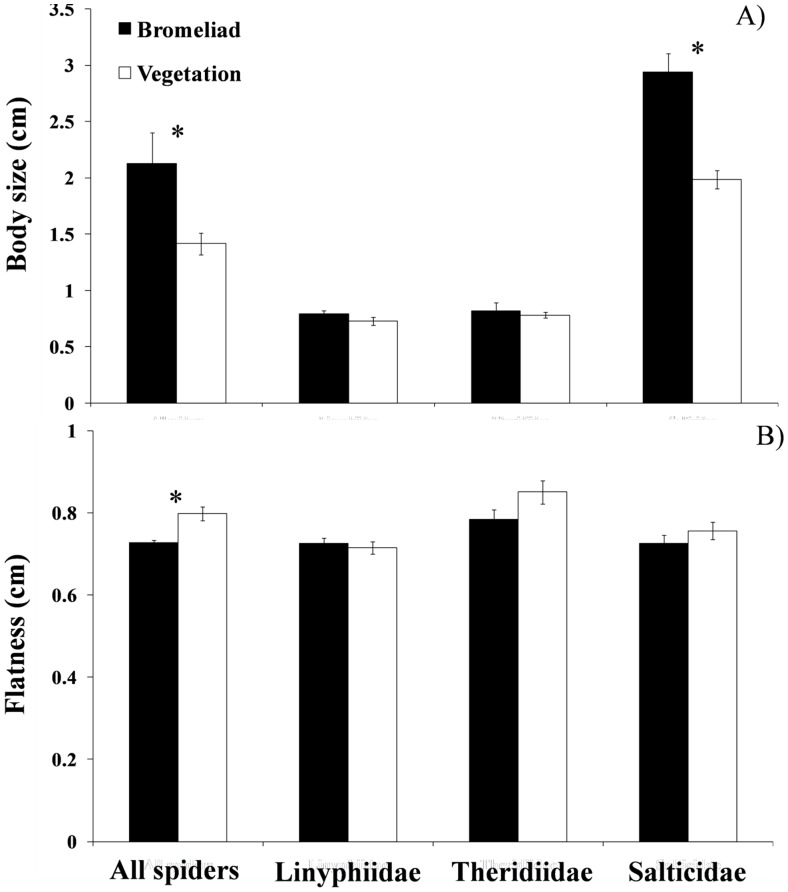
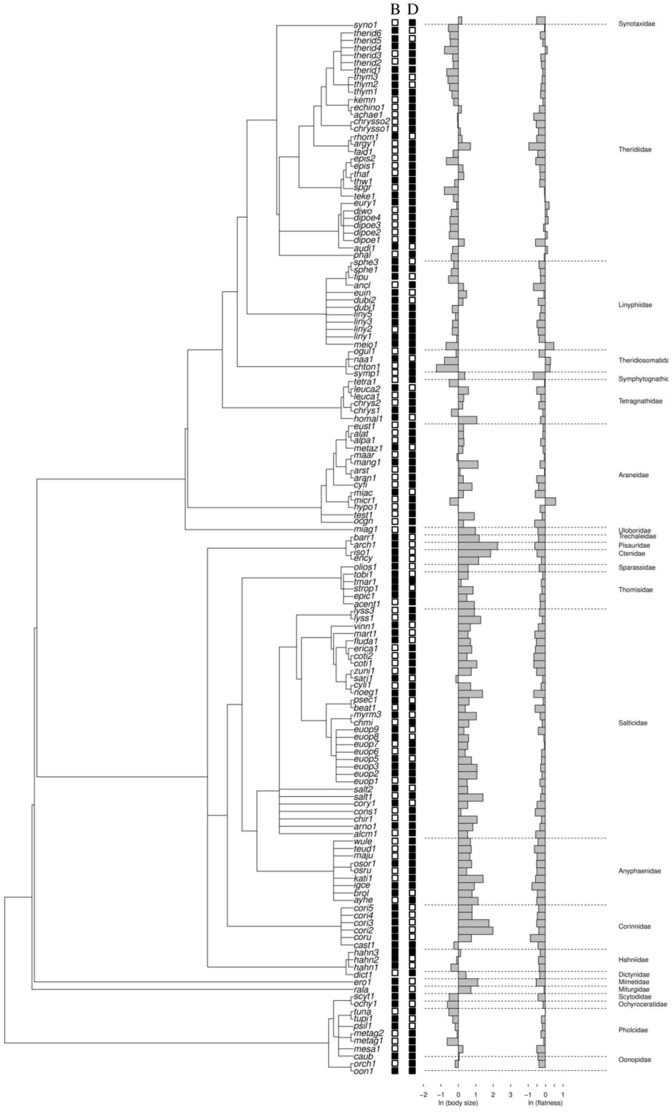
An understanding of how the degree of phylogenetic relatedness influences the ecological similarity among species is crucial to inferring the mechanisms governing the assembly of communities. We evaluated the relative importance of spider phylogenetic relationships and ecological niche (plant morphological variables) to the variation in spider body size and shape by comparing spiders at different scales: (i) between bromeliads and dicot plants (i.e., habitat scale) and (ii) among bromeliads with distinct architectural features (i.e., microhabitat scale). We partitioned the interspecific variation in body size and shape into phylogenetic (that express trait values as expected by phylogenetic relationships among species) and ecological components (that express trait values independent of phylogenetic relationships). At the habitat scale, bromeliad spiders were larger and flatter than spiders associated with the surrounding dicots. At this scale, plant morphology sorted out close related spiders. Our results showed that spider flatness is phylogenetically clustered at the habitat scale, whereas it is phylogenetically overdispersed at the microhabitat scale, although phylogenic signal is present in both scales. Taken together, these results suggest that whereas at the habitat scale selective colonization affect spider body size and shape, at fine scales both selective colonization and adaptive evolution determine spider body shape. By partitioning the phylogenetic and ecological components of phenotypic variation, we were able to disentangle the evolutionary history of distinct spider traits and show that plant architecture plays a role in the evolution of spider body size and shape. We also discussed the relevance in considering multiple scales when studying phylogenetic community structure.
了解系统发育相关性程度如何影响物种间的生态相似性,对于推断群落组装的调控机制至关重要。我们通过在不同尺度上比较蜘蛛来评估蜘蛛系统发育关系和生态位(植物形态变量)对蜘蛛体型和形状变化的相对重要性:(i)在凤梨科植物和双子叶植物之间(即栖息地尺度)以及(ii)在具有不同建筑特征的凤梨科植物之间(即微栖息地尺度)。我们将体型和形状的种间变异划分为系统发育成分(根据物种间系统发育关系预期表达性状值)和生态成分(表达独立于系统发育关系的性状值)。在栖息地尺度上,凤梨科蜘蛛比与周围双子叶植物相关的蜘蛛更大且更扁平。在这个尺度上,植物形态对亲缘关系较近的蜘蛛进行了分类。我们的结果表明,蜘蛛的扁平度在栖息地尺度上是系统发育聚类的,而在微栖息地尺度上是系统发育过度分散的,尽管在两个尺度上都存在系统发育信号。综合来看,这些结果表明,在栖息地尺度上,选择性定殖影响蜘蛛的体型和形状,而在精细尺度上,选择性定殖和适应性进化都决定蜘蛛的体型。通过划分表型变异的系统发育和生态成分,我们能够理清不同蜘蛛性状的进化历史,并表明植物结构在蜘蛛体型和形状的进化中发挥作用。我们还讨论了在研究系统发育群落结构时考虑多个尺度的相关性。