Takahashi Daiei, Mori Takayasu, Nomura Naohiro, Khan Muhammad Zakir Hossain, Araki Yuya, Zeniya Moko, Sohara Eisei, Rai Tatemitsu, Sasaki Sei, Uchida Shinichi
*Department of Nephrology, Graduate School of Medical and Dental Sciences, Tokyo Medical and Dental University, 1-5-45 Yushima, Bunkyo, Tokyo 113-8519, Japan.
Biosci Rep. 2014 May 9;34(3):e00107. doi: 10.1042/BSR20140047.
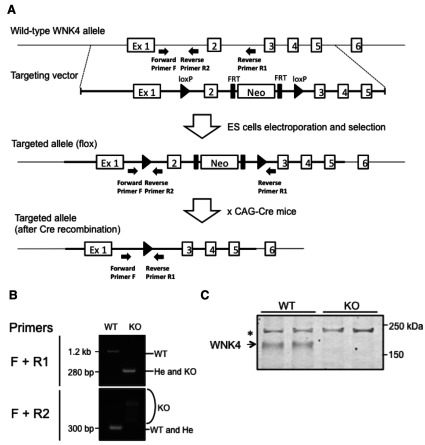
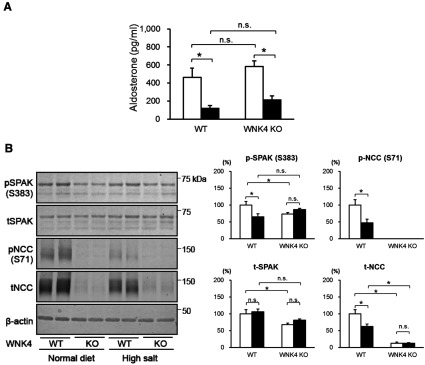
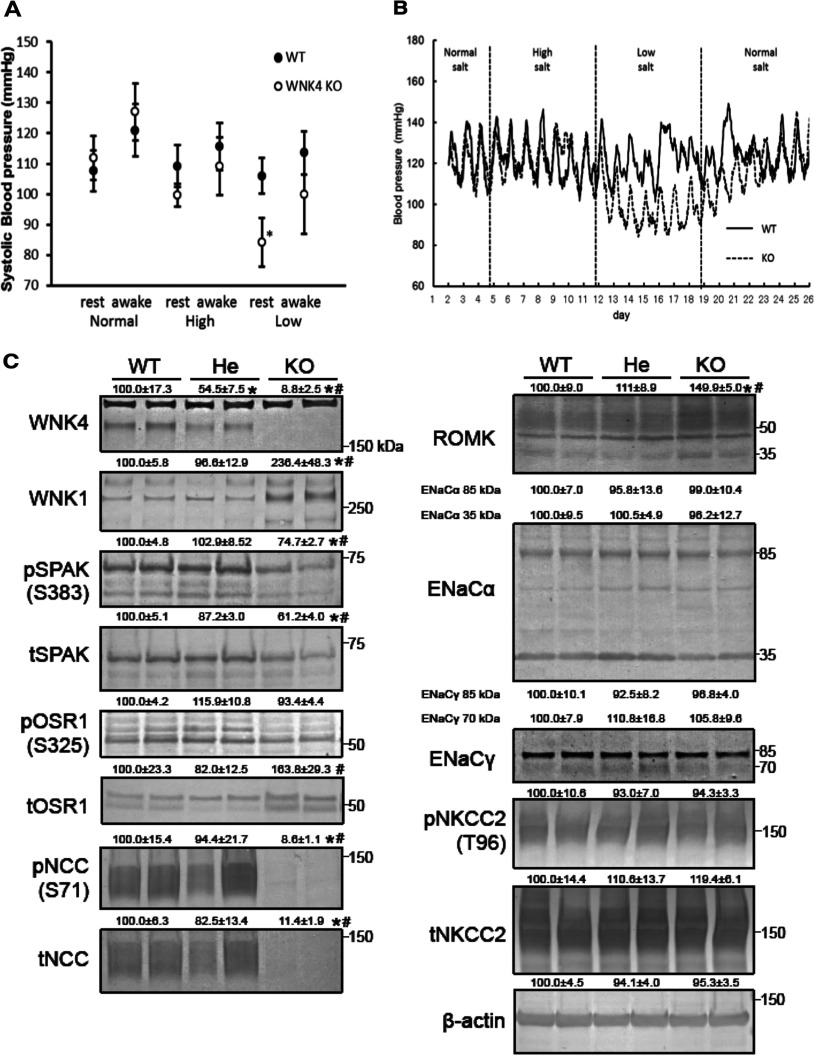
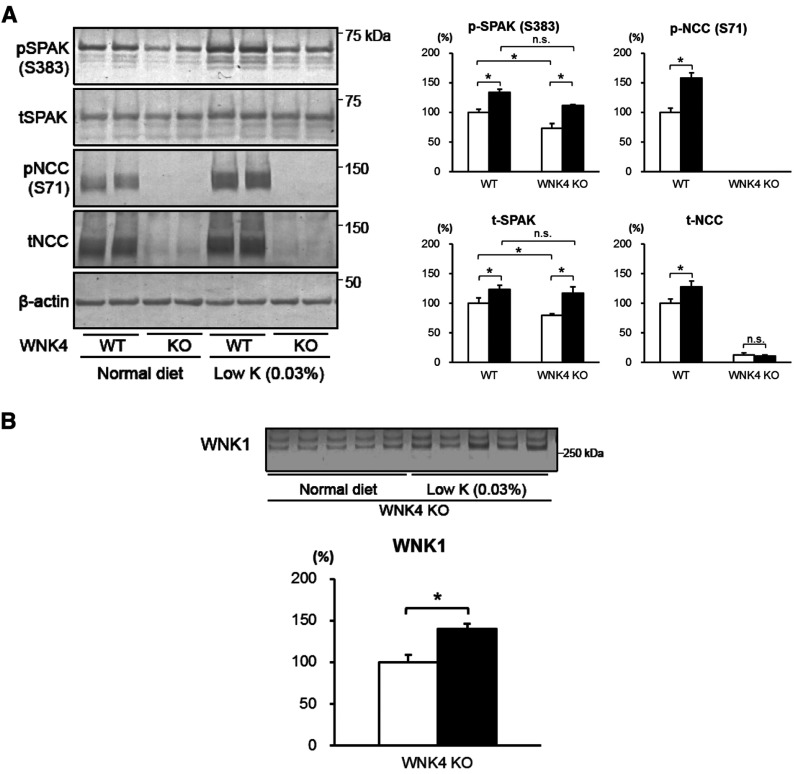
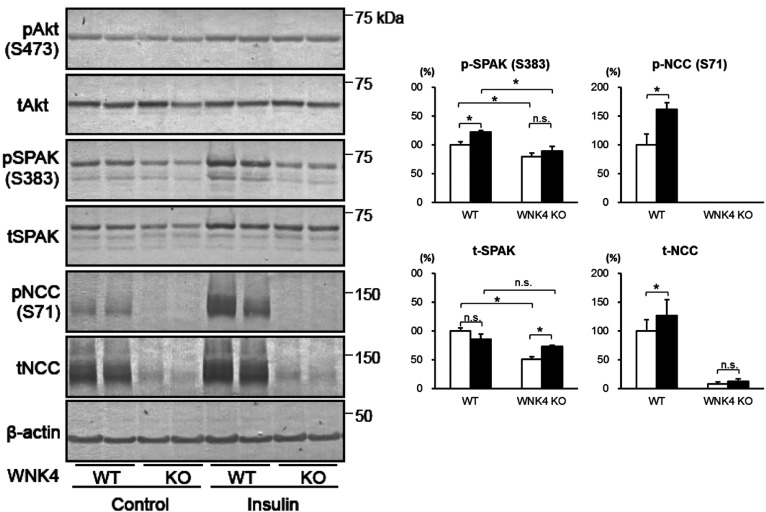
By analysing the pathogenesis of a hereditary hypertensive disease, PHAII (pseudohypoaldosteronism type II), we previously discovered that WNK (with-no-lysine kinase)-OSR1/SPAK (oxidative stress-responsive 1/Ste20-like proline/alanine-rich kinase) cascade regulates NCC (Na-Cl co-transporter) in the DCT (distal convoluted tubules) of the kidney. However, the role of WNK4 in the regulation of NCC remains controversial. To address this, we generated and analysed WNK4-/- mice. Although a moderate decrease in SPAK phosphorylation and a marked increase in WNK1 expression were evident in the kidneys of WNK4-/- mice, the amount of phosphorylated and total NCC decreased to almost undetectable levels, indicating that WNK4 is the major WNK positively regulating NCC, and that WNK1 cannot compensate for WNK4 deficiency in the DCT. Insulin- and low-potassium diet-induced NCC phosphorylation were abolished in WNK4-/- mice, establishing that both signals to NCC were mediated by WNK4. As shown previously, a high-salt diet decreases phosphorylated and total NCC in WNK4+/+ mice via AngII (angiotensin II) and aldosterone suppression. This was not ameliorated by WNK4 knock out, excluding the negative regulation of WNK4 on NCC postulated to be active in the absence of AngII stimulation. Thus, WNK4 is the major positive regulator of NCC in the kidneys.
通过分析遗传性高血压疾病——II型假性醛固酮减少症(PHAII)的发病机制,我们先前发现,WNK(无赖氨酸激酶)-OSR1/SPAK(氧化应激反应激酶1/类Ste20富含脯氨酸/丙氨酸激酶)级联反应调节肾脏远曲小管(DCT)中的NCC(氯化钠共转运体)。然而,WNK4在NCC调节中的作用仍存在争议。为了解决这个问题,我们构建并分析了WNK4基因敲除小鼠。尽管在WNK4基因敲除小鼠的肾脏中,SPAK磷酸化水平适度降低,WNK1表达显著增加,但磷酸化NCC和总NCC的量均降至几乎检测不到的水平,这表明WNK4是正向调节NCC的主要WNK,并且WNK1不能补偿DCT中WNK4的缺失。在WNK4基因敲除小鼠中,胰岛素和低钾饮食诱导的NCC磷酸化被消除,这表明这两种作用于NCC的信号均由WNK4介导。如先前所示,高盐饮食通过抑制血管紧张素II(AngII)和醛固酮,降低WNK4+/+小鼠中磷酸化NCC和总NCC的水平。WNK4基因敲除并未改善这种情况,排除了在没有AngII刺激时假定的WNK4对NCC的负向调节作用。因此,WNK4是肾脏中NCC的主要正向调节因子。