Shih Andrew, Nazi Ishac, Kelton John G, Arnold Donald M
McMaster University, Department of Medicine, Hamilton, Ontario, Canada.
McMaster University, Department of Medicine, Hamilton, Ontario, Canada; Canadian Blood Services, Hamilton, Ontario, Canada.
Presse Med. 2014 Apr;43(4 Pt 2):e87-95. doi: 10.1016/j.lpm.2014.02.006. Epub 2014 Mar 20.
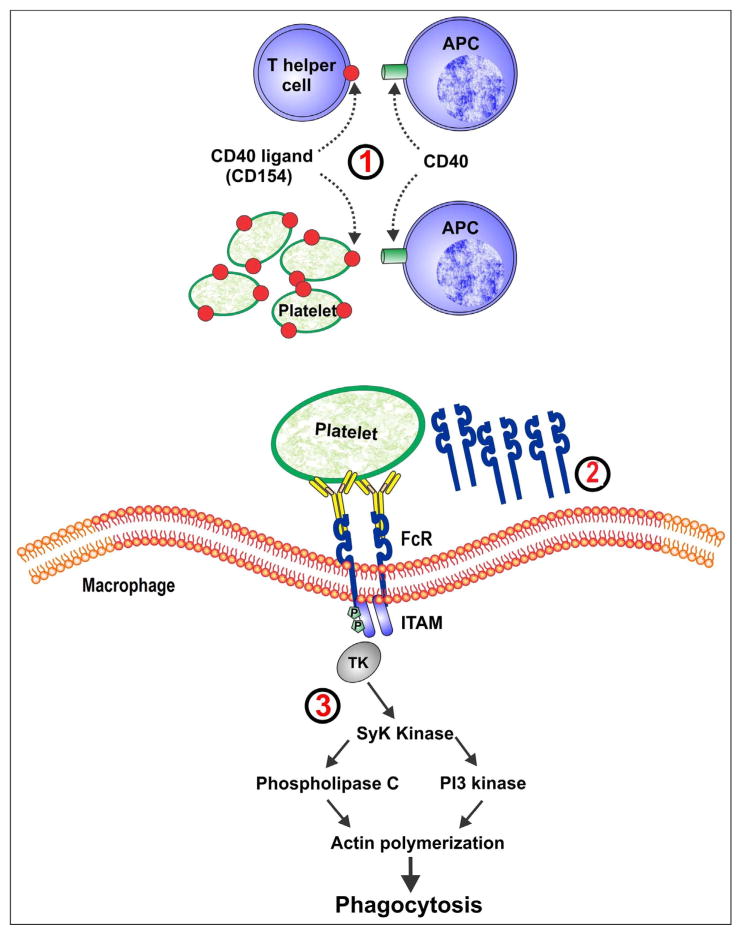
Primary immune thrombocytopenia (ITP) is caused by platelet autoantibodies and T-cell dysregulation. Both platelets and their precursor megakaryocytes may be targeted leading to platelet destruction and underproduction. Current treatments for ITP are inadequate since they do not reverse the disease process and generally do not result in durable remissions. In addition, many treatments are limited by side effects including infection and potentially thrombosis. Novel agents that are currently in development target certain key steps in the disease process, including: (1) the interaction between T-cell and antigen presenting cells (CD40-CD154 interaction); (2) the binding of the Fc portion of platelet autoantibodies to Fc-receptors on macrophages (soluble Fc-RIIb); and (3) the signaling pathways leading to platelet phagocytosis by macrophages (Syk inhibition). Other strategies have been to augment platelet production by simulating thrombopoiesis or by neutralizing physiological inhibitors of megakaryopoiesis. Targeted therapies in ITP have the potential to improve disease morbidity and mortality while limiting systemic side effects. Before these agents can be used in practice, additional clinical studies are needed with rational study outcomes including platelet count, bleeding and quality of life. An individualized treatment strategy is needed for patients since ITP is a distinctly heterogeneous disease.
原发性免疫性血小板减少症(ITP)由血小板自身抗体和T细胞失调引起。血小板及其前体巨核细胞均可成为靶点,导致血小板破坏和生成不足。ITP的现有治疗方法并不充分,因为它们无法逆转疾病进程,且通常无法实现持久缓解。此外,许多治疗方法受到包括感染和潜在血栓形成在内的副作用的限制。目前正在研发的新型药物针对疾病进程中的某些关键步骤,包括:(1)T细胞与抗原呈递细胞之间的相互作用(CD40-CD154相互作用);(2)血小板自身抗体的Fc部分与巨噬细胞上的Fc受体的结合(可溶性Fc-RIIb);以及(3)导致巨噬细胞吞噬血小板的信号通路(Syk抑制)。其他策略包括通过模拟血小板生成或中和巨核细胞生成的生理抑制剂来增加血小板生成。ITP的靶向治疗有可能改善疾病的发病率和死亡率,同时限制全身副作用。在这些药物能够实际应用之前,需要进行更多的临床研究,并得出包括血小板计数、出血情况和生活质量等合理的研究结果。由于ITP是一种明显异质性的疾病,因此需要为患者制定个体化的治疗策略。