Liu Ruohai, Jin Pengpeng, Yu Liqun, Wang Ying, Han Liping, Shi Tong, Li Xu
Department of Anaesthesia, Second Affiliated Hospital, Wenzhou Medical University, Wenzhou, China.
Department of Physiology, Renji College, Wenzhou Medical University, Wenzhou, China.
PLoS One. 2014 Mar 21;9(3):e92810. doi: 10.1371/journal.pone.0092810. eCollection 2014.
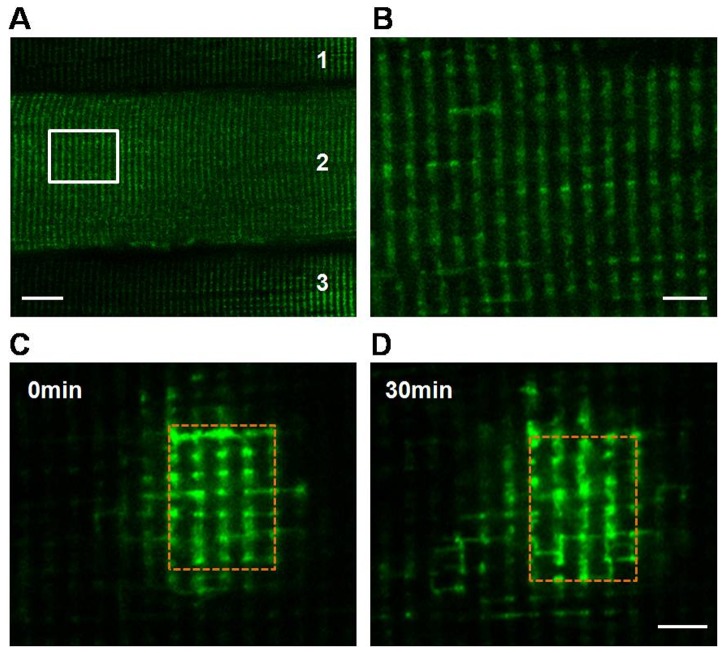
In most cells, mitochondria are highly dynamic organelles that constantly fuse, divide and move. These processes allow mitochondria to redistribute in a cell and exchange contents among the mitochondrial population, and subsequently repair damaged mitochondria. However, most studies on mitochondrial dynamics have been performed on cultured cell lines and neurons, and little is known about whether mitochondria are dynamic organelles in vivo, especially in the highly specialized and differentiated adult skeletal muscle cells. Using mitochondrial matrix-targeted photoactivatable green fluorescent protein (mtPAGFP) and electroporation methods combined with confocal microscopy, we found that mitochondria are dynamic in skeletal muscle in vivo, which enables mitochondria exchange contents within the whole mitochondrial population through nanotunneling-mediated mitochondrial fusion. Mitochondrial network promotes rapid transfer of mtPAGFP within the cell. More importantly, the dynamic behavior was impaired in high-fat diet (HFD)-induced obese mice, accompanying with disturbed mitochondrial respiratory function and decreased ATP content in skeletal muscle. We further found that proteins controlling mitochondrial fusion MFN1 and MFN2 but not Opa1 were decreased and proteins governing mitochondrial fission Fis1 and Drp1 were increased in skeletal muscle of HFD-induced mice when compared to normal diet-fed mice. Altogether, we conclude that mitochondria are dynamic organelles in vivo in skeletal muscle, and it is essential in maintaining mitochondrial respiration and bioenergetics.
在大多数细胞中,线粒体是高度动态的细胞器,不断进行融合、分裂和移动。这些过程使线粒体能够在细胞内重新分布,并在整个线粒体群体中交换内容物,进而修复受损的线粒体。然而,大多数关于线粒体动态变化的研究都是在培养的细胞系和神经元上进行的,对于线粒体在体内是否是动态细胞器,尤其是在高度特化和分化的成年骨骼肌细胞中,人们了解甚少。我们使用线粒体基质靶向的光激活绿色荧光蛋白(mtPAGFP)和电穿孔方法,并结合共聚焦显微镜,发现线粒体在体内骨骼肌中是动态的,这使得线粒体能够通过纳米隧道介导的线粒体融合在整个线粒体群体中交换内容物。线粒体网络促进了mtPAGFP在细胞内的快速转移。更重要的是,在高脂饮食(HFD)诱导的肥胖小鼠中,这种动态行为受损,同时伴随着线粒体呼吸功能紊乱和骨骼肌中ATP含量降低。与正常饮食喂养的小鼠相比,我们进一步发现,在HFD诱导的小鼠骨骼肌中,控制线粒体融合的蛋白MFN1和MFN2减少,而不是Opa1,以及控制线粒体分裂的蛋白Fis1和Drp1增加。总之,我们得出结论,线粒体在体内骨骼肌中是动态细胞器,并且对于维持线粒体呼吸和生物能量学至关重要。