
中枢神经系统中海洛因诱导的脱髓鞘和髓鞘再生过程中的神经胶质反应:经验教训。
Glial response during cuprizone-induced de- and remyelination in the CNS: lessons learned.
机构信息
Department of Neurology, Hannover Medical School Hannover, Germany.
Department of Neurology, Hannover Medical School Hannover, Germany ; Center for Systems Neuroscience Hannover, Germany.
出版信息
Front Cell Neurosci. 2014 Mar 13;8:73. doi: 10.3389/fncel.2014.00073. eCollection 2014.
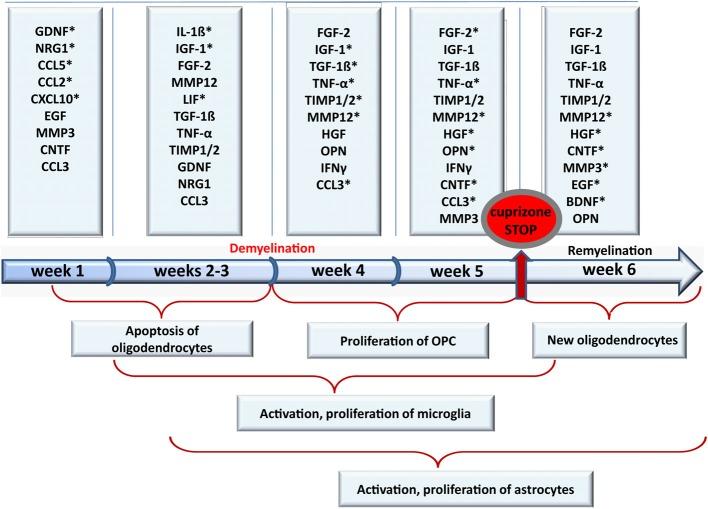
Although astrogliosis and microglia activation are characteristic features of multiple sclerosis (MS) and other central nervous system (CNS) lesions the exact functions of these events are not fully understood. Animal models help to understand the complex interplay between the different cell types of the CNS and uncover general mechanisms of damage and repair of myelin sheaths. The so called cuprizone model is a toxic model of demyelination in the CNS white and gray matter, which lacks an autoimmune component. Cuprizone induces apoptosis of mature oligodendrocytes that leads to a robust demyelination and profound activation of both astrocytes and microglia with regional heterogeneity between different white and gray matter regions. Although not suitable to study autoimmune mediated demyelination, this model is extremely helpful to elucidate basic cellular and molecular mechanisms during de- and particularly remyelination independently of interactions with peripheral immune cells. Phagocytosis and removal of damaged myelin seems to be one of the major roles of microglia in this model and it is well known that removal of myelin debris is a prerequisite of successful remyelination. Furthermore, microglia provide several signals that support remyelination. The role of astrocytes during de- and remyelination is not well defined. Both supportive and destructive functions have been suggested. Using the cuprizone model we could demonstrate that there is an important crosstalk between astrocytes and microglia. In this review we focus on the role of glial reactions and interaction in the cuprizone model. Advantages and limitations of as well as its potential therapeutic relevance for the human disease MS are critically discussed in comparison to other animal models.
尽管星形胶质细胞增生和小胶质细胞激活是多发性硬化症(MS)和其他中枢神经系统(CNS)病变的特征,但这些事件的确切功能尚未完全了解。动物模型有助于理解中枢神经系统不同细胞类型之间的复杂相互作用,并揭示髓鞘损伤和修复的一般机制。所谓的铜染模型是中枢神经系统白质和灰质脱髓鞘的毒性模型,缺乏自身免疫成分。铜染诱导成熟少突胶质细胞凋亡,导致强烈的脱髓鞘和星形胶质细胞和小胶质细胞的强烈激活,不同白质和灰质区域之间存在区域异质性。虽然不适合研究自身免疫介导的脱髓鞘,但该模型对于阐明脱髓鞘和特别是再髓鞘过程中的基本细胞和分子机制非常有帮助,而与外周免疫细胞的相互作用无关。吞噬和清除受损的髓鞘似乎是小胶质细胞在该模型中的主要作用之一,众所周知,清除髓鞘碎片是成功再髓鞘的前提。此外,小胶质细胞提供了几种支持再髓鞘的信号。星形胶质细胞在脱髓鞘和再髓鞘过程中的作用尚未明确定义。有人提出了支持和破坏两种功能。使用铜染模型,我们可以证明星形胶质细胞和小胶质细胞之间存在重要的相互作用。在这篇综述中,我们重点讨论了胶质细胞反应和相互作用在铜染模型中的作用。与其他动物模型相比,我们批判性地讨论了该模型在人类疾病 MS 中的优势、局限性及其潜在的治疗相关性。


 Zotero 插件