Gene Discovery Research Group, RIKEN Center for Sustainable Resource Science Tsukuba, Japan.
Center for Collaboration among Agriculture, Industry and Commerce, The University of Tokushima Tokushima, Japan.
Front Plant Sci. 2014 Mar 13;5:86. doi: 10.3389/fpls.2014.00086. eCollection 2014.
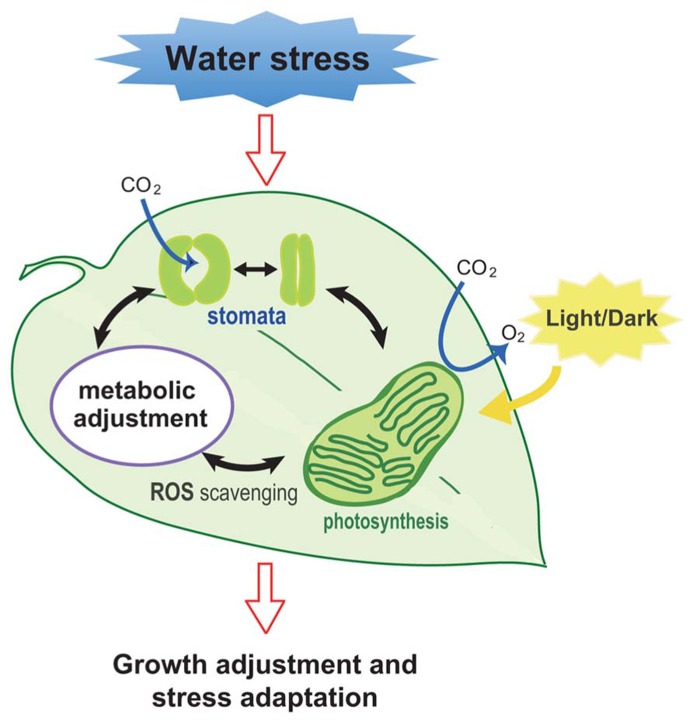
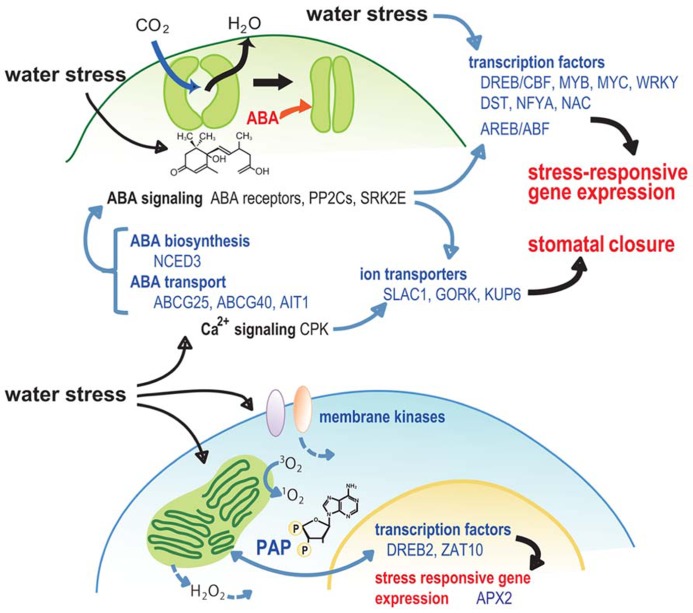
Water stress adversely impacts many aspects of the physiology of plants, especially photosynthetic capacity. If the stress is prolonged, plant growth, and productivity are severely diminished. Plants have evolved complex physiological and biochemical adaptations to adjust and adapt to a variety of environmental stresses. The molecular and physiological mechanisms associated with water-stress tolerance and water-use efficiency have been extensively studied. The systems that regulate plant adaptation to water stress through a sophisticated regulatory network are the subject of the current review. Molecular mechanisms that plants use to increase stress tolerance, maintain appropriate hormone homeostasis and responses and prevent excess light damage, are also discussed. An understanding of how these systems are regulated and ameliorate the impact of water stress on plant productivity will provide the information needed to improve plant stress tolerance using biotechnology, while maintaining the yield and quality of crops.
水分胁迫严重影响植物的生理机能,尤其是光合作用。如果胁迫持续时间过长,植物的生长和生产力将严重下降。植物已经进化出复杂的生理和生化适应机制,以适应和调整各种环境胁迫。与水分胁迫耐受性和水分利用效率相关的分子和生理机制已得到广泛研究。本文综述了通过复杂的调控网络调节植物适应水分胁迫的系统。本文还讨论了植物用来提高胁迫耐受性、维持适当的激素平衡和响应以及防止过量光损伤的分子机制。了解这些系统是如何调节的,并减轻水分胁迫对植物生产力的影响,将为利用生物技术提高植物的胁迫耐受性提供必要的信息,同时保持作物的产量和质量。