Ganesan Shyamala, Comstock Adam T, Sajjan Uma S
Department of Pediatrics and Communicable Diseases; University of Michigan; Ann Arbor, MI USA.
Tissue Barriers. 2013 Oct 1;1(4):e24997. doi: 10.4161/tisb.24997. Epub 2013 May 30.
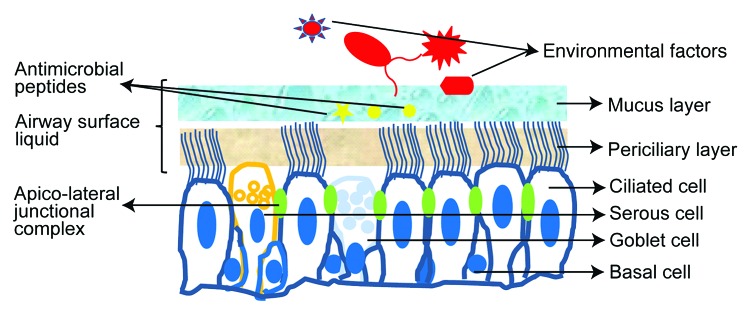
Airway epithelium contributes significantly to the barrier function of airway tract. Mucociliary escalator, intercellular apical junctional complexes which regulate paracellular permeability and antimicrobial peptides secreted by the airway epithelial cells are the three primary components of barrier function of airway tract. These three components act cooperatively to clear inhaled pathogens, allergens and particulate matter without inducing inflammation and maintain tissue homeostasis. Therefore impairment of one or more of these essential components of barrier function may increase susceptibility to infection and promote exaggerated and prolonged innate immune responses to environmental factors including allergens and pathogens resulting in chronic inflammation. Here we review the regulation of components of barrier function with respect to chronic airways diseases.
气道上皮对气道的屏障功能有重要贡献。黏液纤毛清除系统、调节细胞旁通透性的细胞顶端连接复合体以及气道上皮细胞分泌的抗菌肽是气道屏障功能的三个主要组成部分。这三个组成部分协同作用,清除吸入的病原体、过敏原和颗粒物,而不引发炎症,并维持组织稳态。因此,这些屏障功能基本组成部分中一个或多个的受损可能会增加感染易感性,并促进对包括过敏原和病原体在内的环境因素产生过度和持久的先天性免疫反应,从而导致慢性炎症。在此,我们就慢性气道疾病对屏障功能组成部分的调节进行综述。