Mahmoud Doaa Elsayed, Hosseini Seyedeh Hanieh, Rathore Hassaan Anwer, Alkilany Alaaldin M, Heise Andreas, Elhissi Abdelbary
Department of Pharmaceutical Sciences, College of Pharmacy, QU Health, Qatar University, Doha 2713, Qatar.
Department of Biomedical Sciences, College of Health Sciences, QU Health, Qatar University, Doha 2713, Qatar.
Pharmaceutics. 2025 Jul 9;17(7):893. doi: 10.3390/pharmaceutics17070893.
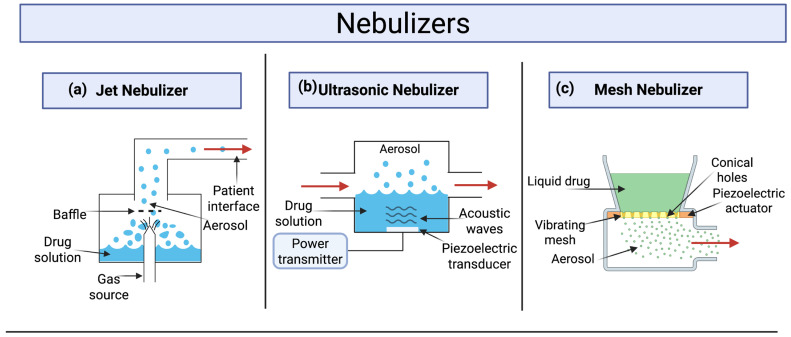
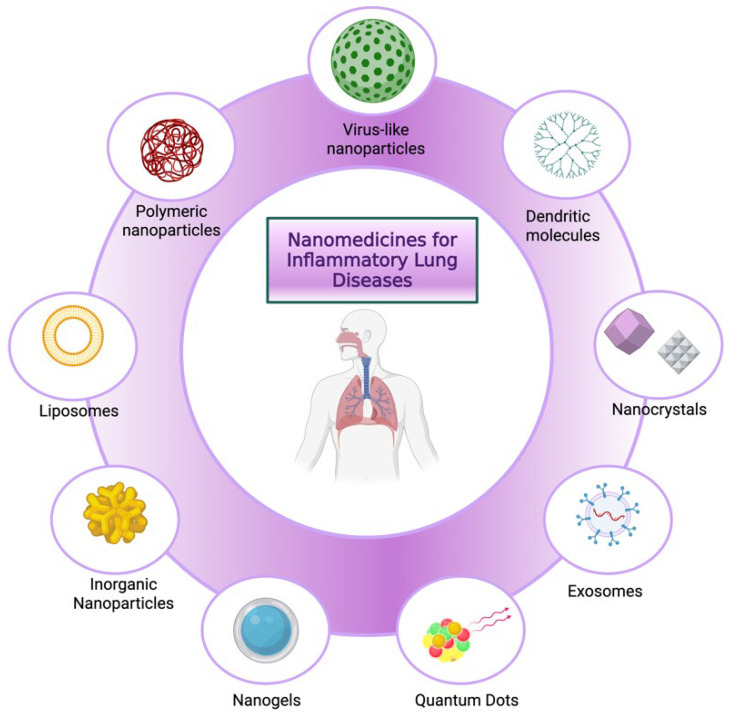
This review explores recent advancements in inhaled nanoparticle formulations and inhalation devices, with a focus on various types of nanoparticles used for inhalation to treat inflammatory lung diseases and the types of devices used in their delivery. Medical nebulizers have been found to be the most appropriate type of inhalation devices for the pulmonary delivery of nanoparticles, since formulations can be prepared using straightforward techniques, with no need for liquefied propellants as in the case of pressurized metered dose inhalers (pMDIs), or complicated preparation procedures as in the case of dry powder inhalers (DPIs). We demonstrated examples of how formulations should be designed considering the operation mechanism of nebulizers, and how an interplay of factors can affect the aerosol characteristics of nanoparticle formulations. Overall, nanoparticle-based formulations offer promising potential for the treatment of inflammatory lung diseases due to their unique physicochemical properties and ability to provide localized drug delivery in the lung following inhalation.
本综述探讨了吸入纳米颗粒制剂和吸入装置的最新进展,重点关注用于治疗炎症性肺病的各类吸入纳米颗粒以及用于递送这些纳米颗粒的装置类型。已发现医用雾化器是用于肺部递送纳米颗粒的最合适的吸入装置类型,因为制剂可以使用简单的技术制备,不像压力定量吸入器(pMDIs)那样需要液化推进剂,也不像干粉吸入器(DPIs)那样需要复杂的制备程序。我们展示了一些示例,说明应如何根据雾化器的操作机制设计制剂,以及各种因素之间的相互作用如何影响纳米颗粒制剂的气溶胶特性。总体而言,基于纳米颗粒的制剂因其独特的物理化学性质以及吸入后在肺部提供局部药物递送的能力,为治疗炎症性肺病提供了有前景的潜力。