Rana Suresh B, Pokharel Shyam
Department of Medical Physics, ProCure Proton Therapy Center, Oklahoma City, OK, USA.
Department of Radiation Oncology, Premiere Oncology, Fort Myers, FL, USA.
South Asian J Cancer. 2014 Jan;3(1):18-21. doi: 10.4103/2278-330X.126506.
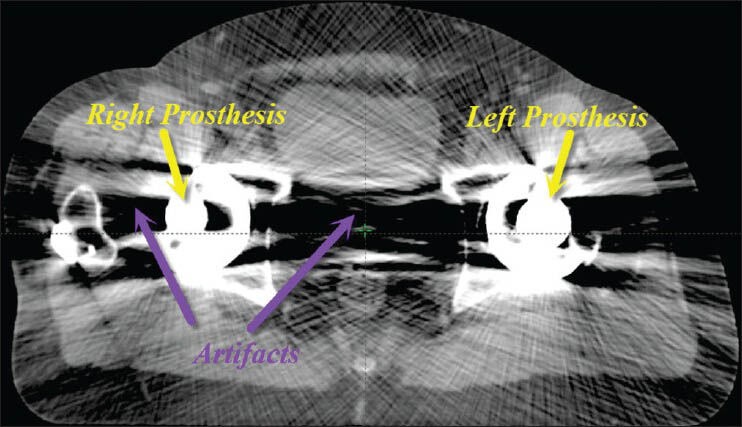
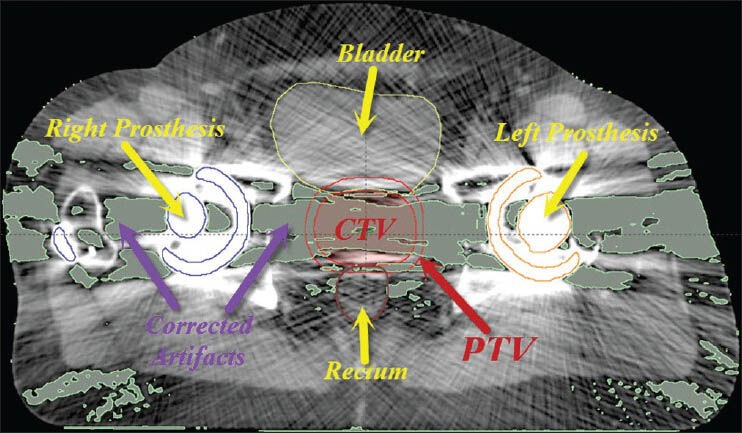
Recently, megavoltage (MV) photon volumetric modulated arc therapy (VMAT) has gained widespread acceptance as the technique of choice for prostate cancer patients undergoing external beam radiation therapy. However, radiation treatment planning for patients with metallic hip prostheses composed of high-Z materials can be challenging due to (1) presence of streak artifacts from prosthetic hips in computed tomography dataset, and (2) inhomogeneous dose distribution within the target volume. The purpose of this study was to compare the dosimetric quality of VMAT techniques in the form of Rapid Arc (RA) for treating low-risk prostate cancer patient with bilateral prostheses.
Three treatment plans were created using RA techniques utilizing 2 arcs (2-RA), 3 arcs (3-RA), and 4 arcs (4-RA) for 6 MV photon beam in Eclipse treatment planning system. Each plan was optimized for total dose of 79.2 Gy prescribed to the planning target volume (PTV) over 44 fractions. All three RA plans were calculated with anisotropic analytical algorithm.
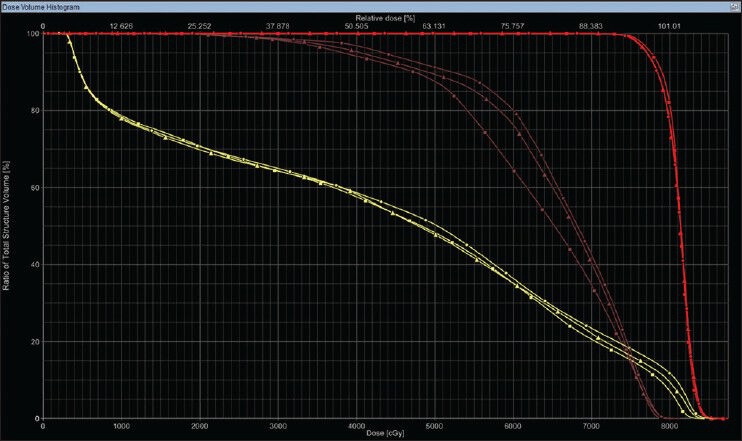
The mean and maximum doses to the PTV as well as the homogeneity index among all three RA plans were comparable. The plan conformity index was highest in the 2-Arc plan (1.19) and lowest in the 4-Arc plan (1.10). In comparison to the 2-RA technique, the 4-RA technique reduced the doses to rectum by up to 18.8% and to bladder by up to 7.8%. In comparison to the 3-RA technique, the 4-RA technique reduced the doses to rectum by up to 14.6% and to bladder by up to 3.5%.
Based on the RA techniques investigated for a low-risk prostate cancer patient with bilateral prostheses, the 4-RA plan produced lower rectal and bladder dose and better dose conformity across the PTV in comparison with the 2-RA and 3-RA plans.
近期,兆伏(MV)光子容积调强弧形治疗(VMAT)作为接受外照射放疗的前列腺癌患者的首选技术已得到广泛认可。然而,对于由高原子序数材料制成的金属髋关节假体患者,放射治疗计划可能具有挑战性,原因如下:(1)计算机断层扫描数据集中假体髋关节存在条纹伪影;(2)靶区内剂量分布不均匀。本研究的目的是比较以快速弧形(RA)形式的VMAT技术治疗双侧假体的低风险前列腺癌患者的剂量学质量。
在Eclipse治疗计划系统中,使用RA技术为6 MV光子束创建了三个治疗计划,分别采用2个弧形(2-RA)、3个弧形(3-RA)和4个弧形(4-RA)。每个计划针对计划靶区(PTV)规定的79.2 Gy总剂量在44次分割中进行优化。所有三个RA计划均采用各向异性分析算法计算。
所有三个RA计划中PTV的平均剂量、最大剂量以及均匀性指数相当。计划适形指数在2弧形计划中最高(1.19),在4弧形计划中最低(1.10)。与2-RA技术相比,4-RA技术使直肠剂量降低多达18.8%,膀胱剂量降低多达7.8%。与3-RA技术相比,4-RA技术使直肠剂量降低多达14.6%,膀胱剂量降低多达3.5%。
基于对双侧假体的低风险前列腺癌患者研究的RA技术,与2-RA和3-RA计划相比,4-RA计划产生的直肠和膀胱剂量更低,且在PTV上的剂量适形性更好。