Department of Community Dentistry, University of Oulu, P,O, Box 5281, 90014 Oulu, Finland.
BMC Oral Health. 2014 Mar 26;14:26. doi: 10.1186/1472-6831-14-26.
The majority of young children receive no early dental examination while attending primary health care for routine check-ups. Our aim was to study primary care nurses' knowledge of oral health care (OHC) and their attitudes toward delivering OHC, as well as to assess their willingness to obtain OHC information.
We conducted a cross-sectional survey of all primary-care nurses working in the public health centres of Tehran city. An anonymous self-administered questionnaire queried their knowledge in paediatric-, general and medicine-related areas of dentistry, providing knowledge scores for three domains. The nurses' attitudes toward OHC and their willingness to obtain OHC information underwent evaluation with statements utilizing a five-point Likert scale. Altogether 680 nurses took part in the survey. The Chi-square test, t-test, one-way ANOVA and logistic regression model served for statistical analyses.
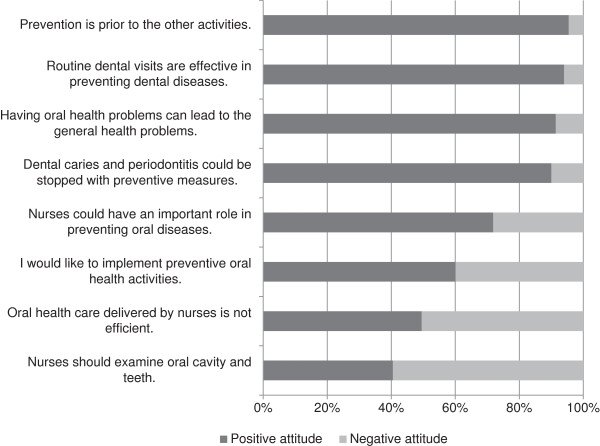
The mean score for the paediatric dentistry domain (3.6, SD: 1.5) was lower than for the medical (4.4, SD: 2.3) and dental domains (5.8, SD: 1.5). Obtaining higher scores in the paediatric (OR = 1.2) and dental (OR = 1.3) domains, and a greater willingness to receive OHC information (OR = 5.3), were associated with a positive attitude toward OHC. Nurses with a lower education (OR = 1.9) and better oral health behaviour (OR = 1.1) as well as those working in a non-affluent region (OR = 1.6) had a more positive attitude toward OHC.
Primary care nurses' low level of knowledge in OHC and their positive attitude and willingness to obtain more information point to the need for appropriate OHC training and encouragement for the nurses to promote oral health and prevent dental diseases.
大多数幼儿在接受初级卫生保健进行常规检查时都没有接受早期牙科检查。我们的目的是研究初级保健护士对口腔保健(OHC)的知识和他们提供 OHC 的态度,以及评估他们获取 OHC 信息的意愿。
我们对德黑兰市公立卫生中心的所有初级保健护士进行了横断面调查。匿名自填式问卷询问了他们在儿科、普通科和牙科相关医学领域的知识,为三个领域提供了知识评分。护士对 OHC 的态度和他们获得 OHC 信息的意愿通过使用五点 Likert 量表的陈述进行评估。共有 680 名护士参加了调查。使用卡方检验、t 检验、单向方差分析和逻辑回归模型进行统计分析。
儿科牙科领域的平均得分(3.6,SD:1.5)低于医学(4.4,SD:2.3)和牙科领域(5.8,SD:1.5)。在儿科(OR=1.2)和牙科(OR=1.3)领域获得更高的分数,以及更愿意接受 OHC 信息(OR=5.3),与对 OHC 的积极态度相关。教育程度较低的护士(OR=1.9)、口腔健康行为较好的护士(OR=1.1)以及在不富裕地区工作的护士(OR=1.6)对 OHC 的态度更为积极。
初级保健护士对 OHC 的知识水平较低,但他们对 OHC 的积极态度和获取更多信息的意愿表明,需要对护士进行适当的 OHC 培训,并鼓励他们促进口腔健康和预防牙科疾病。