Department of Biological Sciences and Center for Structural Biology, Vanderbilt University , Nashville, Tennessee 37235-1634, United States.
Biochemistry. 2014 Apr 15;53(14):2366-70. doi: 10.1021/bi5002807. Epub 2014 Apr 7.
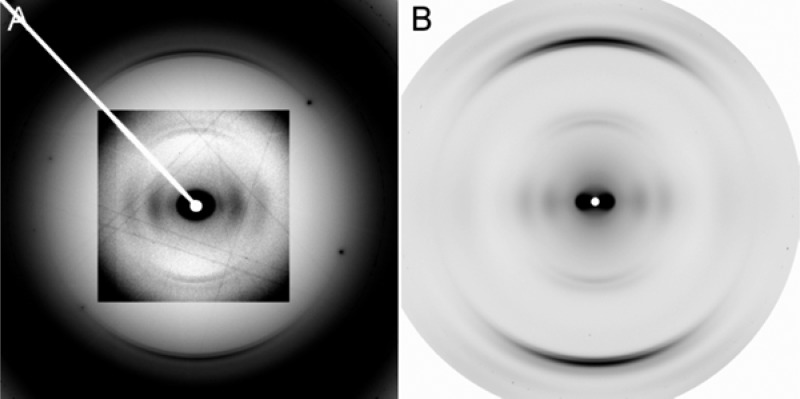
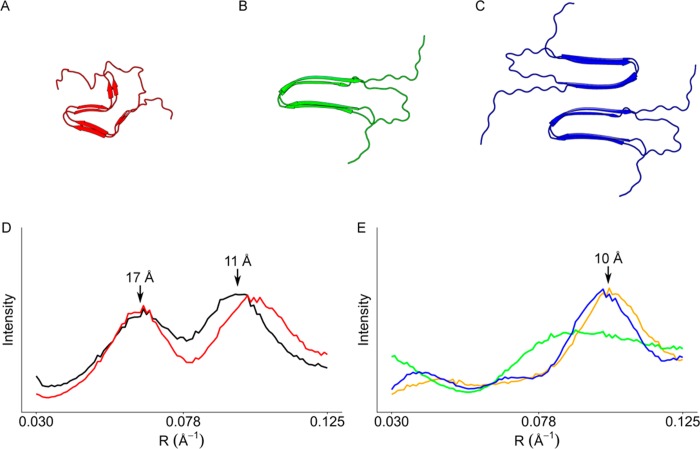
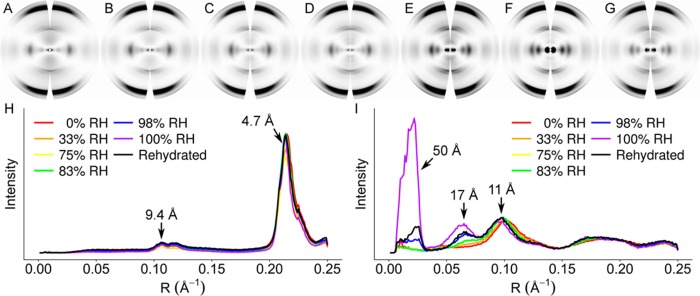
Amyloids are filamentous protein aggregates that can be formed by many different proteins and are associated with both disease and biological functions. The pathogenicities or biological functions of amyloids are determined by their particular molecular structures, making accurate structural models a requirement for understanding their biological effects. One potential factor that can affect amyloid structures is hydration. Previous studies of simple stacked β-sheet amyloids have suggested that dehydration does not impact structure, but other studies indicated dehydration-related structural changes of a putative water-filled nanotube. Our results show that dehydration significantly affects the molecular structure of the fungal prion-forming domain HET-s(218-289), which forms a β-solenoid with no internal solvent-accessible regions. The dehydration-related structural deformation of HET-s(218-289) indicates that water can play a significant role in complex amyloid structures, even when no obvious water-accessible cavities are present.
淀粉样蛋白是由许多不同蛋白质形成的纤维状蛋白聚集体,与疾病和生物学功能都有关联。淀粉样蛋白的致病性或生物学功能取决于其特定的分子结构,因此准确的结构模型是理解其生物学效应的必要条件。一个可能影响淀粉样蛋白结构的因素是水合作用。以前对简单堆叠β-折叠淀粉样蛋白的研究表明,脱水不会影响结构,但其他研究表明,水合作用与假定充满水的纳米管的结构变化有关。我们的研究结果表明,脱水会显著影响真菌朊病毒形成结构域 HET-s(218-289)的分子结构,该结构域形成没有内部可及溶剂区域的β-发夹螺旋。HET-s(218-289)的脱水相关结构变形表明,即使没有明显的可及水分子腔存在,水也可以在复杂的淀粉样蛋白结构中发挥重要作用。