Departamento de Genética/FMRP/USP, Laboratório de Genética Molecular e Bioinformática, Rua Tenente Catão Roxo, 2501, CEP 14,051- 140 Ribeirão Preto, São Paulo, Brazil.
BMC Genomics. 2014 Mar 26;15:236. doi: 10.1186/1471-2164-15-236.
The rubber tree, Hevea brasiliensis, is a species native to the Brazilian Amazon region and it supplies almost all the world's natural rubber, a strategic raw material for a variety of products. One of the major challenges for developing rubber tree plantations is adapting the plant to biotic and abiotic stress. Transcriptome analysis is one of the main approaches for identifying the complete set of active genes in a cell or tissue for a specific developmental stage or physiological condition.
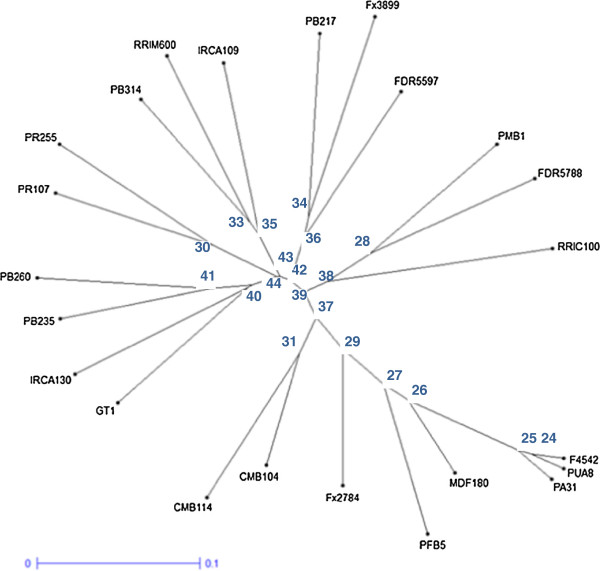
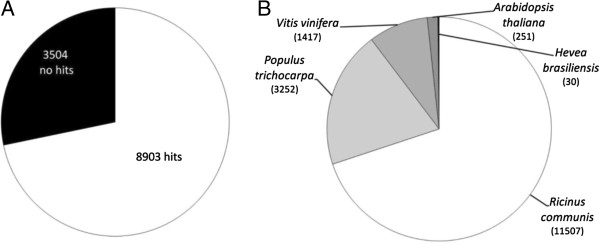
Here, we report on the sequencing, assembling, annotation and screening for molecular markers from a pool of H. brasiliensis tissues. A total of 17,166 contigs were successfully annotated. Then, 2,191 Single Nucleotide Variation (SNV) and 1.397 Simple Sequence Repeat (SSR) loci were discriminated from the sequences. From 306 putative, mainly non-synonymous SNVs located in CDS sequences, 191 were checked for their ability to characterize 23 Hevea genotypes by an allele-specific amplification technology. For 172 (90%), the nucleotide variation at the predicted genomic location was confirmed, thus validating the different steps from sequencing to the in silico detection of the SNVs.
This is the first study of the H. brasiliensis transcriptome, covering a wide range of tissues and organs, leading to the production of the first developed SNP markers. This process could be amplified to a larger set of in silico detected SNVs in expressed genes in order to increase the marker density in available and future genetic maps. The results obtained in this study will contribute to the H. brasiliensis genetic breeding program focused on improving of disease resistance and latex yield.
橡胶树(Hevea brasiliensis)原产于巴西亚马逊地区,它为全球提供了几乎所有的天然橡胶,这是一种用于各种产品的战略原材料。开发橡胶树种植园的主要挑战之一是使植物适应生物和非生物胁迫。转录组分析是鉴定特定发育阶段或生理条件下细胞或组织中所有活性基因的主要方法之一。
在这里,我们报告了对橡胶树组织进行测序、组装、注释和筛选分子标记的情况。共成功注释了 17166 个连续序列。然后,从序列中区分出 2191 个单核苷酸变异(SNV)和 1.397 个简单重复序列(SSR)位点。从位于 CDS 序列中的 306 个假定的、主要是非同义的 SNV 中,通过等位基因特异性扩增技术检查了 191 个 SNV 鉴定 23 个橡胶树基因型的能力。在预测的基因组位置处,172 个(90%)核苷酸变异得到了证实,从而验证了从测序到 SNV 的计算机检测的不同步骤。
这是橡胶树转录组的首次研究,涵盖了广泛的组织和器官,产生了第一批开发的 SNP 标记。这个过程可以扩展到表达基因中更多的计算机检测到的 SNV,以增加现有和未来遗传图谱中标记的密度。本研究的结果将有助于橡胶树遗传育种计划,重点是提高抗病性和乳胶产量。