Cancer Genome Project, Wellcome Trust Sanger Institute, Hinxton, UK.
Leukaemia Research Cytogenetics Group, Northern Institute for Cancer Research, Newcastle University, Newcastle upon Tyne, UK.
Nature. 2014 Apr 3;508(7494):98-102. doi: 10.1038/nature13115. Epub 2014 Mar 23.
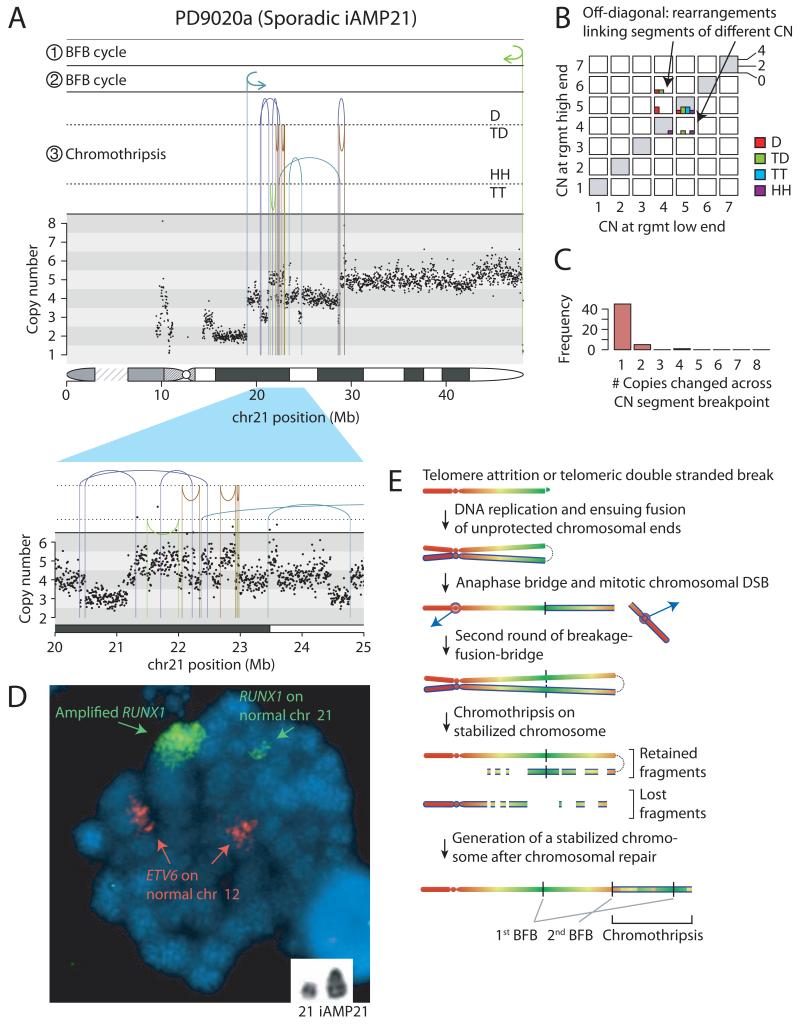
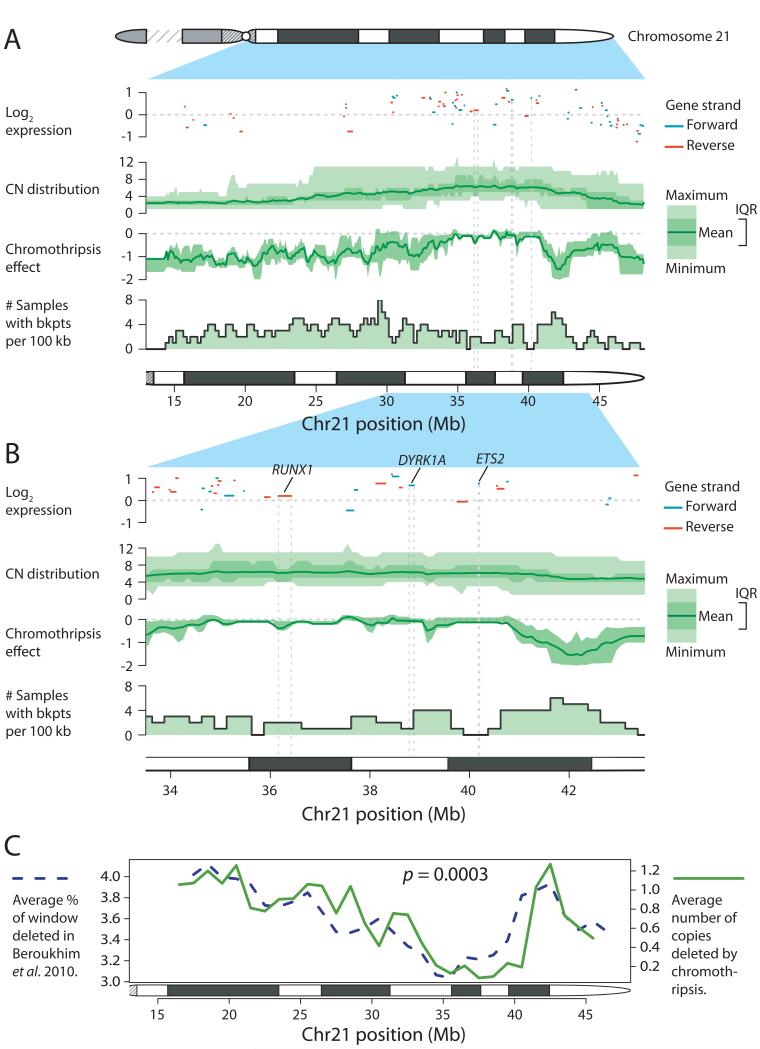
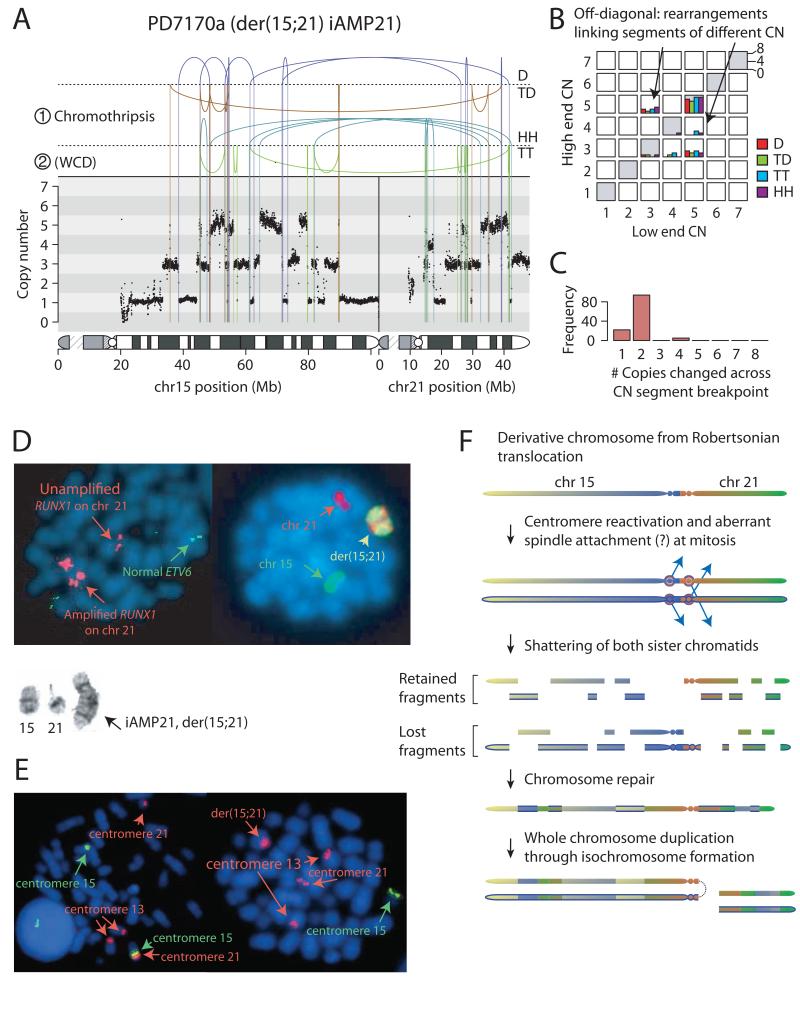
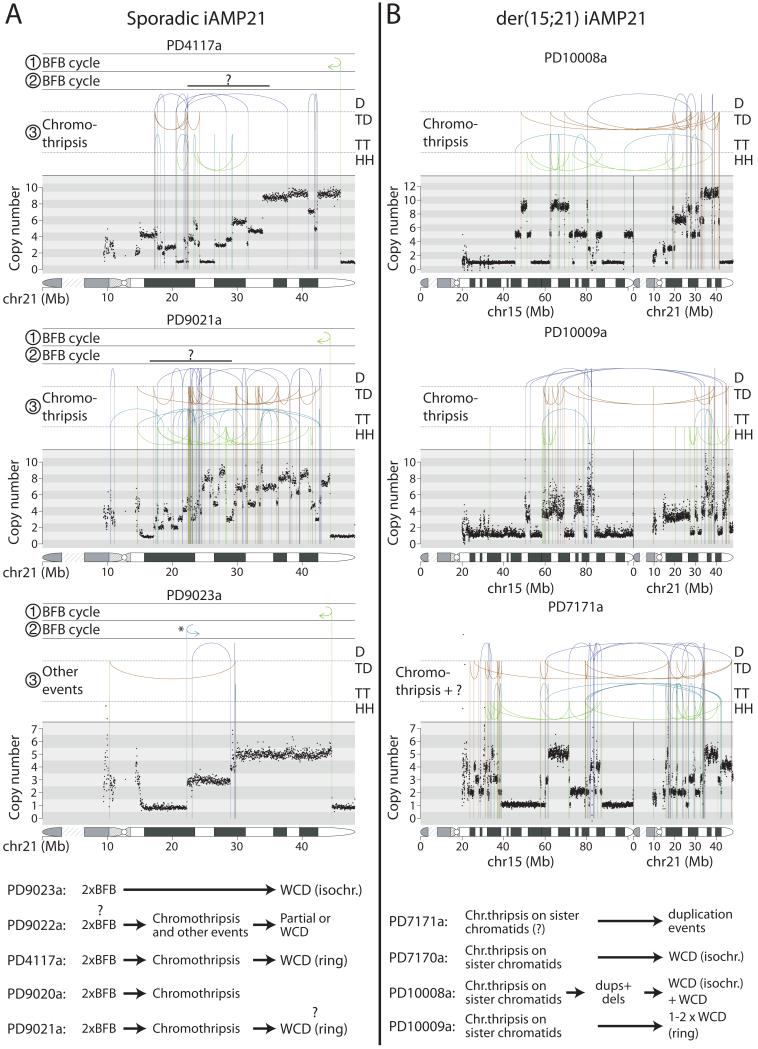
Changes in gene dosage are a major driver of cancer, known to be caused by a finite, but increasingly well annotated, repertoire of mutational mechanisms. This can potentially generate correlated copy-number alterations across hundreds of linked genes, as exemplified by the 2% of childhood acute lymphoblastic leukaemia (ALL) with recurrent amplification of megabase regions of chromosome 21 (iAMP21). We used genomic, cytogenetic and transcriptional analysis, coupled with novel bioinformatic approaches, to reconstruct the evolution of iAMP21 ALL. Here we show that individuals born with the rare constitutional Robertsonian translocation between chromosomes 15 and 21, rob(15;21)(q10;q10)c, have approximately 2,700-fold increased risk of developing iAMP21 ALL compared to the general population. In such cases, amplification is initiated by a chromothripsis event involving both sister chromatids of the Robertsonian chromosome, a novel mechanism for cancer predisposition. In sporadic iAMP21, breakage-fusion-bridge cycles are typically the initiating event, often followed by chromothripsis. In both sporadic and rob(15;21)c-associated iAMP21, the final stages frequently involve duplications of the entire abnormal chromosome. The end-product is a derivative of chromosome 21 or the rob(15;21)c chromosome with gene dosage optimized for leukaemic potential, showing constrained copy-number levels over multiple linked genes. Thus, dicentric chromosomes may be an important precipitant of chromothripsis, as we show rob(15;21)c to be constitutionally dicentric and breakage-fusion-bridge cycles generate dicentric chromosomes somatically. Furthermore, our data illustrate that several cancer-specific mutational processes, applied sequentially, can coordinate to fashion copy-number profiles over large genomic scales, incrementally refining the fitness benefits of aggregated gene dosage changes.
基因剂量变化是癌症的主要驱动因素,已知其由有限但越来越被注释的突变机制谱引起。这可能会在数百个连锁基因中产生相关的拷贝数改变,如 2%的儿童急性淋巴细胞白血病(ALL)中染色体 21 上 megabase 区域的反复扩增(iAMP21)就是一个例子。我们使用基因组、细胞遗传学和转录分析,结合新的生物信息学方法,重建了 iAMP21 ALL 的进化。在这里,我们表明,具有罕见的染色体 15 和 21 之间的罗伯逊易位(rob(15;21)(q10;q10)c)的个体,与一般人群相比,患有 iAMP21 ALL 的风险增加了约 2700 倍。在这种情况下,扩增是由涉及罗伯逊染色体的两条姐妹染色单体的染色体重排事件引发的,这是一种癌症易感性的新机制。在散发性 iAMP21 中,断裂-融合-桥循环通常是起始事件,通常紧随其后的是染色体重排。在散发性和 rob(15;21)c 相关的 iAMP21 中,最终阶段通常涉及整个异常染色体的重复。最终产物是染色体 21 或 rob(15;21)c 染色体的衍生物,其基因剂量优化为白血病潜能,显示多个连锁基因的拷贝数水平受限。因此,双着丝粒染色体可能是染色体重排的一个重要诱因,正如我们所展示的 rob(15;21)c 是结构性双着丝粒的,并且断裂-融合-桥循环会产生体细胞双着丝粒染色体。此外,我们的数据说明了几个癌症特异性的突变过程,按顺序应用,可以协调在大基因组尺度上的拷贝数谱,逐步提高聚集基因剂量变化的适应性优势。