Hiraki Linda T, Joshi Amit D, Ng Kimmie, Fuchs Charles S, Ma Jing, Hazra Aditi, Peters Ulrike, Karlson Elizabeth W, Giovannucci Edward, Kraft Peter, Chan Andrew T
Program in Molecular and Genetic Epidemiology, Department of Epidemiology, Harvard School of Public Health, Boston, Massachusetts, United States of America.
Medical Oncology, Dana Farber Cancer Institute, Boston, Massachusetts, United States of America.
PLoS One. 2014 Mar 26;9(3):e92212. doi: 10.1371/journal.pone.0092212. eCollection 2014.
Genome wide association studies (GWAS) have identified several SNPs associated with colorectal cancer (CRC) susceptibility. Vitamin D is also inversely associated with CRC risk.
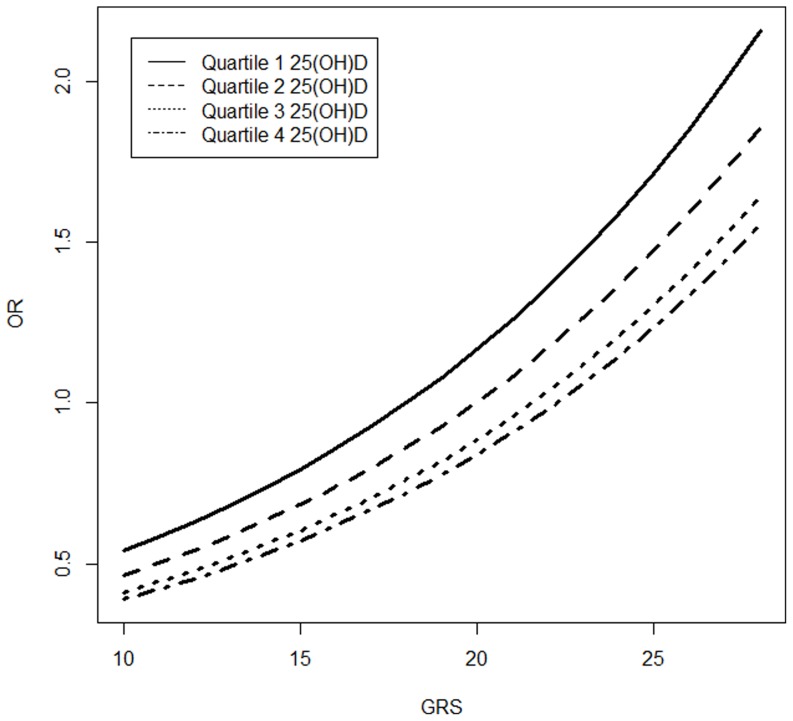
We examined main and joint effects of previously GWAS identified genetic markers of CRC and plasma 25-hydroxyvitamin D (25(OH)D) on CRC risk in three prospective cohorts: the Nurses' Health Study (NHS), the Health Professionals Follow-up Study (HPFS), and the Physicians' Health Study (PHS). We included 1895 CRC cases and 2806 controls with genomic DNA. We calculated odds ratios and 95% confidence intervals for CRC associated with additive genetic risk scores (GRSs) comprised of all CRC SNPs and subsets of these SNPs based on proximity to regions of increased vitamin D receptor binding to vitamin D response elements (VDREs), based on published ChiP-seq data. Among a subset of subjects with additional prediagnostic 25(OH)D we tested multiplicative interactions between plasma 25(OH)D and GRS's. We used fixed effects models to meta-analyze the three cohorts.
The per allele multivariate OR was 1.12 (95% CI, 1.06-1.19) for GRS-proximalVDRE; and 1.10 (95% CI, 1.06-1.14) for GRS-nonproxVDRE. The lowest quartile of plasma 25(OH)D compared with the highest, had a multivariate OR of 0.63 (95% CI, 0.48-0.82) for CRC. We did not observe any significant interactions between any GRSs and plasma 25(OH)D.
We did not observe evidence for the modification of genetic susceptibility for CRC according to vitamin D status, or evidence that the effect of common CRC risk alleles differed according to their proximity to putative VDR binding sites.
全基因组关联研究(GWAS)已鉴定出多个与结直肠癌(CRC)易感性相关的单核苷酸多态性(SNP)。维生素D也与CRC风险呈负相关。
我们在三项前瞻性队列研究中,即护士健康研究(NHS)、卫生专业人员随访研究(HPFS)和医师健康研究(PHS),研究了先前GWAS鉴定出的CRC基因标记物和血浆25-羟基维生素D(25(OH)D)对CRC风险的主要和联合作用。我们纳入了1895例CRC病例和2806例具有基因组DNA的对照。我们根据已发表的染色质免疫沉淀测序(ChIP-seq)数据,计算了与由所有CRC SNP以及基于与维生素D受体结合到维生素D反应元件(VDRE)增加区域的接近程度的这些SNP子集组成的加性遗传风险评分(GRS)相关的CRC的比值比和95%置信区间。在有额外诊断前25(OH)D的受试者子集中,我们测试了血浆25(OH)D与GRS之间的相乘交互作用。我们使用固定效应模型对这三项队列进行荟萃分析。
对于GRS-近端VDRE,每个等位基因的多变量比值比为1.12(95%置信区间,1.06-1.19);对于GRS-非近端VDRE,为1.10(95%置信区间,1.06-1.14)。与最高四分位数相比,血浆25(OH)D最低四分位数的CRC多变量比值比为0.63(95%置信区间,0.48-0.82)。我们未观察到任何GRS与血浆25(OH)D之间存在显著交互作用。
我们未观察到根据维生素D状态对CRC遗传易感性进行修饰的证据,也未观察到常见CRC风险等位基因的效应根据其与假定的维生素D受体(VDR)结合位点的接近程度而有所不同的证据。