Close Helen, Reilly Joe, Mason James M, Kripalani Mukesh, Wilson Douglas, Main John, Hungin A Pali S
Durham Clinical Trials Unit, School of Medicine, Pharmacy and Health, Durham University, Queen's Campus, Wolfson Research Institute, Stockton-on-Tees, United Kingdom.
School of Medicine, Pharmacy and Health, Durham University, Queen's Campus, Wolfson Research Institute, Stockton-on-Tees, United Kingdom; Tees, Esk & Wear Valleys NHS Foundation Trust, West Park Hospital, Darlington, County Durham, United Kingdom.
PLoS One. 2014 Mar 26;9(3):e90169. doi: 10.1371/journal.pone.0090169. eCollection 2014.
Lithium users are offered routine renal monitoring but few studies have quantified the risk to renal health. The aim of this study was to assess the association between use of lithium carbonate and incidence of renal failure in patients with bipolar disorder.
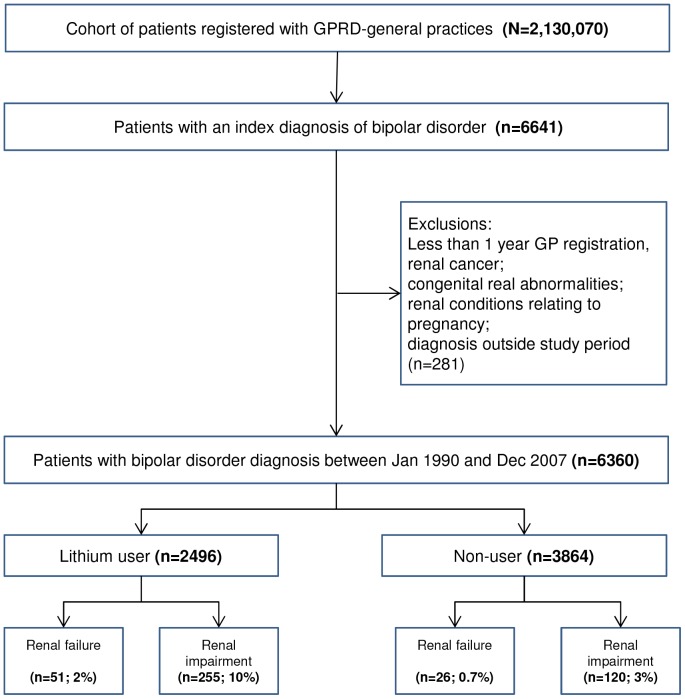
This was a retrospective cohort study using the General Practice Research Database (GPRD) and a nested validation study of lithium exposure and renal failure. A cohort of 6360 participants aged over 18 years had a first recorded diagnosis of bipolar disorder between January 1, 1990 and December 31, 2007. Data were examined from electronic primary care records from 418 general practices across the UK. The primary outcome was the hazard ratio for renal failure in participants exposed to lithium carbonate as compared with non-users of lithium, adjusting for age, gender, co-morbidities, and poly-pharmacy.
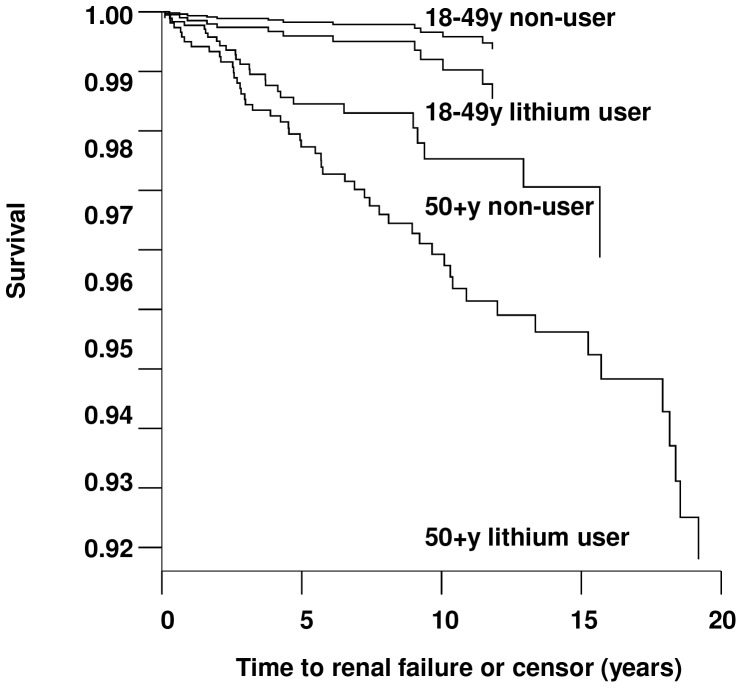
Ever use of lithium was associated with a hazard ratio for renal failure of 2.5 (95% confidence interval 1.6 to 4.0) adjusted for known renal risk factors. Absolute risk was age dependent, with patients of 50 years or older at particular risk of renal failure: Number Needed to Harm (NNH) was 44 (21 to 150).
Lithium is associated with an increased risk of renal failure, particularly among the older age group. The absolute risk of renal failure associated with lithium use remains small.
为锂盐使用者提供常规肾脏监测,但很少有研究对肾脏健康风险进行量化。本研究旨在评估碳酸锂使用与双相情感障碍患者肾衰竭发生率之间的关联。
这是一项使用全科医学研究数据库(GPRD)的回顾性队列研究,以及一项关于锂暴露与肾衰竭的嵌套验证研究。一组6360名年龄超过18岁的参与者在1990年1月1日至2007年12月31日期间首次被记录诊断为双相情感障碍。数据来自英国418家全科诊所的电子初级保健记录。主要结局是暴露于碳酸锂的参与者与未使用锂盐者相比发生肾衰竭的风险比,并对年龄、性别、合并症和联合用药进行了调整。
在对已知肾脏风险因素进行调整后,曾经使用锂盐与肾衰竭风险比为2.5(95%置信区间为1.6至4.0)相关。绝对风险与年龄有关,50岁及以上的患者尤其有肾衰竭风险:伤害所需人数(NNH)为44(21至150)。
锂盐与肾衰竭风险增加有关,尤其是在老年人群中。与使用锂盐相关的肾衰竭绝对风险仍然较小。