Miendlarzewska Ewa A, Trost Wiebke J
Department of Fundamental Neurosciences, (CMU), University of Geneva Geneva, Switzerland ; Swiss Centre of Affective Sciences, University of Geneva Geneva, Switzerland.
Swiss Centre of Affective Sciences, University of Geneva Geneva, Switzerland.
Front Neurosci. 2014 Jan 20;7:279. doi: 10.3389/fnins.2013.00279. eCollection 2013.
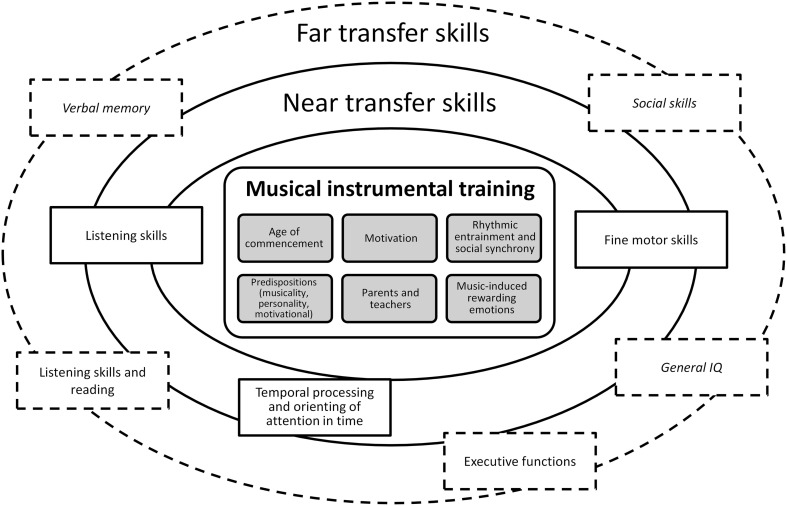
Musical training has recently gained additional interest in education as increasing neuroscientific research demonstrates its positive effects on brain development. Neuroimaging revealed plastic changes in the brains of adult musicians but it is still unclear to what extent they are the product of intensive music training rather than of other factors, such as preexisting biological markers of musicality. In this review, we synthesize a large body of studies demonstrating that benefits of musical training extend beyond the skills it directly aims to train and last well into adulthood. For example, children who undergo musical training have better verbal memory, second language pronunciation accuracy, reading ability and executive functions. Learning to play an instrument as a child may even predict academic performance and IQ in young adulthood. The degree of observed structural and functional adaptation in the brain correlates with intensity and duration of practice. Importantly, the effects on cognitive development depend on the timing of musical initiation due to sensitive periods during development, as well as on several other modulating variables. Notably, we point to motivation, reward and social context of musical education, which are important yet neglected factors affecting the long-term benefits of musical training. Further, we introduce the notion of rhythmic entrainment and suggest that it may represent a mechanism supporting learning and development of executive functions. It also hones temporal processing and orienting of attention in time that may underlie enhancements observed in reading and verbal memory. We conclude that musical training uniquely engenders near and far transfer effects, preparing a foundation for a range of skills, and thus fostering cognitive development.
随着越来越多的神经科学研究表明音乐训练对大脑发育具有积极影响,它最近在教育领域引发了更多关注。神经影像学显示成年音乐家的大脑存在可塑性变化,但目前尚不清楚这些变化在多大程度上是强化音乐训练的产物,而非其他因素,如音乐天赋的预先存在的生物学标记。在这篇综述中,我们综合了大量研究,这些研究表明音乐训练的益处不仅限于其直接旨在培养的技能,而且能持续到成年期。例如,接受音乐训练的儿童具有更好的言语记忆、第二语言发音准确性、阅读能力和执行功能。儿童时期学习演奏乐器甚至可能预测其成年早期的学业成绩和智商。大脑中观察到的结构和功能适应程度与练习的强度和持续时间相关。重要的是,由于发育过程中的敏感期,以及其他几个调节变量,对认知发展的影响取决于音乐启蒙的时机。值得注意的是,我们指出音乐教育的动机、奖励和社会环境,这些都是影响音乐训练长期益处的重要但被忽视的因素。此外,我们引入了节奏同步的概念,并认为它可能代表一种支持执行功能学习和发展的机制。它还能优化时间处理和注意力的时间定向,这可能是阅读和言语记忆中观察到的增强的基础。我们得出结论,音乐训练独特地产生近迁移和远迁移效应,为一系列技能奠定基础,从而促进认知发展。