DOE Great Lakes Bioenergy Research Center, University of Wisconsin-Madison Madison, WI, USA.
Front Microbiol. 2014 Mar 14;5:90. doi: 10.3389/fmicb.2014.00090. eCollection 2014.
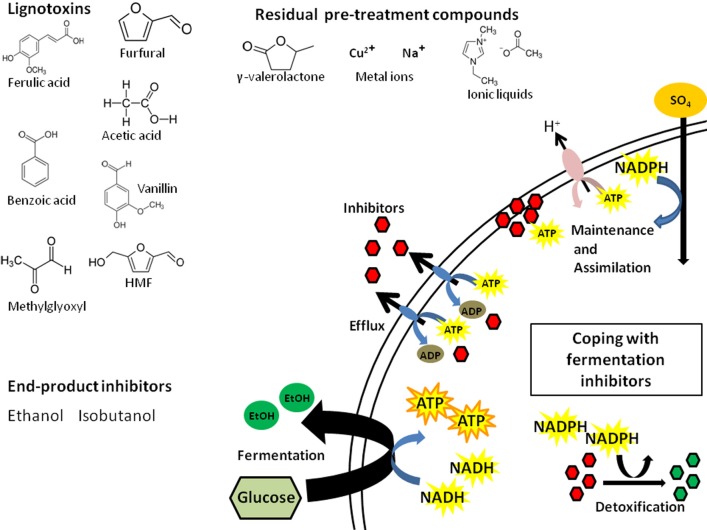
Lignocellulosic hydrolysate (LCH) inhibitors are a large class of bioactive molecules that arise from pretreatment, hydrolysis, and fermentation of plant biomass. These diverse compounds reduce lignocellulosic biofuel yields by inhibiting cellular processes and diverting energy into cellular responses. LCH inhibitors present one of the most significant challenges to efficient biofuel production by microbes. Development of new strains that lessen the effects of LCH inhibitors is an economically favorable strategy relative to expensive detoxification methods that also can reduce sugar content in deconstructed biomass. Systems biology analyses and metabolic modeling combined with directed evolution and synthetic biology are successful strategies for biocatalyst development, and methods that leverage state-of-the-art tools are needed to overcome inhibitors more completely. This perspective considers the energetic costs of LCH inhibitors and technologies that can be used to overcome their drain on conversion efficiency. We suggest academic and commercial research groups could benefit by sharing data on LCH inhibitors and implementing "translational biofuel research."
木质纤维素水解物 (LCH) 抑制剂是一大类生物活性分子,它们来源于植物生物质的预处理、水解和发酵。这些不同的化合物通过抑制细胞过程并将能量转移到细胞反应中来降低木质纤维素生物燃料的产量。LCH 抑制剂是微生物高效生产生物燃料的最重大挑战之一。与昂贵的解毒方法相比,开发能够减轻 LCH 抑制剂影响的新菌株是一种经济有利的策略,因为解毒方法也会降低解构生物质中的糖含量。系统生物学分析和代谢建模结合定向进化和合成生物学是生物催化剂开发的成功策略,需要利用最先进的工具来更彻底地克服抑制剂。本观点考虑了 LCH 抑制剂的能量成本以及可用于克服其对转化效率的影响的技术。我们建议学术和商业研究小组可以通过共享 LCH 抑制剂的数据并实施“转化生物燃料研究”从中受益。