Laboratory of Genetics, University of Wisconsin-Madison, Madison, Wisconsin, United States of America.
Great Lakes Bioenergy Research Center, University of Wisconsin-Madison, Madison, Wisconsin, United States of America.
PLoS Genet. 2023 Jul 6;19(7):e1010593. doi: 10.1371/journal.pgen.1010593. eCollection 2023 Jul.
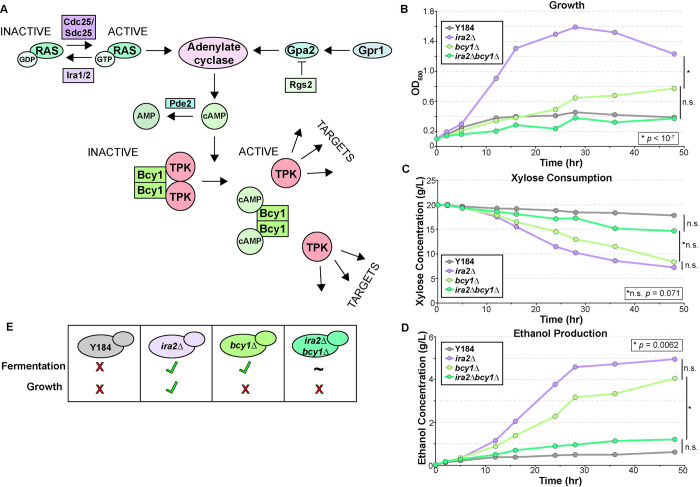
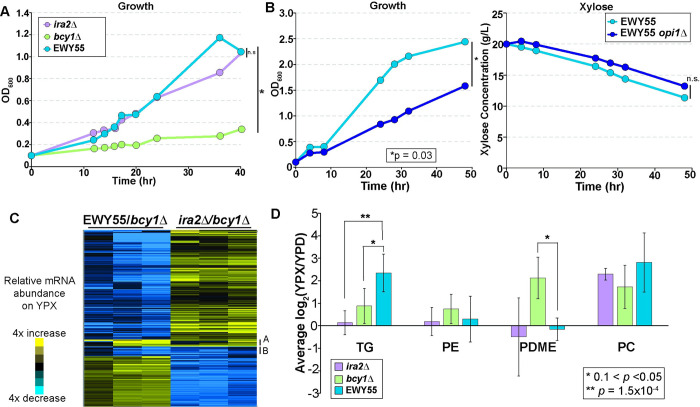
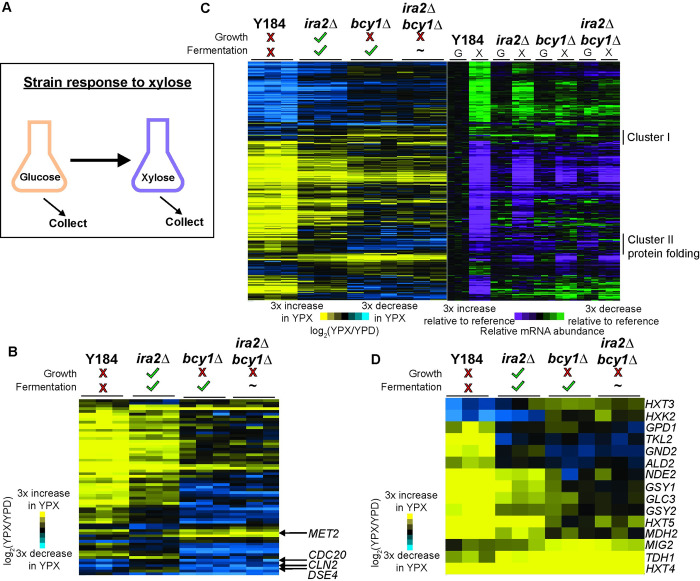
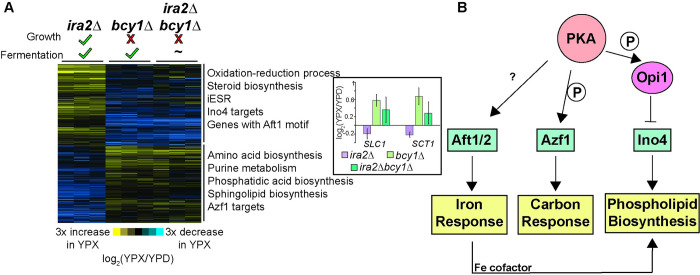
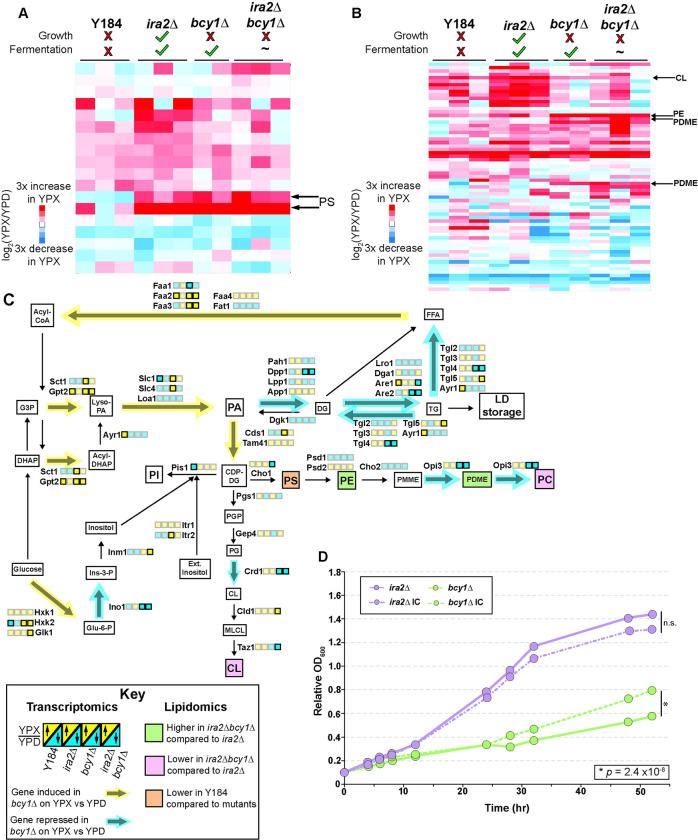
Organisms have evolved elaborate physiological pathways that regulate growth, proliferation, metabolism, and stress response. These pathways must be properly coordinated to elicit the appropriate response to an ever-changing environment. While individual pathways have been well studied in a variety of model systems, there remains much to uncover about how pathways are integrated to produce systemic changes in a cell, especially in dynamic conditions. We previously showed that deletion of Protein Kinase A (PKA) regulatory subunit BCY1 can decouple growth and metabolism in Saccharomyces cerevisiae engineered for anaerobic xylose fermentation, allowing for robust fermentation in the absence of division. This provides an opportunity to understand how PKA signaling normally coordinates these processes. Here, we integrated transcriptomic, lipidomic, and phospho-proteomic responses upon a glucose to xylose shift across a series of strains with different genetic mutations promoting either coupled or decoupled xylose-dependent growth and metabolism. Together, results suggested that defects in lipid homeostasis limit growth in the bcy1Δ strain despite robust metabolism. To further understand this mechanism, we performed adaptive laboratory evolutions to re-evolve coupled growth and metabolism in the bcy1Δ parental strain. The evolved strain harbored mutations in PKA subunit TPK1 and lipid regulator OPI1, among other genes, and evolved changes in lipid profiles and gene expression. Deletion of the evolved opi1 gene partially reverted the strain's phenotype to the bcy1Δ parent, with reduced growth and robust xylose fermentation. We suggest several models for how cells coordinate growth, metabolism, and other responses in budding yeast and how restructuring these processes enables anaerobic xylose utilization.
生物已经进化出了复杂的生理途径来调节生长、增殖、代谢和应激反应。这些途径必须得到适当的协调,以对不断变化的环境做出适当的反应。虽然在各种模式系统中已经对单个途径进行了很好的研究,但对于途径如何整合以在细胞中产生系统变化,尤其是在动态条件下,仍有许多需要揭示。我们之前表明,删除蛋白激酶 A(PKA)调节亚基 BCY1 可以使酵母工程菌在厌氧木糖发酵中解耦生长和代谢,从而在没有分裂的情况下实现稳健的发酵。这为了解 PKA 信号如何正常协调这些过程提供了机会。在这里,我们整合了转录组学、脂质组学和磷酸化蛋白质组学的响应,这些响应是在一系列具有不同遗传突变的菌株中从葡萄糖到木糖的转变过程中产生的,这些突变促进了耦合或解耦的木糖依赖生长和代谢。结果表明,尽管代谢旺盛,但脂质稳态的缺陷限制了 bcy1Δ 菌株的生长。为了进一步了解这一机制,我们进行了适应性实验室进化实验,以重新进化 bcy1Δ 亲本菌株中的耦合生长和代谢。进化后的菌株在 PKA 亚基 TPK1 和脂质调节因子 OPI1 等基因中发生了突变,并在脂质谱和基因表达方面发生了进化变化。删除进化后的 opi1 基因部分使菌株的表型恢复到 bcy1Δ 亲本,表现为生长减少和木糖发酵增强。我们提出了几种模型来解释细胞如何在出芽酵母中协调生长、代谢和其他反应,以及如何重构这些过程以实现厌氧木糖利用。