Martin Joanna, Hamshere Marian L, Stergiakouli Evangelia, O'Donovan Michael C, Thapar Anita
MRC Centre for Neuropsychiatric Genetics and Genomics, Institute of Psychological Medicine and Clinical Neurosciences, Cardiff University School of Medicine, Cardiff.
MRC Centre for Neuropsychiatric Genetics and Genomics, Institute of Psychological Medicine and Clinical Neurosciences, Cardiff University School of Medicine, Cardiff.
Biol Psychiatry. 2014 Oct 15;76(8):664-71. doi: 10.1016/j.biopsych.2014.02.013. Epub 2014 Feb 25.
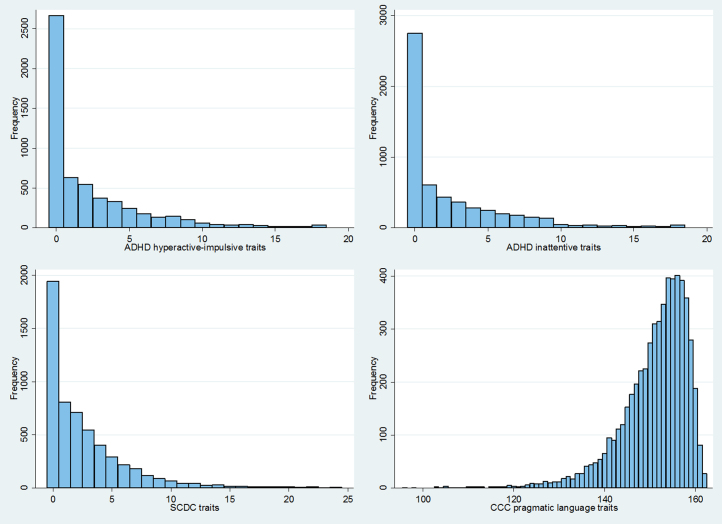
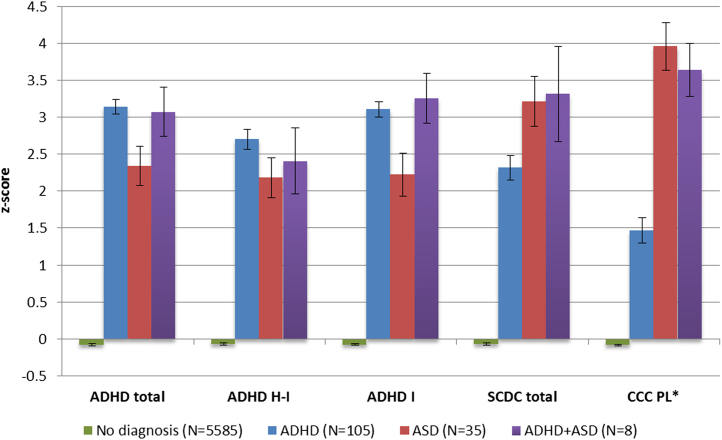
Attention-deficit/hyperactivity disorder (ADHD) can be viewed as the extreme end of traits in the general population. Epidemiological and twin studies suggest that ADHD frequently co-occurs with and shares genetic susceptibility with autism spectrum disorder (ASD) and ASD-related traits. The aims of this study were to determine whether a composite of common molecular genetic variants, previously found to be associated with clinically diagnosed ADHD, predicts ADHD and ASD-related traits in the general population.
Polygenic risk scores were calculated in the Avon Longitudinal Study of Parents and Children (ALSPAC) population sample (N = 8229) based on a discovery case-control genome-wide association study of childhood ADHD. Regression analyses were used to assess whether polygenic scores predicted ADHD traits and ASD-related measures (pragmatic language abilities and social cognition) in the ALSPAC sample. Polygenic scores were also compared in boys and girls endorsing any (rating ≥ 1) ADHD item (n = 3623).
Polygenic risk for ADHD showed a positive association with ADHD traits (hyperactive-impulsive, p = .0039; inattentive, p = .037). Polygenic risk for ADHD was also negatively associated with pragmatic language abilities (p = .037) but not with social cognition (p = .43). In children with a rating ≥ 1 for ADHD traits, girls had a higher polygenic score than boys (p = .003).
These findings provide molecular genetic evidence that risk alleles for the categorical disorder of ADHD influence hyperactive-impulsive and attentional traits in the general population. The results further suggest that common genetic variation that contributes to ADHD diagnosis may also influence ASD-related traits, which at their extreme are a characteristic feature of ASD.
注意力缺陷多动障碍(ADHD)可被视为普通人群中某些特质的极端表现。流行病学和双胞胎研究表明,ADHD常与自闭症谱系障碍(ASD)及ASD相关特质同时出现,并共享遗传易感性。本研究的目的是确定先前发现与临床诊断的ADHD相关的常见分子遗传变异组合是否能预测普通人群中的ADHD及ASD相关特质。
基于一项针对儿童ADHD的发现性病例对照全基因组关联研究,在阿冯父母与儿童纵向研究(ALSPAC)人群样本(N = 8229)中计算多基因风险评分。回归分析用于评估多基因评分是否能预测ALSPAC样本中的ADHD特质及ASD相关指标(语用语言能力和社会认知)。还比较了认可任何(评分≥1)ADHD项目的男孩和女孩(n = 3623)的多基因评分。
ADHD的多基因风险与ADHD特质呈正相关(多动冲动,p = .0039;注意力不集中,p = .037)。ADHD的多基因风险也与语用语言能力呈负相关(p = .037),但与社会认知无关(p = .43)。在ADHD特质评分≥1的儿童中,女孩的多基因评分高于男孩(p = .003)。
这些发现提供了分子遗传学证据,表明ADHD分类障碍的风险等位基因会影响普通人群中的多动冲动和注意力特质。结果进一步表明,导致ADHD诊断的常见基因变异也可能影响ASD相关特质,而这些特质在极端情况下是ASD的一个特征。