Fauré Adrien, Vreede Barbara M I, Sucena Elio, Chaouiya Claudine
Instituto Gulbenkian de Ciência, Oeiras, Portugal; Yamaguchi University, Faculty of Science, Yoshida, Yamaguchi City, Yamaguchi, Japan.
Instituto Gulbenkian de Ciência, Oeiras, Portugal.
PLoS Comput Biol. 2014 Mar 27;10(3):e1003527. doi: 10.1371/journal.pcbi.1003527. eCollection 2014 Mar.
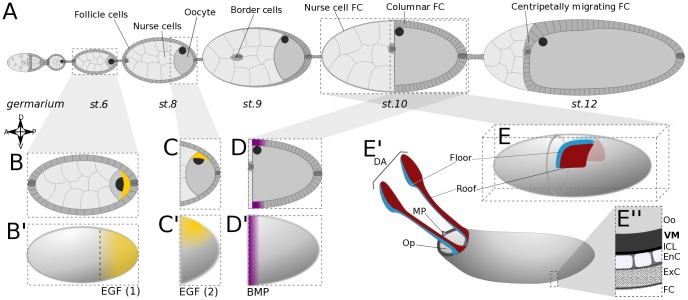
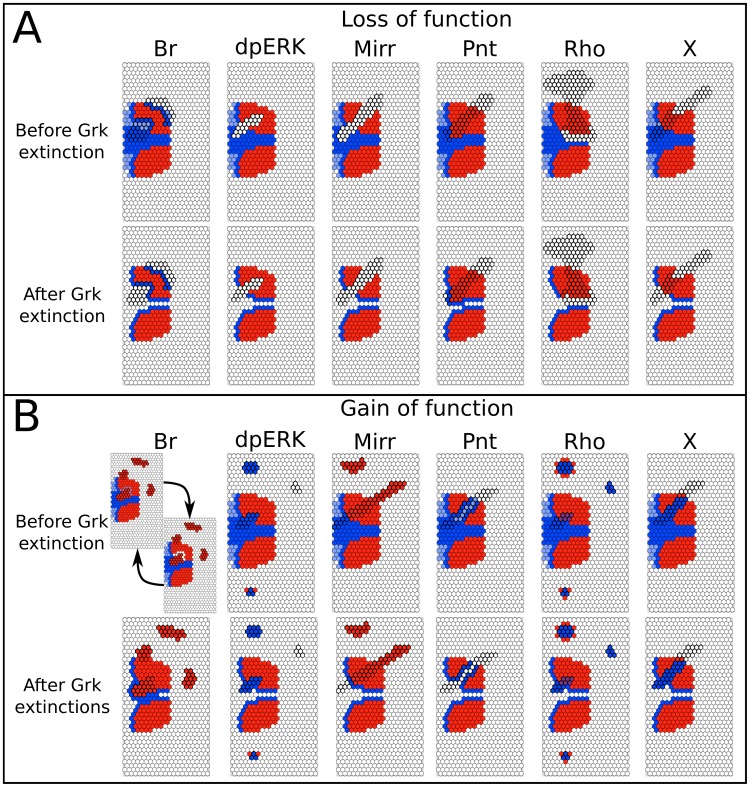
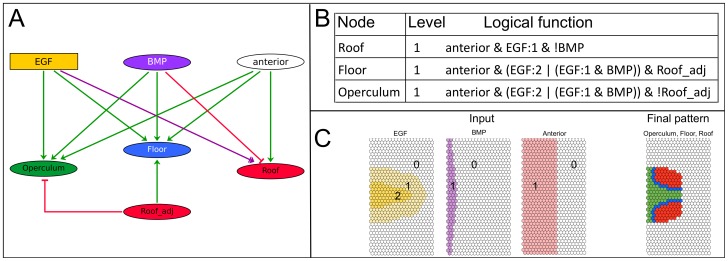
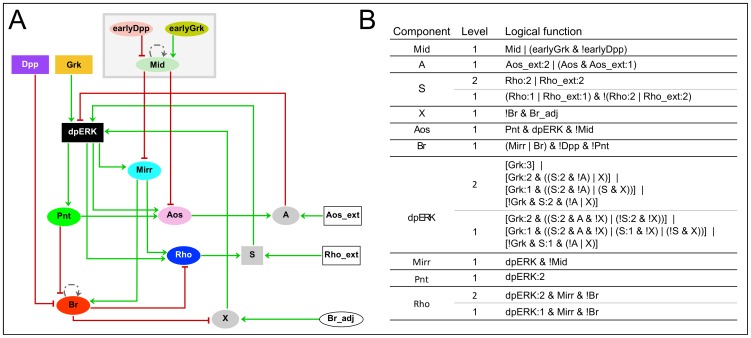
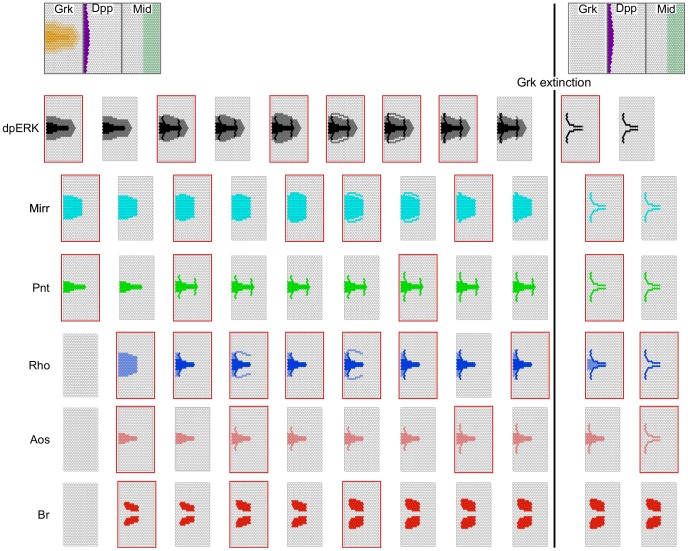
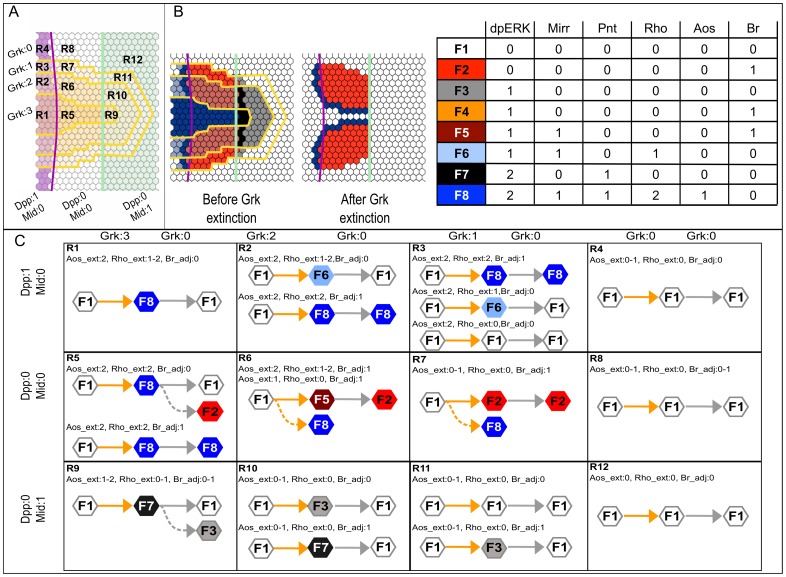
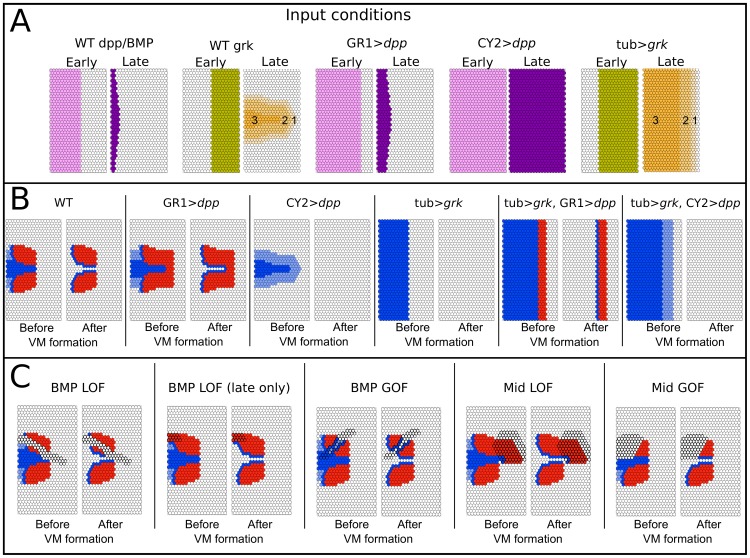
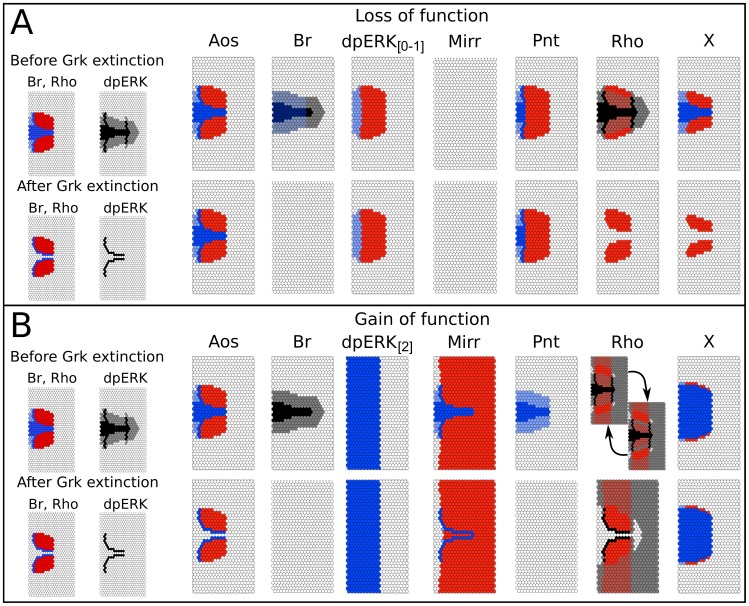
The Drosophila eggshell constitutes a remarkable system for the study of epithelial patterning, both experimentally and through computational modeling. Dorsal eggshell appendages arise from specific regions in the anterior follicular epithelium that covers the oocyte: two groups of cells expressing broad (roof cells) bordered by rhomboid expressing cells (floor cells). Despite the large number of genes known to participate in defining these domains and the important modeling efforts put into this developmental system, key patterning events still lack a proper mechanistic understanding and/or genetic basis, and the literature appears to conflict on some crucial points. We tackle these issues with an original, discrete framework that considers single-cell models that are integrated to construct epithelial models. We first build a phenomenological model that reproduces wild type follicular epithelial patterns, confirming EGF and BMP signaling input as sufficient to establish the major features of this patterning system within the anterior domain. Importantly, this simple model predicts an instructive juxtacrine signal linking the roof and floor domains. To explore this prediction, we define a mechanistic model that integrates the combined effects of cellular genetic networks, cell communication and network adjustment through developmental events. Moreover, we focus on the anterior competence region, and postulate that early BMP signaling participates with early EGF signaling in its specification. This model accurately simulates wild type pattern formation and is able to reproduce, with unprecedented level of precision and completeness, various published gain-of-function and loss-of-function experiments, including perturbations of the BMP pathway previously seen as conflicting results. The result is a coherent model built upon rules that may be generalized to other epithelia and developmental systems.
果蝇卵壳无论是在实验方面还是通过计算建模,都是研究上皮细胞模式形成的一个卓越系统。背侧卵壳附属物起源于覆盖卵母细胞的前卵泡上皮中的特定区域:两组表达broad的细胞(顶细胞),由表达rhomboid的细胞(底细胞)界定边界。尽管已知有大量基因参与定义这些区域,并且对这个发育系统进行了重要的建模工作,但关键的模式形成事件仍然缺乏恰当的机制理解和/或遗传基础,而且文献在一些关键点上似乎存在冲突。我们用一个原创的离散框架来解决这些问题,该框架考虑整合单细胞模型以构建上皮模型。我们首先构建了一个现象学模型,该模型再现了野生型卵泡上皮模式,证实表皮生长因子(EGF)和骨形态发生蛋白(BMP)信号输入足以在前部区域建立这个模式形成系统的主要特征。重要的是,这个简单模型预测了一种指导型旁分泌信号连接顶区和底区。为了探究这个预测,我们定义了一个机制模型,该模型整合了细胞遗传网络、细胞通讯以及通过发育事件进行的网络调整的综合效应。此外,我们聚焦于前部感受态区域,并假设早期BMP信号与早期EGF信号共同参与其特化过程。这个模型准确地模拟了野生型模式形成,并能够以前所未有的精度和完整性再现各种已发表的功能获得和功能丧失实验,包括以前被视为相互矛盾结果的BMP信号通路的扰动。结果是一个基于可推广到其他上皮细胞和发育系统的规则构建的连贯模型。