Kianoush Nima, Adler Christina J, Nguyen Ky-Anh T, Browne Gina V, Simonian Mary, Hunter Neil
Institute of Dental Research, Westmead Centre for Oral Health and Westmead Millennium Institute, Westmead, Sydney, Australia; Department of Oral Biology, Faculty of Dentistry, University of Sydney, Sydney, Australia.
Institute of Dental Research, Westmead Centre for Oral Health and Westmead Millennium Institute, Westmead, Sydney, Australia.
PLoS One. 2014 Mar 27;9(3):e92940. doi: 10.1371/journal.pone.0092940. eCollection 2014.
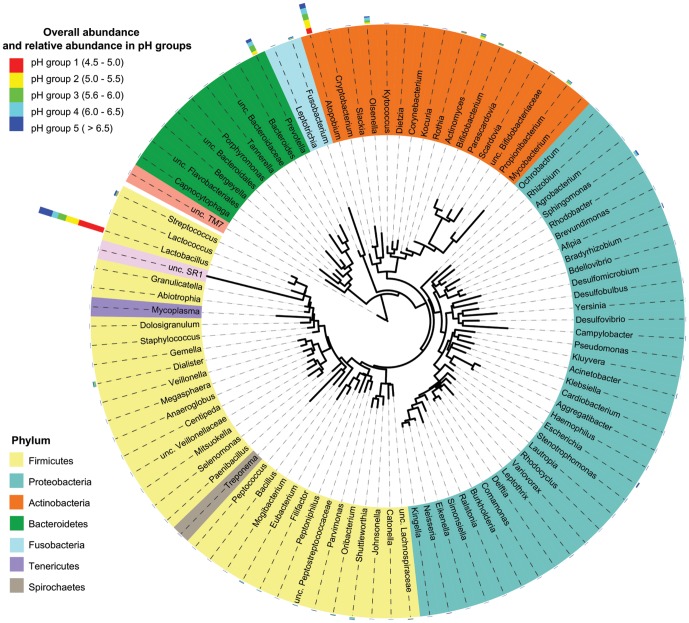
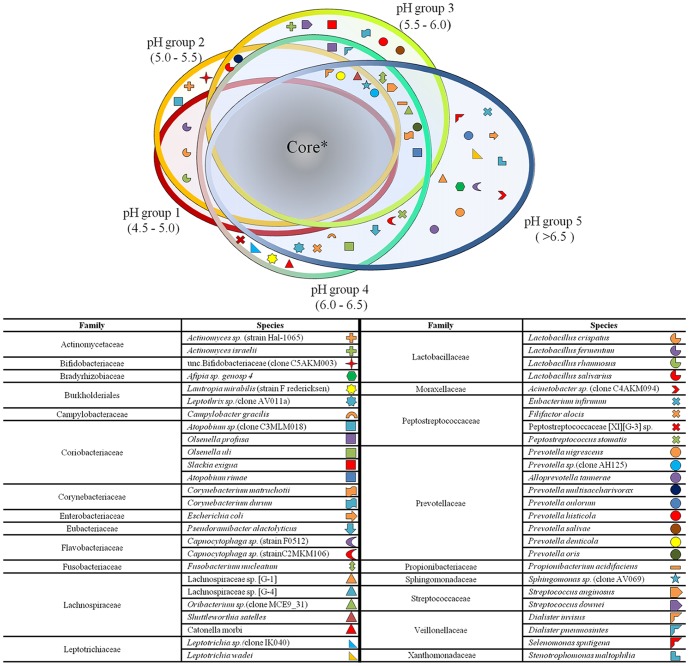
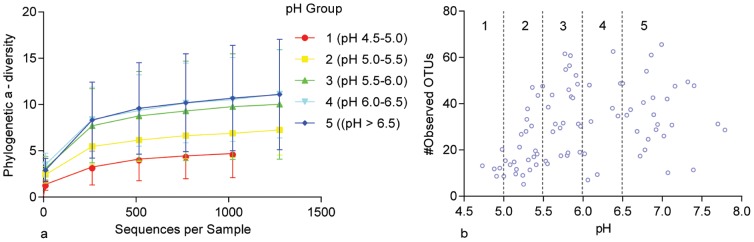
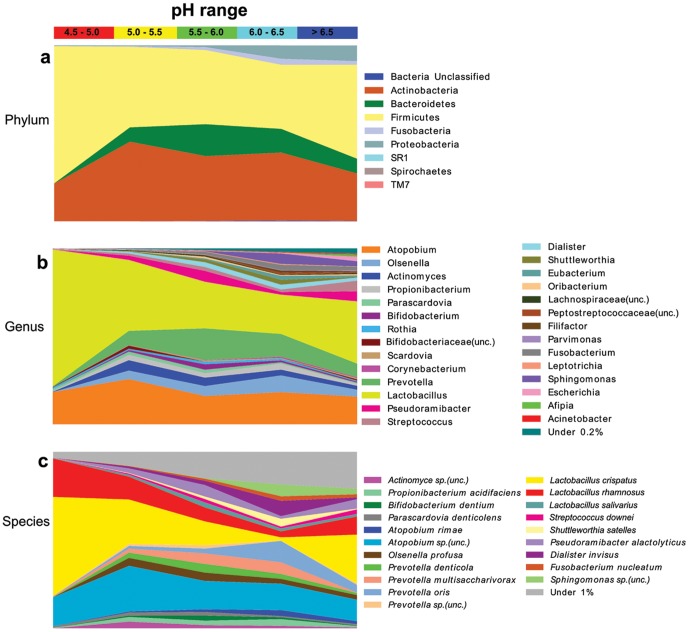
Dental caries is caused by the release of organic acids from fermentative bacteria, which results in the dissolution of hydroxyapatite matrices of enamel and dentine. While low environmental pH is proposed to cause a shift in the consortium of oral bacteria, favouring the development of caries, the impact of this variable has been overlooked in microbial population studies. This study aimed to detail the zonal composition of the microbiota associated with carious dentine lesions with reference to pH. We used 454 sequencing of the 16S rRNA gene (V3-V4 region) to compare microbial communities in layers ranging in pH from 4.5-7.8 from 25 teeth with advanced dentine caries. Pyrosequencing of the amplicons yielded 449,762 sequences. Nine phyla, 97 genera and 409 species were identified from the quality-filtered, de-noised and chimera-free sequences. Among the microbiota associated with dentinal caries, the most abundant taxa included Lactobacillus sp., Prevotella sp., Atopobium sp., Olsenella sp. and Actinomyces sp. We found a disparity between microbial communities localised at acidic versus neutral pH strata. Acidic conditions were associated with low diversity microbial populations, with Lactobacillus species including L. fermentum, L. rhamnosus and L. crispatus, being prominent. In comparison, the distinctive species of a more diverse flora associated with neutral pH regions of carious lesions included Alloprevotella tanerrae, Leptothrix sp., Sphingomonas sp. and Streptococcus anginosus. While certain bacteria were affected by the pH gradient, we also found that ∼ 60% of the taxa associated with caries were present across the investigated pH range, representing a substantial core. We demonstrated that some bacterial species implicated in caries progression show selective clustering with respect to pH gradient, providing a basis for specific therapeutic strategies.
龋齿是由发酵细菌释放有机酸引起的,这会导致牙釉质和牙本质的羟基磷灰石基质溶解。虽然低环境pH值被认为会导致口腔细菌群落发生变化,有利于龋齿的发展,但这一变量在微生物种群研究中一直被忽视。本研究旨在详细描述与龋损牙本质病变相关的微生物群的区域组成,并参考pH值。我们使用16S rRNA基因(V3-V4区域)的454测序技术,比较了25颗患有晚期牙本质龋的牙齿中pH值在4.5至7.8之间各层的微生物群落。扩增子的焦磷酸测序产生了449,762条序列。从经过质量过滤、去噪和无嵌合体的序列中鉴定出9个门、97个属和409个物种。在与牙本质龋相关的微生物群中,最丰富的分类群包括乳酸杆菌属、普雷沃菌属、阿托波菌属、奥尔森菌属和放线菌属。我们发现位于酸性和中性pH层的微生物群落之间存在差异。酸性条件与低多样性的微生物种群相关,其中突出的是包括发酵乳杆菌(L. fermentum)、鼠李糖乳杆菌(L. rhamnosus)和卷曲乳杆菌(L. crispatus)在内的乳酸杆菌属物种。相比之下,与龋损病变中性pH区域相关的更多样化菌群的独特物种包括塔纳异普雷沃菌(Alloprevotella tanerrae)、纤发菌属(Leptothrix sp.)、鞘氨醇单胞菌属(Sphingomonas sp.)和咽峡炎链球菌(Streptococcus anginosus)。虽然某些细菌受到pH梯度的影响,但我们还发现,约60%与龋齿相关的分类群存在于所研究pH范围内,代表了一个相当大的核心菌群。我们证明,一些与龋齿进展有关的细菌物种在pH梯度方面表现出选择性聚集,为特定的治疗策略提供了依据。