Biosecurity Research Institute, Kansas State University, Manhattan, KS 66506, USA.
Virol J. 2014 Mar 29;11:60. doi: 10.1186/1743-422X-11-60.
The RGD motif in the mosquito-borne flaviviruses envelope protein domain III (EDIII) FG loop was shown to bind negatively charged cellular molecules and mediate virus entry in mammals. However, its importance in virus entry in the mosquito has not yet been defined. The sequences of RGD motifs are conserved in JEV-serocomplex members primarily transmitted by Culex mosquitoes but absent from members of the DENV serocomplex, which utilize Aedes mosquitoes as vectors. Interestingly, the RGD sequence is present in the attenuated 17D strain of yellow fever virus as a result of the T380R mutation in the EDIII of Asibi strain following extensive in vitro passage in mice and chicken embryos and was found to contribute to the more rapid clearance in mice challenged with 17D. However, viral infectivity and dissemination in mosquitoes had not been evaluated for this mutant.
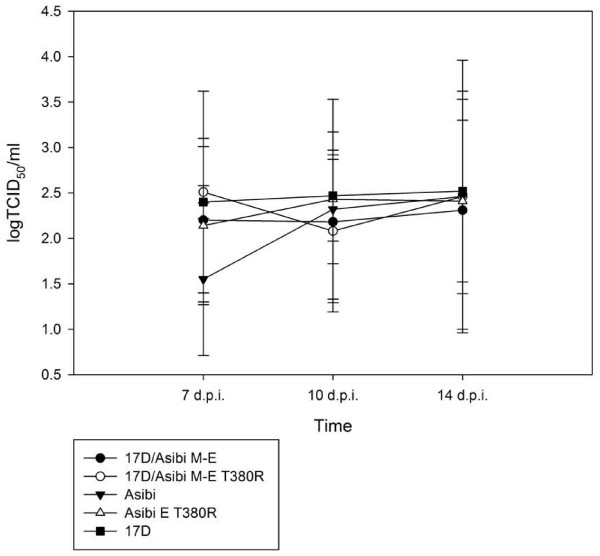
The study utilized the reverse genetics system of YFV and Ae. aegypti RexD WE mosquitoes to assess the impact of a T380R mutation in YFV Asibi and 17D/Asibi M-E chimera. The T380R mutation led to higher infection rates but similar dissemination rates when introduced into the YFV Asibi strain and 17D/Asibi M-E chimera.
While the increase of the positive charge in EDIII may reduce the virulence of YFV in mice, this mutation favored the establishment of the viral infection in Ae. aegypti. However, such gain in viral infectivity did not increase dissemination in infected mosquitoes.
登革热病毒包膜蛋白结构域 III(EDIII)FG 环中的 RGD 基序被证明可与带负电荷的细胞分子结合,并介导哺乳动物中的病毒进入。然而,其在蚊子中病毒进入的重要性尚未确定。RGD 基序的序列在主要由库蚊传播的 JEV 血清型复合物成员中保守,但在登革热病毒血清型复合物成员中缺失,后者利用伊蚊作为媒介。有趣的是,由于 Asibi 株的 EDIII 中的 T380R 突变,17D 黄热病病毒的减毒株中存在 RGD 序列,该突变是在小鼠和鸡胚中进行大量体外传代后发生的,并且被发现有助于 17D 挑战的小鼠更快清除。然而,尚未评估该突变体在蚊子中的病毒感染力和传播。
本研究利用 YFV 的反向遗传学系统和埃及伊蚊 RexD WE 蚊子来评估 YFV Asibi 和 17D/Asibi M-E 嵌合体中的 T380R 突变的影响。当将 T380R 突变引入 YFV Asibi 株和 17D/Asibi M-E 嵌合体时,该突变导致更高的感染率,但传播率相似。
虽然 EDIII 中正电荷的增加可能降低 YFV 在小鼠中的毒力,但该突变有利于病毒在埃及伊蚊中的感染建立。然而,这种病毒感染力的增加并没有增加感染蚊子中的传播。