Feuille Elizabeth, Nowak-Węgrzyn Anna
Department of Pediatrics, Jaffe Food Allergy Institute, Division of Allergy and Immunology, Icahn School of Medicine at Mount Sinai, New York, New York, USA.
Curr Opin Allergy Clin Immunol. 2014 Jun;14(3):222-8. doi: 10.1097/ACI.0000000000000055.
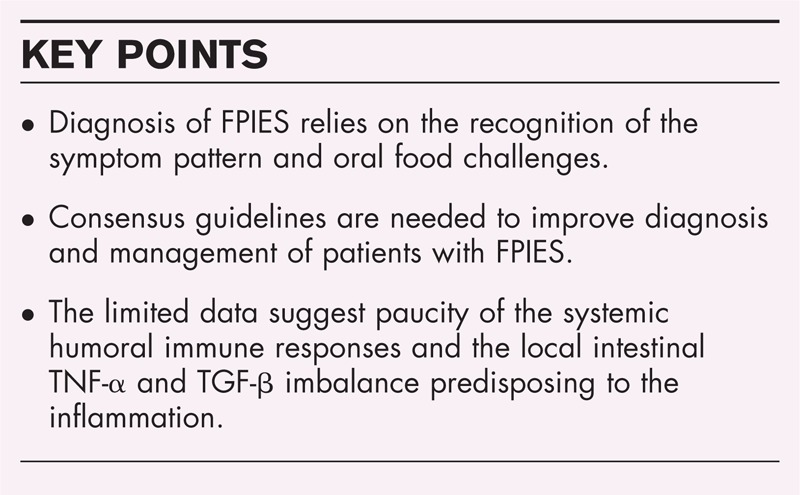
Food protein-induced enterocolitis syndrome (FPIES) is a poorly understood non-IgE-mediated food hypersensitivity, primarily affecting infants and toddlers. There are few data regarding pathophysiology of FPIES that suggest local intestinal imbalance between TNF-α and TGF-β. Patients frequently present with multiple reactions, which are characterized by projectile, repetitive emesis, dehydration, lethargy, and failure to thrive. Despite the severity of presentation, the diagnosis is frequently delayed, and patients often undergo extensive and invasive evaluation prior to reaching the diagnosis.
Reviews published in the last year provide a general approach to diagnosis and management of FPIES and aim to increase awareness and understanding of FPIES among general pediatricians.
Multicenter studies are necessary to reevaluate and modify the oral food challenge criteria. Research on the pathophysiology of FPIES reactions is necessary to provide insight into the evidence-based approach to diagnosis and management of FPIES. Registries are needed to understand the phenotype, triggers, and prevalence of FPIES.
食物蛋白诱导的小肠结肠炎综合征(FPIES)是一种尚未被充分理解的非IgE介导的食物过敏反应,主要影响婴幼儿。关于FPIES病理生理学的数据很少,提示肿瘤坏死因子-α(TNF-α)和转化生长因子-β(TGF-β)之间存在局部肠道失衡。患者常出现多种反应,其特征为喷射性、反复呕吐、脱水、嗜睡和生长发育迟缓。尽管临床表现严重,但诊断往往延迟,患者在确诊前常接受广泛的侵入性检查。
去年发表的综述提供了FPIES诊断和管理的一般方法,旨在提高普通儿科医生对FPIES的认识和理解。
多中心研究对于重新评估和修改口服食物激发试验标准是必要的。对FPIES反应病理生理学的研究对于深入了解FPIES诊断和管理的循证方法是必要的。需要建立登记系统以了解FPIES的表型、触发因素和患病率。