Department of Production and Population Health, Royal Veterinary College, Hatfield, Hertfordshire, United Kingdom Department of Parasitology, Pembroke Place, Liverpool School of Tropical Medicine, United Kingdom.
Department of Veterinary Disease Biology, Faculty of Health and Medical Sciences, University of Copenhagen, Denmark.
J Infect Dis. 2014 Sep 15;210(6):932-41. doi: 10.1093/infdis/jiu193. Epub 2014 Mar 31.
The roundworm Ascaris lumbricoides infects 0.8 billion people worldwide, and Ascaris suum infects innumerable pigs across the globe. The extent of natural cross-transmission of Ascaris between pig and human hosts in different geographical settings is unknown, warranting investigation.
Adult Ascaris organisms were obtained from humans and pigs in Europe, Africa, Asia, and Latin America. Barcodes were assigned to 536 parasites on the basis of sequence analysis of the mitochondrial cytochrome c oxidase I gene. Genotyping of 410 worms was also conducted using a panel of microsatellite markers. Phylogenetic, population genetic, and Bayesian assignment methods were used for analysis.
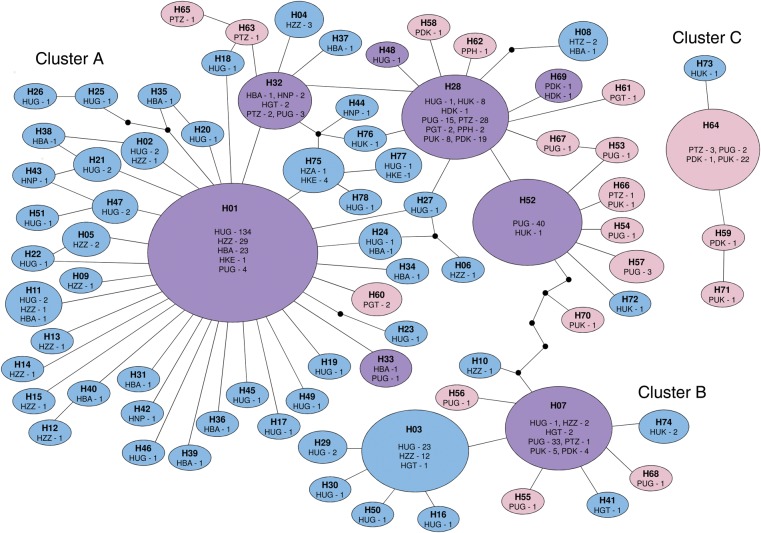
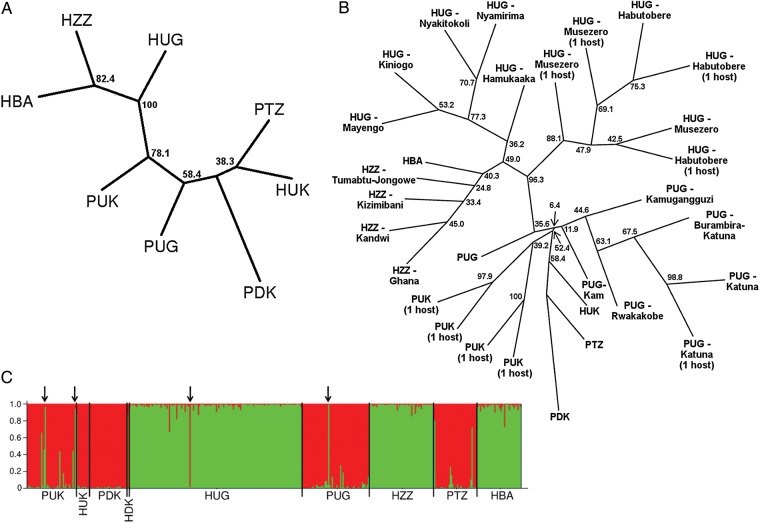
There was marked genetic segregation between worms originating from human hosts and those originating from pig hosts. However, human Ascaris infections in Europe were of pig origin, and there was evidence of cross-transmission between humans and pigs in Africa. Significant genetic differentiation exists between parasite populations from different countries, villages, and hosts.
In conducting an analysis of variation within Ascaris populations from pig and human hosts across the globe, we demonstrate that cross-transmission takes place in developing and developed countries, contingent upon epidemiological potential and local phylogeography. Our results provide novel insights into the transmission dynamics and speciation of Ascaris worms from humans and pigs that are of importance for control programs.
全球有 8 亿人感染蛔虫,而全球无数的猪都感染了猪蛔虫。在不同的地理环境中,猪和人类宿主之间蛔虫的自然交叉传播程度尚不清楚,值得研究。
从欧洲、非洲、亚洲和拉丁美洲的人类和猪中获得成年蛔虫。根据线粒体细胞色素 c 氧化酶 I 基因的序列分析,为 536 个寄生虫分配了条码。还使用微卫星标记面板对 410 条蠕虫进行了基因分型。使用系统发育、种群遗传和贝叶斯分配方法进行分析。
源自人类宿主和源自猪宿主的蠕虫之间存在明显的遗传隔离。然而,欧洲的人类蛔虫感染来自猪,并且在非洲存在人类和猪之间的交叉传播证据。来自不同国家、村庄和宿主的寄生虫种群存在显著的遗传分化。
通过分析全球猪和人类宿主蛔虫种群的变异,我们证明在发展中国家和发达国家都存在交叉传播,这取决于流行病学潜力和当地系统地理学。我们的研究结果为人类和猪蛔虫的传播动态和物种形成提供了新的见解,这对控制计划很重要。