Stuart Jeffrey A, Maddalena Lucas A, Merilovich Max, Robb Ellen L
Department of Biological Sciences, Brock University, St, Catharines, ON L2S 3A1, Canada.
Longev Healthspan. 2014 Apr 1;3(1):4. doi: 10.1186/2046-2395-3-4.
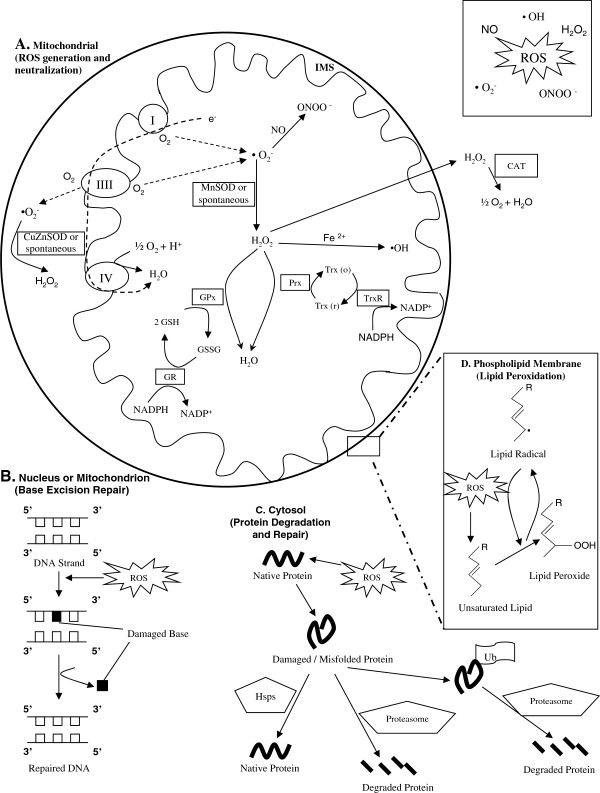
Since its inception more than four decades ago, the Mitochondrial Free Radical Theory of Aging (MFRTA) has served as a touchstone for research into the biology of aging. The MFRTA suggests that oxidative damage to cellular macromolecules caused by reactive oxygen species (ROS) originating from mitochondria accumulates in cells over an animal's lifespan and eventually leads to the dysfunction and failure that characterizes aging. A central prediction of the theory is that the ability to ameliorate or slow this process should be associated with a slowed rate of aging and thus increased lifespan. A vast pool of data bearing on this idea has now been published. ROS production, ROS neutralization and macromolecule repair have all been extensively studied in the context of longevity. We review experimental evidence from comparisons between naturally long- or short-lived animal species, from calorie restricted animals, and from genetically modified animals and weigh the strength of results supporting the MFRTA. Viewed as a whole, the data accumulated from these studies have too often failed to support the theory. Excellent, well controlled studies from the past decade in particular have isolated ROS as an experimental variable and have shown no relationship between its production or neutralization and aging or longevity. Instead, a role for mitochondrial ROS as intracellular messengers involved in the regulation of some basic cellular processes, such as proliferation, differentiation and death, has emerged. If mitochondrial ROS are involved in the aging process, it seems very likely it will be via highly specific and regulated cellular processes and not through indiscriminate oxidative damage to macromolecules.
自四十多年前提出以来,线粒体衰老自由基理论(MFRTA)一直是衰老生物学研究的试金石。MFRTA认为,线粒体产生的活性氧(ROS)对细胞大分子造成的氧化损伤在动物的一生中会在细胞内积累,最终导致衰老所特有的功能障碍和衰竭。该理论的一个核心预测是,改善或减缓这一过程的能力应与衰老速度减缓相关,从而延长寿命。现在已经发表了大量与此观点相关的数据。在长寿的背景下,ROS的产生、ROS的中和以及大分子修复都得到了广泛研究。我们回顾了来自自然长寿或短寿动物物种之间比较、限食动物以及转基因动物的实验证据,并权衡了支持MFRTA的结果的力度。总体来看,这些研究积累的数据往往未能支持该理论。特别是过去十年中出色的、严格对照的研究将ROS作为实验变量进行了分离,结果表明其产生或中和与衰老或寿命之间没有关系。相反,线粒体ROS作为参与调节某些基本细胞过程(如增殖、分化和死亡)的细胞内信使的作用已经显现。如果线粒体ROS参与衰老过程,那么很可能是通过高度特异性和受调控的细胞过程,而不是通过对大分子的随意氧化损伤。