Natesan S, Ashworth S, Nielsen J, Tang S-P, Salinas C, Kealey S, Lauridsen J B, Stensbøl T B, Gunn R N, Rabiner E A, Kapur S
Department of Psychosis Studies, Institute of Psychiatry, King's College London, London, UK.
Imanova Centre for Imaging Sciences, Hammersmith Hospital, London, UK.
Transl Psychiatry. 2014 Apr 1;4(4):e376. doi: 10.1038/tp.2014.17.
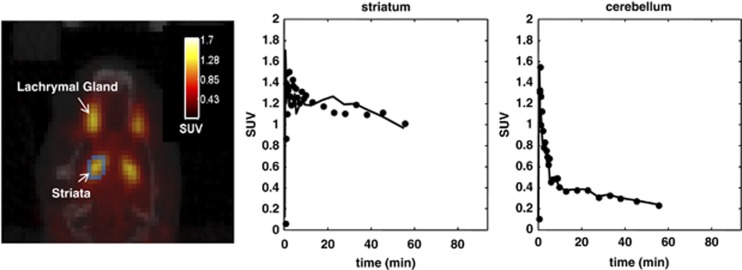
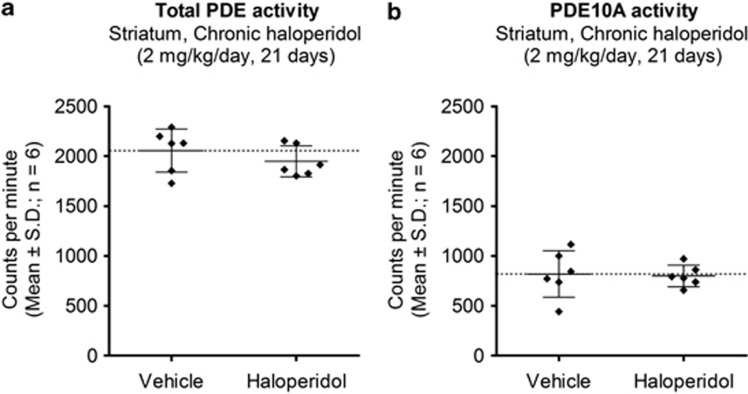
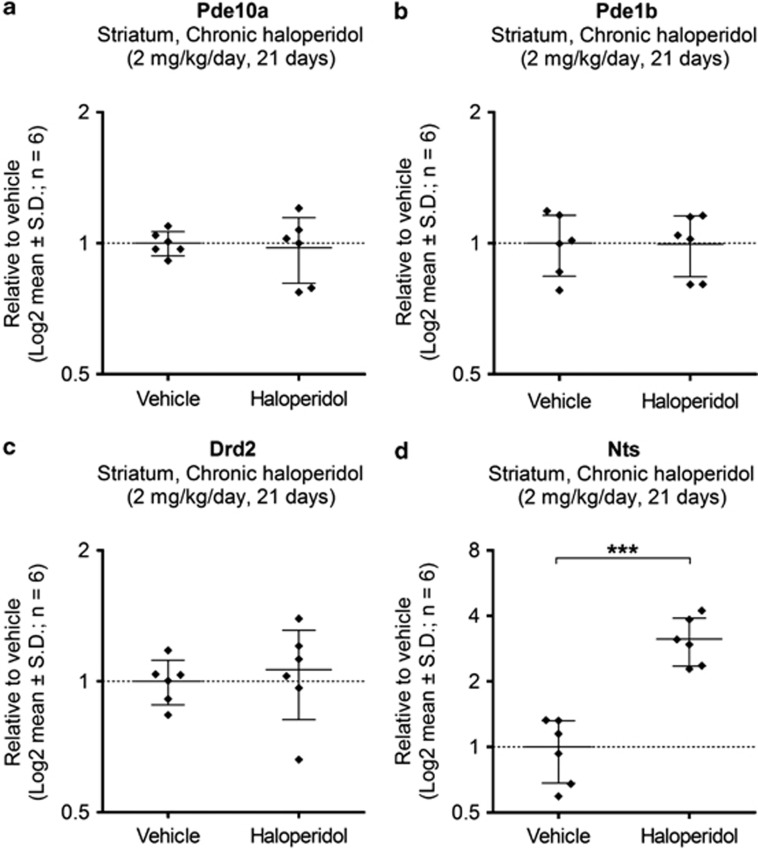
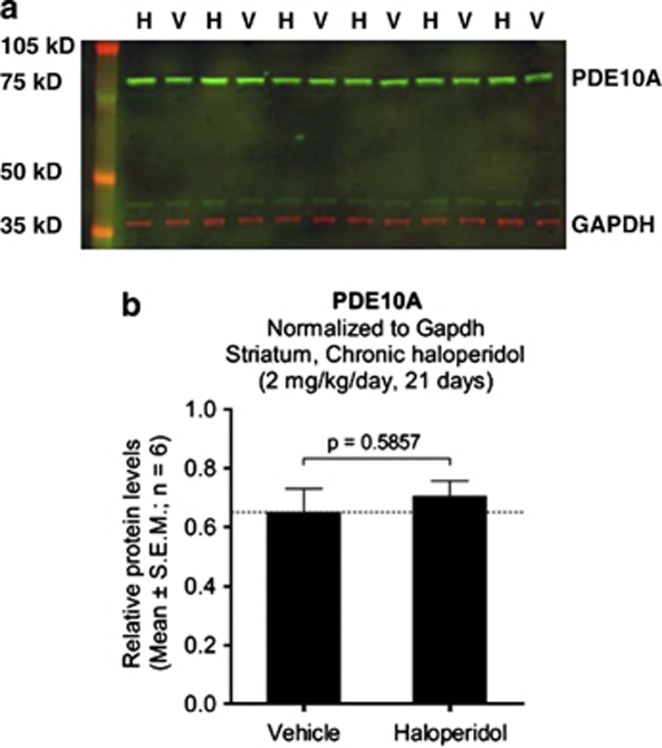
A number of phosphodiesterase 10A (PDE10) inhibitors are about to undergo clinical evaluation for their efficacy in treating schizophrenia. As phosphodiesterases are in the same signalling pathway as dopamine D2 receptors, it is possible that prior antipsychotic treatment could influence these enzyme systems in patients. Chronic, in contrast to acute, antipsychotic treatment has been reported to increase brain PDE10A levels in rodents. The aim of this study was to confirm these findings in a manner that can be translated to human imaging studies to understand its consequences. Positron emission tomography (PET) scanning was used to evaluate PDE10A enzyme availability, after chronic haloperidol administration, using a specific PDE10A ligand ([(11)C]MP-10). The binding of [(11)C]MP-10 in the striatum and the cerebellum was measured in rodents and a simplified reference tissue model (SRTM) with cerebellum as the reference region was used to determine the binding potential (BPND). In rats treated chronically with haloperidol (2 mg kg(-1) per day), there was no significant difference in PDE10A levels compared with the vehicle-treated group (BPND±s.d.: 3.57 ± 0.64 versus 2.86 ± 0.71). Following PET scans, ex vivo analysis of striatal brain tissue for PDE10A mRNA (Pde10a) and PDE10A enzyme activity showed no significant difference. Similarly, the PDE10A protein content determined by western blot analysis was similar between the two groups, contrary to an earlier finding. The results of the study indicate that prior exposure to antipsychotic medication in rodents does not alter PDE10A levels.
一些磷酸二酯酶10A(PDE10)抑制剂即将接受治疗精神分裂症疗效的临床评估。由于磷酸二酯酶与多巴胺D2受体处于相同的信号通路,先前的抗精神病药物治疗有可能影响患者的这些酶系统。据报道,与急性抗精神病药物治疗相比,慢性抗精神病药物治疗可增加啮齿动物脑内PDE10A水平。本研究的目的是以一种可转化为人体成像研究的方式证实这些发现,以了解其后果。使用正电子发射断层扫描(PET),在长期给予氟哌啶醇后,使用特异性PDE10A配体([(11)C]MP-10)评估PDE10A酶的可用性。在啮齿动物中测量[(11)C]MP-10在纹状体和小脑中的结合,并使用以小脑为参考区域的简化参考组织模型(SRTM)来确定结合潜能(BPND)。在长期接受氟哌啶醇(每天2 mg kg(-1))治疗的大鼠中,与溶剂对照组相比,PDE10A水平无显著差异(BPND±标准差:3.57±0.64对2.86±0.71)。PET扫描后,对纹状体脑组织进行PDE10A mRNA(Pde10a)和PDE10A酶活性的离体分析显示无显著差异。同样,通过蛋白质印迹分析确定的PDE10A蛋白含量在两组之间相似,这与早期的一项发现相反。该研究结果表明,啮齿动物先前接触抗精神病药物不会改变PDE10A水平。