Bodén R, Persson J, Wall A, Lubberink M, Ekselius L, Larsson E-M, Antoni G
Department of Neuroscience, Psychiatry, Uppsala University, Uppsala, Sweden.
Department of Surgical Sciences, Radiology, Uppsala University, Uppsala, Sweden.
Transl Psychiatry. 2017 Mar 7;7(3):e1050. doi: 10.1038/tp.2017.11.
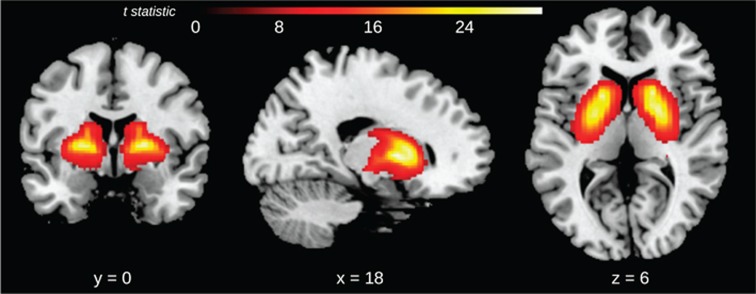
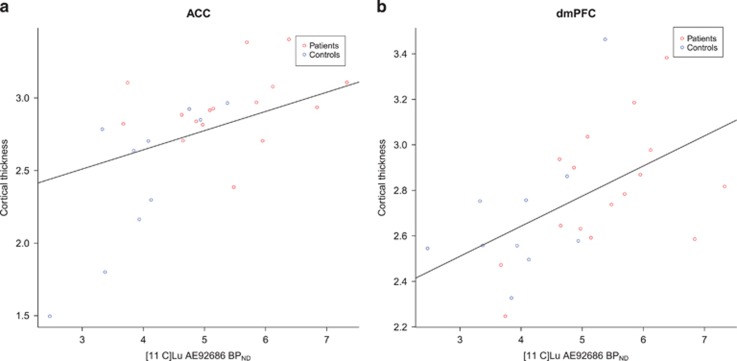
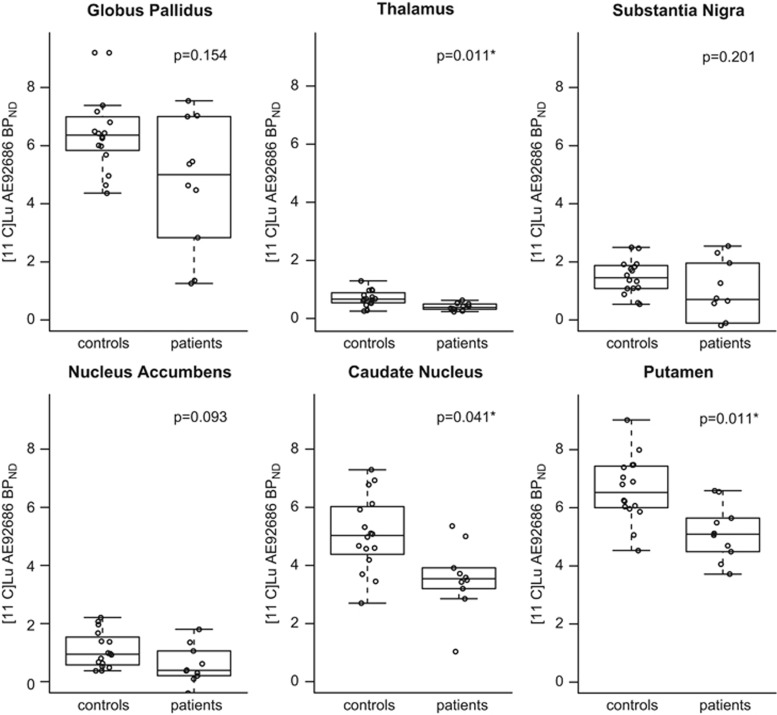
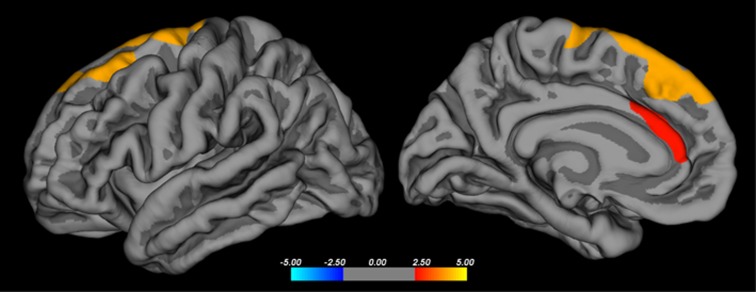
The enzyme phosphodiesterase 10A (PDE10A) is abundant in striatal medium spiny neurons and has been implicated in the pathophysiology of schizophrenia in animal models and is investigated as a possible new pharmacological treatment target. A reduction of prefrontal cortical thickness is common in schizophrenia, but how this relates to PDE10A expression is unknown. Our study aim was to compare, we believe for the first time, the striatal non-displaceable binding potential (BP) of the new validated PDE10A ligand [C]Lu AE92686 between patients with schizophrenia and healthy controls. Furthermore, we aimed to assess the correlation of PDE10A BP to cortical thickness. Sixteen healthy male controls and 10 male patients with schizophrenia treated with clozapine, olanzapine or quetiapine were investigated with positron emission tomography (PET) and magnetic resonance imaging (MRI). Striatal binding potential (BP) of [C]Lu AE92686 was acquired through dynamic PET scans and cortical thickness by structural MRI. Clinical assessments of symptoms and cognitive function were performed and the antipsychotic dosage was recorded. Patients with schizophrenia had a significantly lower BP of [C]Lu AE92686 in striatum (P=0.003) than healthy controls. The striatal BP significantly correlated to cortical thickness in the medial prefrontal cortex and superior frontal gyrus across patients with schizophrenia and healthy controls. No significant correlation was observed between the BP for [C]Lu AE92686 in striatum and age, schizophrenia symptoms, antipsychotic dosage, coffee consumption, smoking, duration of illness or cognitive function in the patients. In conclusion, PDE10A may be important for functioning in the striato-cortical interaction and in the pathophysiology of schizophrenia.
磷酸二酯酶10A(PDE10A)在纹状体中等棘状神经元中含量丰富,在动物模型中与精神分裂症的病理生理学有关,并且作为一种可能的新药理学治疗靶点正在接受研究。前额叶皮质厚度减少在精神分裂症中很常见,但这与PDE10A表达之间的关系尚不清楚。我们的研究目的是,我们认为首次比较新型经过验证的PDE10A配体[C]Lu AE92686在精神分裂症患者和健康对照者之间的纹状体不可置换结合潜能(BP)。此外,我们旨在评估PDE10A BP与皮质厚度的相关性。对16名健康男性对照者和10名接受氯氮平、奥氮平或喹硫平治疗的男性精神分裂症患者进行了正电子发射断层扫描(PET)和磁共振成像(MRI)检查。通过动态PET扫描获得[C]Lu AE92686的纹状体结合潜能(BP),通过结构MRI获得皮质厚度。进行了症状和认知功能的临床评估并记录了抗精神病药物剂量。精神分裂症患者纹状体中[C]Lu AE92686的BP显著低于健康对照者(P = 0.003)。在精神分裂症患者和健康对照者中,纹状体BP与内侧前额叶皮质和额上回的皮质厚度显著相关。在患者中,纹状体中[C]Lu AE92686的BP与年龄、精神分裂症症状、抗精神病药物剂量、咖啡摄入量、吸烟、病程或认知功能之间未观察到显著相关性。总之,PDE10A可能在纹状体 - 皮质相互作用及精神分裂症的病理生理学中发挥重要作用。