Ngonghala Calistus N, Pluciński Mateusz M, Murray Megan B, Farmer Paul E, Barrett Christopher B, Keenan Donald C, Bonds Matthew H
Department of Global Health and Social Medicine, Harvard Medical School, Boston, Massachusetts, United States of America; National Institute for Mathematical and Biological Synthesis (NIMBioS), The University of Tennessee, Knoxville, Tennessee, United States of America.
Department of Environmental Science, Policy and Management, University of California, Berkeley, Berkeley, California, United States of America.
PLoS Biol. 2014 Apr 1;12(4):e1001827. doi: 10.1371/journal.pbio.1001827. eCollection 2014 Apr.
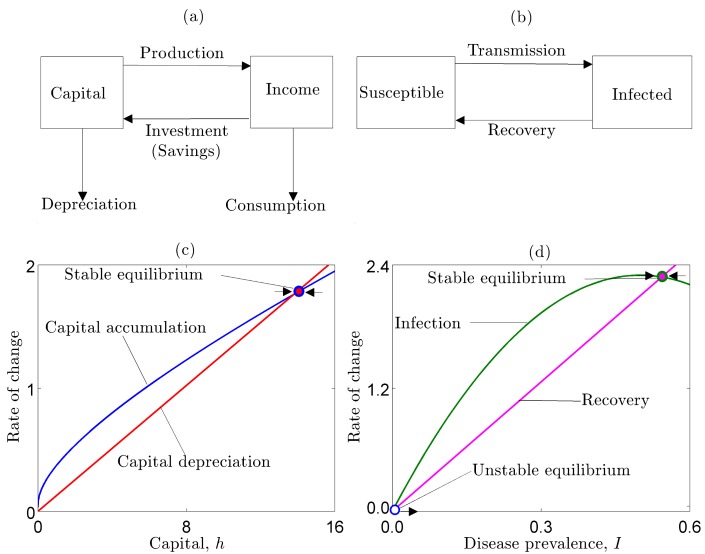
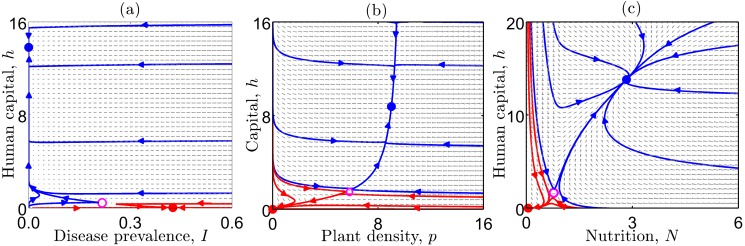
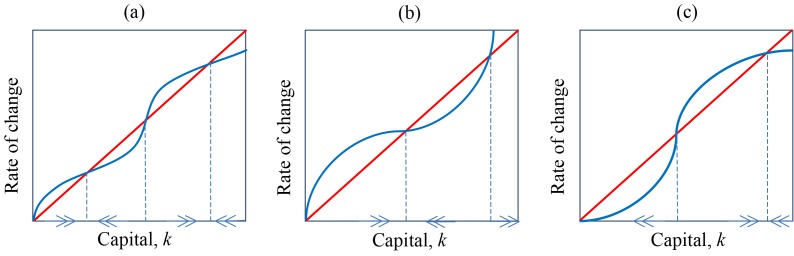
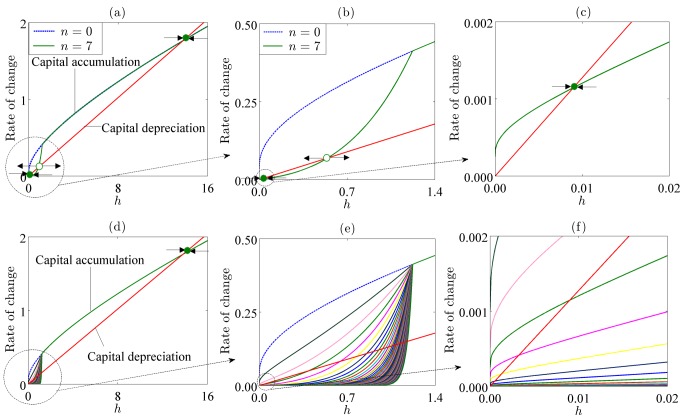
Understanding why some human populations remain persistently poor remains a significant challenge for both the social and natural sciences. The extremely poor are generally reliant on their immediate natural resource base for subsistence and suffer high rates of mortality due to parasitic and infectious diseases. Economists have developed a range of models to explain persistent poverty, often characterized as poverty traps, but these rarely account for complex biophysical processes. In this Essay, we argue that by coupling insights from ecology and economics, we can begin to model and understand the complex dynamics that underlie the generation and maintenance of poverty traps, which can then be used to inform analyses and possible intervention policies. To illustrate the utility of this approach, we present a simple coupled model of infectious diseases and economic growth, where poverty traps emerge from nonlinear relationships determined by the number of pathogens in the system. These nonlinearities are comparable to those often incorporated into poverty trap models in the economics literature, but, importantly, here the mechanism is anchored in core ecological principles. Coupled models of this sort could be usefully developed in many economically important biophysical systems--such as agriculture, fisheries, nutrition, and land use change--to serve as foundations for deeper explorations of how fundamental ecological processes influence structural poverty and economic development.
对于社会科学和自然科学而言,理解为何一些人群长期处于贫困状态仍然是一项重大挑战。极端贫困人口通常依赖其直接的自然资源基础维持生计,并且因寄生虫病和传染病而面临高死亡率。经济学家已经开发出一系列模型来解释长期贫困,这些贫困通常被描述为贫困陷阱,但这些模型很少考虑复杂的生物物理过程。在本文中,我们认为,通过结合生态学和经济学的见解,我们可以开始对构成贫困陷阱产生和维持基础的复杂动态进行建模和理解,进而将其用于分析及可能的干预政策。为了说明这种方法的效用,我们提出了一个传染病与经济增长的简单耦合模型,其中贫困陷阱源自系统中病原体数量所决定的非线性关系。这些非线性关系与经济学文献中通常纳入贫困陷阱模型的那些关系类似,但重要的是,这里的机制基于核心生态原理。这种类型的耦合模型可以在许多具有经济重要性的生物物理系统(如农业、渔业、营养和土地利用变化)中得到有益的开发,作为更深入探索基本生态过程如何影响结构性贫困和经济发展的基础。