Han Sheng, Meng Lingxuan, Han Shuai, Wang Yunjie, Wu Anhua
Department of Neurosurgery, The First Hospital of China Medical University, Shenyang, China.
PLoS One. 2014 Apr 1;9(4):e93791. doi: 10.1371/journal.pone.0093791. eCollection 2014.
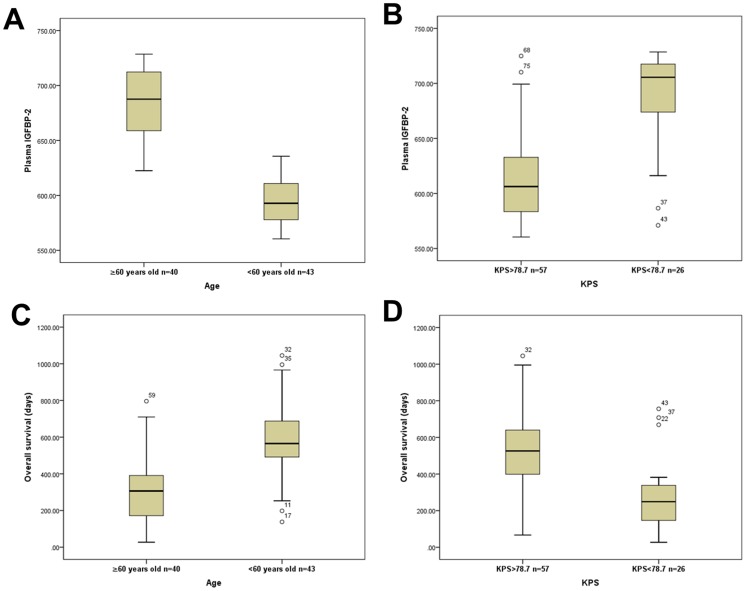
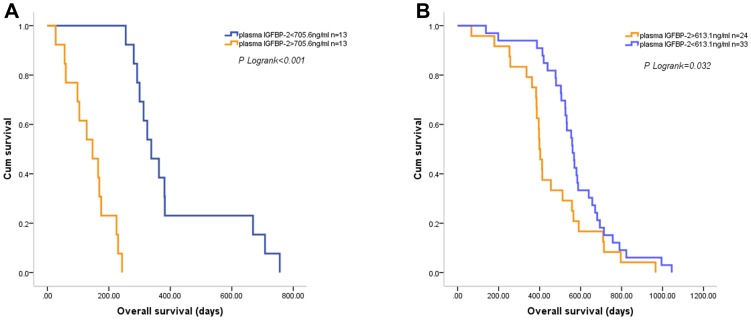
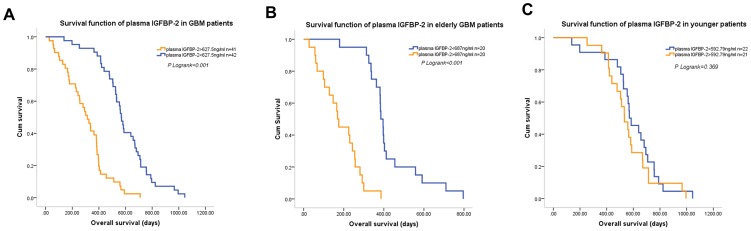
It has been found that preoperative plasma IGFBP-2 levels correlate with prognosis in glioma patients. The prognostic value of plasma IGFBP-2 after postoperative combined radiotherapy and chemotherapy in glioma patients is unknown. Plasma IGFBP-2 levels in 83 glioblastoma patients after postoperative radiotherapy plus chemotherapy were analyzed using an IGFBP-2 ELISA kit. We found that after standard therapy plasma IGFBP-2 levels significantly correlated with the patient's age (R = 0.738, P<0.001) and Karnofsky performance status (KPS, R = -0.633, P<0.05). Cox proportional hazards models were used to calculate hazard ratios (HRs) of death according to plasma IGFBP-2 levels adjusted for patient clinical characteristics. Plasma IGFBP-2 levels significantly correlated with overall survival in glioblastoma patients (multivariate HR = 1.035; 95% CI, 1.024-1.047; P<0.001). The effect of plasma IGFBP-2 levels on survival seemed to differ according to patients' age. Among patients older than 60, high plasma IGFBP-2 levels were associated with a significant increase in overall mortality (HR = 1.097; 95% CI, 1.055-1.140; P<0.001). In contrast, plasma IGFBP-2 levels conferred no significant effect on mortality among patients younger than 60. Elevated plasma IGFBP-2 levels after combined postoperative radiotherapy and chemotherapy in elderly glioblastoma patients correlate with poor KPS score and predicts poor prognosis.
研究发现,术前血浆胰岛素样生长因子结合蛋白-2(IGFBP-2)水平与胶质瘤患者的预后相关。术后联合放疗和化疗后血浆IGFBP-2在胶质瘤患者中的预后价值尚不清楚。使用IGFBP-2 ELISA试剂盒分析了83例胶质母细胞瘤患者术后放疗加化疗后的血浆IGFBP-2水平。我们发现,标准治疗后血浆IGFBP-2水平与患者年龄显著相关(R = 0.738,P<0.001)和卡诺夫斯基表现状态(KPS,R = -0.633,P<0.05)。使用Cox比例风险模型根据针对患者临床特征调整后的血浆IGFBP-2水平计算死亡风险比(HRs)。血浆IGFBP-2水平与胶质母细胞瘤患者的总生存期显著相关(多变量HR = 1.035;95% CI,1.024 - 1.047;P<0.001)。血浆IGFBP-2水平对生存的影响似乎因患者年龄而异。在60岁以上的患者中,高血浆IGFBP-2水平与总死亡率显著增加相关(HR = 1.097;95% CI,1.055 - 1.140;P<0.001)。相比之下,血浆IGFBP-2水平对60岁以下患者的死亡率没有显著影响。老年胶质母细胞瘤患者术后联合放疗和化疗后血浆IGFBP-2水平升高与KPS评分低相关,并预示预后不良。