Steele Vaughn R, Staley Cameron, Fong Timothy, Prause Nicole
The Mind Research Network, Albuquerque, NM, USA ; Department of Psychology, University of New Mexico, Albuquerque, NM, USA.
Counseling Center, Idaho State University, Pocatello, ID, USA.
Socioaffect Neurosci Psychol. 2013 Jul 16;3:20770. doi: 10.3402/snp.v3i0.20770. eCollection 2013.
Modulation of sexual desires is, in some cases, necessary to avoid inappropriate or illegal sexual behavior (downregulation of sexual desire) or to engage with a romantic partner (upregulation of sexual desire). Some have suggested that those who have difficulty downregulating their sexual desires be diagnosed as having a sexual 'addiction'. This diagnosis is thought to be associated with sexual urges that feel out of control, high-frequency sexual behavior, consequences due to those behaviors, and poor ability to reduce those behaviors. However, such symptoms also may be better understood as a non-pathological variation of high sexual desire. Hypersexuals are thought to be relatively sexual reward sensitized, but also to have high exposure to visual sexual stimuli. Thus, the direction of neural responsivity to sexual stimuli expected was unclear. If these individuals exhibit habituation, their P300 amplitude to sexual stimuli should be diminished; if they merely have high sexual desire, their P300 amplitude to sexual stimuli should be increased. Neural responsivity to sexual stimuli in a sample of hypersexuals could differentiate these two competing explanations of symptoms.
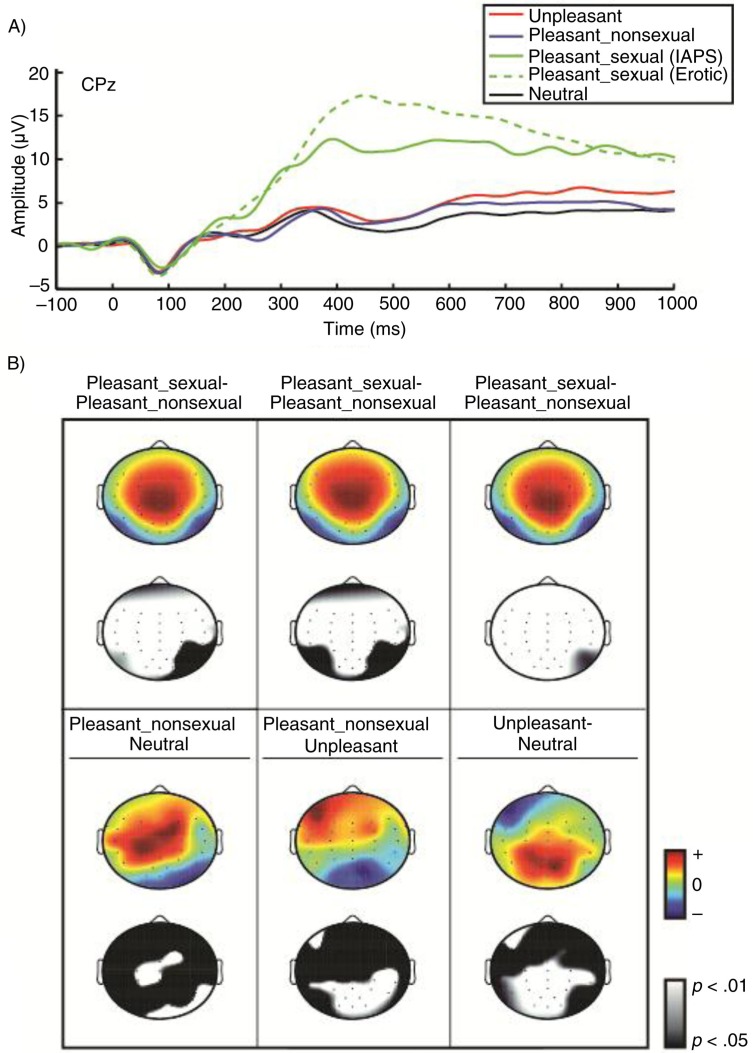
Fifty-two (13 female) individuals who self-identified as having problems regulating their viewing of visual sexual stimuli viewed emotional (pleasant sexual, pleasant-non-sexual, neutral, and unpleasant) photographs while electroencephalography was collected.
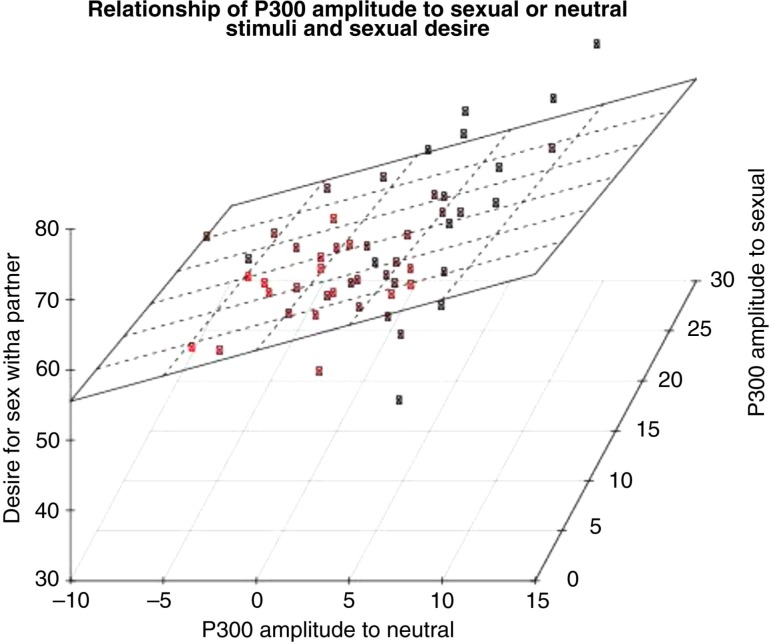
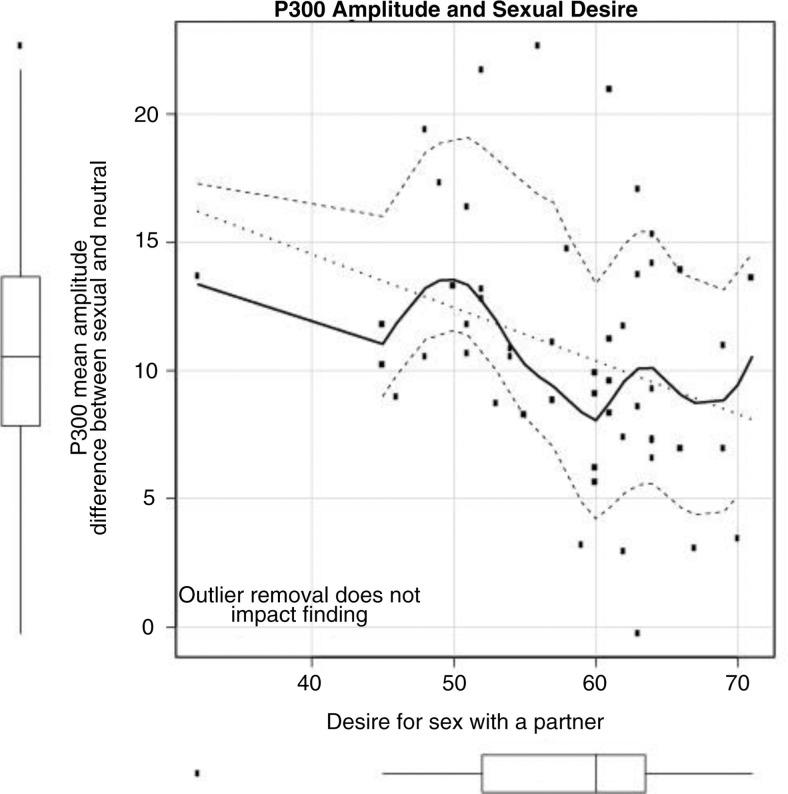
Larger P300 amplitude differences to pleasant sexual stimuli, relative to neutral stimuli, was negatively related to measures of sexual desire, but not related to measures of hypersexuality.
Implications for understanding hypersexuality as high desire, rather than disordered, are discussed.
在某些情况下,调节性欲对于避免不适当或非法的性行为(降低性欲)或与浪漫伴侣互动(增强性欲)是必要的。一些人建议,那些难以降低性欲的人应被诊断为患有性“成瘾”。这种诊断被认为与感觉失控的性冲动、高频性行为、这些行为导致的后果以及减少这些行为的能力差有关。然而,这些症状也可能更好地被理解为高性欲的非病理性变异。人们认为性欲亢进者相对对性奖励敏感,但也接触到大量视觉性刺激。因此,预期的对性刺激的神经反应方向尚不清楚。如果这些个体表现出习惯化,他们对性刺激的P300波幅应该减小;如果他们仅仅有高性欲,他们对性刺激的P300波幅应该增加。对性欲亢进者样本中对性刺激的神经反应可以区分对这些症状的两种相互竞争的解释。
52名(13名女性)自我认定在调节观看视觉性刺激方面有问题的个体在收集脑电图时观看了情感类(愉悦的性、愉悦的非性、中性和不愉快)照片。
相对于中性刺激,对愉悦性刺激的P300波幅差异更大与性欲测量值呈负相关,但与性欲亢进测量值无关。
讨论了将性欲亢进理解为高欲望而非疾病状态的意义。