Kirejczyk Jan K, Porowski Tadeusz, Konstantynowicz Jerzy, Kozerska Agata, Nazarkiewicz Andrzej, Hoppe Bernd, Wasilewska Anna
Department of Pediatric Surgery, Medical University of Bialystok, Bialystok, Poland.
Pediatr Nephrol. 2014 Sep;29(9):1575-82. doi: 10.1007/s00467-014-2806-7. Epub 2014 Apr 3.
Hypocitraturia is considered a major risk factor for calcium stone formation. However, there is no widely accepted reference database of urinary citrate excretion in children. The aim of our study was to determine the amount of citrate eliminated in the urine over a 24-h period in a pediatric cohort and to determine an optimal unit reflecting excretion.
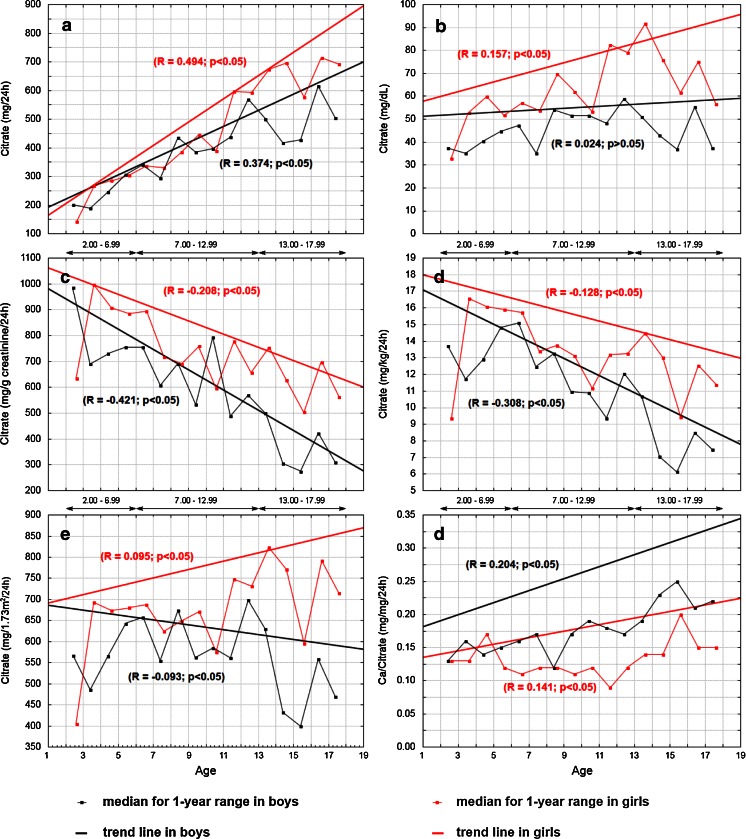
The study cohort comprised 2,334 healthy boys and girls aged 2-18 years. The levels of urinary citrate were assessed by an enzymatic method in 24-hour urine and expressed in absolute values, as urinary concentration, citrate/creatinine ratio, per kilogram of body weight, in relation to 1.73 m2, and as the calcium/citrate index.
Similar incremental age-related citraturia rates were observed in both male and female subjects until puberty during which time citrate excretion became significantly higher in girls. Urinary citrate adjusted for creatinine and for body weight showed a significantly decreasing trend with increasing age in both sexes. Urinary citrate corrected for body surface was weakly correlated with age. Thus, the assumption of 180 mg/1.73 m2/24 h for males and 250 mg/1.73 m2/24 h for females as lower cut-off values appeared to be reliable from a practical perspective.
We found distinct sex-dependent differences in citraturia at the start of puberty, with significantly higher values of urinary citrate in girls than in boys. Further prospective studies are warranted to elucidate whether this difference represents a differentiated risk of urolithiasis.
低枸橼酸尿症被认为是钙结石形成的主要危险因素。然而,目前尚无广泛接受的儿童尿枸橼酸排泄参考数据库。我们研究的目的是确定儿科队列中24小时内尿中排出的枸橼酸量,并确定反映排泄情况的最佳单位。
研究队列包括2334名2至18岁的健康男孩和女孩。采用酶法评估24小时尿液中的尿枸橼酸水平,以绝对值、尿浓度、枸橼酸/肌酐比值、每千克体重、相对于1.73平方米体表面积以及钙/枸橼酸指数表示。
在青春期前,男性和女性受试者的枸橼酸尿症发生率随年龄增长的趋势相似,在此期间女孩的枸橼酸排泄量显著更高。经肌酐和体重校正后的尿枸橼酸在两性中均随年龄增长呈显著下降趋势。经体表面积校正后的尿枸橼酸与年龄呈弱相关。因此,从实际角度来看,男性以180mg/1.73平方米/24小时、女性以250mg/1.73平方米/24小时作为下限值似乎是可靠的。
我们发现在青春期开始时,枸橼酸尿症存在明显的性别差异,女孩的尿枸橼酸值显著高于男孩。有必要进行进一步的前瞻性研究,以阐明这种差异是否代表尿石症的不同风险。