Watts Joel C, Giles Kurt, Patel Smita, Oehler Abby, DeArmond Stephen J, Prusiner Stanley B
Institute for Neurodegenerative Diseases, University of California, San Francisco, San Francisco, California, United States of America; Department of Neurology, University of California, San Francisco, San Francisco, California, United States of America.
Institute for Neurodegenerative Diseases, University of California, San Francisco, San Francisco, California, United States of America.
PLoS Pathog. 2014 Apr 3;10(4):e1003990. doi: 10.1371/journal.ppat.1003990. eCollection 2014 Apr.
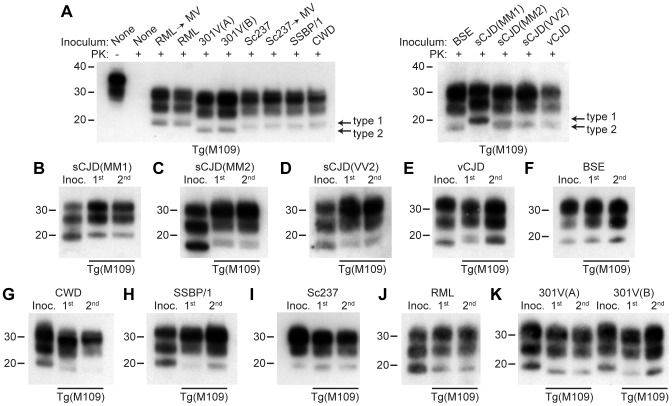
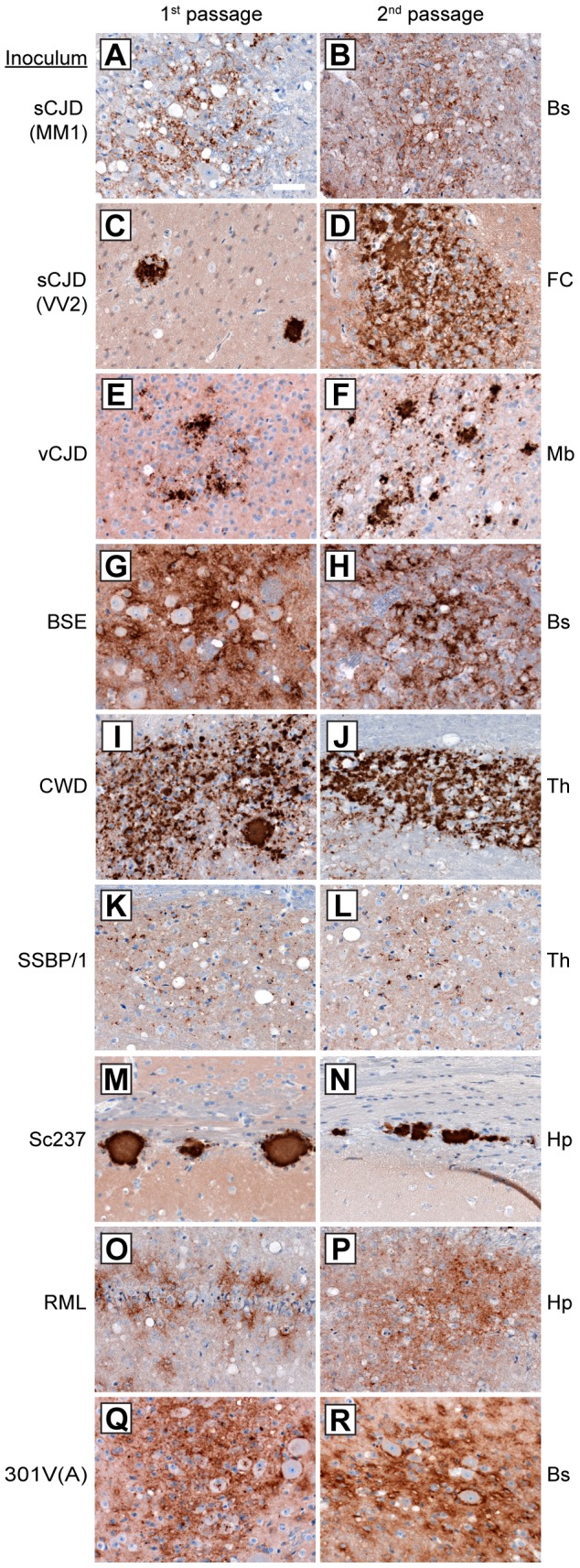
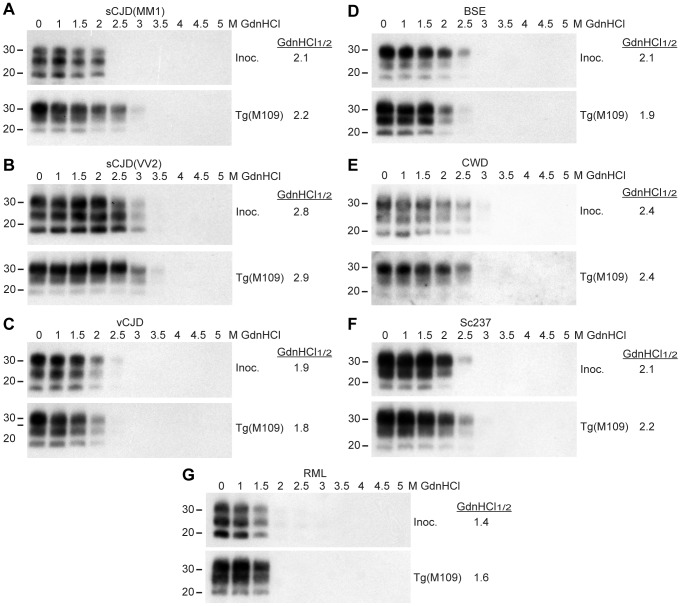
Bank voles are uniquely susceptible to a wide range of prion strains isolated from many different species. To determine if this enhanced susceptibility to interspecies prion transmission is encoded within the sequence of the bank vole prion protein (BVPrP), we inoculated Tg(M109) and Tg(I109) mice, which express BVPrP containing either methionine or isoleucine at polymorphic codon 109, with 16 prion isolates from 8 different species: humans, cattle, elk, sheep, guinea pigs, hamsters, mice, and meadow voles. Efficient disease transmission was observed in both Tg(M109) and Tg(I109) mice. For instance, inoculation of the most common human prion strain, sporadic Creutzfeldt-Jakob disease (sCJD) subtype MM1, into Tg(M109) mice gave incubation periods of ∼200 days that were shortened slightly on second passage. Chronic wasting disease prions exhibited an incubation time of ∼250 days, which shortened to ∼150 days upon second passage in Tg(M109) mice. Unexpectedly, bovine spongiform encephalopathy and variant CJD prions caused rapid neurological dysfunction in Tg(M109) mice upon second passage, with incubation periods of 64 and 40 days, respectively. Despite the rapid incubation periods, other strain-specified properties of many prion isolates--including the size of proteinase K-resistant PrPSc, the pattern of cerebral PrPSc deposition, and the conformational stability--were remarkably conserved upon serial passage in Tg(M109) mice. Our results demonstrate that expression of BVPrP is sufficient to engender enhanced susceptibility to a diverse range of prion isolates, suggesting that BVPrP may be a universal acceptor for prions.
大林姬鼠对从许多不同物种中分离出的多种朊病毒株具有独特的易感性。为了确定大林姬鼠朊病毒蛋白(BVPrP)序列中是否编码了这种对种间朊病毒传播增强的易感性,我们用来自8个不同物种(人类、牛、麋鹿、绵羊、豚鼠、仓鼠、小鼠和草原田鼠)的16种朊病毒分离株接种了Tg(M109)和Tg(I109)小鼠,这两种小鼠在多态密码子109处表达含有甲硫氨酸或异亮氨酸的BVPrP。在Tg(M109)和Tg(I109)小鼠中均观察到了有效的疾病传播。例如,将最常见的人类朊病毒株,散发性克雅氏病(sCJD)MM1亚型接种到Tg(M109)小鼠中,潜伏期约为200天,在第二次传代时略有缩短。慢性消耗病朊病毒的潜伏期约为250天,在Tg(M109)小鼠中第二次传代时缩短至约150天。出乎意料的是,牛海绵状脑病和变异型克雅氏病朊病毒在Tg(M109)小鼠第二次传代时导致快速的神经功能障碍,潜伏期分别为64天和40天。尽管潜伏期很短,但许多朊病毒分离株的其他毒株特异性特性——包括蛋白酶K抗性PrPSc的大小、脑内PrPSc沉积模式和构象稳定性——在Tg(M109)小鼠连续传代后仍显著保守。我们的结果表明,BVPrP的表达足以导致对多种朊病毒分离株的易感性增强,这表明BVPrP可能是朊病毒的通用受体。