Abdelaziz Osama, Deraz Salem
Department of Pediatrics, Faculty of Medicine, Cairo University, Cairo, Egypt.
Department of Pediatrics, Faculty of Medicine, Menoufia University, Shebin El Kom, Egypt.
Ann Pediatr Cardiol. 2014 Jan;7(1):19-24. doi: 10.4103/0974-2069.126543.
Junctional ectopic tachycardia (JET) often occurs in the early postoperative period following surgery for congenital heart diseases and may lead to hemodynamic compromise. Its exact etiology is unknown, however, longer cardiopulmonary bypass (CPB) time, aortic cross clamp (ACC) time, catecholamines, and hypomagnesemia are known risk factors. JET is associated with increased postoperative morbidity and mortality.
A prospective cohort study of 194 consecutive children who underwent open heart surgery on CPB over 1 year period, patients was divided into three groups; JET, non-JET arrhythmia, and no arrhythmia groups. Information on patient's demographics (sex, age, and body weight), type of surgical interventions, duration of CPB and ACC, the use of inotropic support, duration of intensive care unit (ICU) stay, and response to different therapeutic methods were collected.
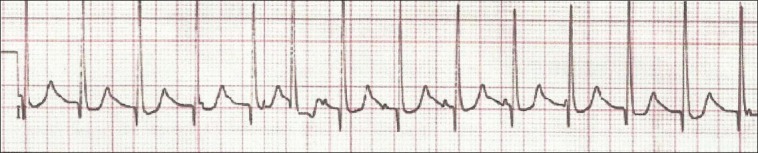
JET was documented in 53 patients (27%) most commonly following tetralogy of Fallot (TOF) repair and was associated with longer CPB and ACC times (118 and 77 min, respectively) as compared to non-JET arrhythmia (93.9 and 55.3 min, respectively) and no arrhythmia groups (94.9 and 54.8 min, respectively). Patients with JET required more inotropic support and longer ICU stay as compared to other groups. Amiodarone was safe and effective in treatment of JET. Atrial electrocardiogram (ECG) and Lewis lead ECG were helpful tools in JET diagnosis. The mortality was 11.5% in JET patients.
Incidence of JET was 27% possibly due to the large number of Fallot repair and Senning operation. Longer CPB and ACC times are risk factors for JET.
交界性异位性心动过速(JET)常发生于先天性心脏病手术后的早期,可能导致血流动力学不稳定。其确切病因尚不清楚,然而,较长的体外循环(CPB)时间、主动脉阻断钳夹(ACC)时间、儿茶酚胺和低镁血症是已知的危险因素。JET与术后发病率和死亡率增加相关。
一项前瞻性队列研究,对194例在1年期间接受CPB下心脏直视手术的连续儿童进行研究,患者分为三组;JET组、非JET心律失常组和无心律失常组。收集患者的人口统计学信息(性别、年龄和体重)、手术干预类型、CPB和ACC持续时间以及使用正性肌力药物支持、重症监护病房(ICU)住院时间和对不同治疗方法的反应。
53例患者(27%)记录到JET,最常见于法洛四联症(TOF)修复术后,与非JET心律失常组(分别为93.9分钟和55.3分钟)和无心律失常组(分别为94.9分钟和54.8分钟)相比,JET组的CPB和ACC时间更长(分别为118分钟和77分钟)。与其他组相比,JET患者需要更多的正性肌力药物支持,且ICU住院时间更长。胺碘酮治疗JET安全有效。心房心电图(ECG)和Lewis导联心电图有助于JET的诊断。JET患者死亡率为11.5%。
JET的发生率为27%,可能是由于大量法洛四联症修复术和森宁手术。较长的CPB和ACC时间是JET的危险因素。