Center for Renal Transplantation, Nanjing First Hospital, Nanjing Medical University, Nanjing, China; Department of Urology, Nanjing First Hospital, Nanjing Medical University, Nanjing, China.
Department of Cardiology, Nanjing First Hospital, Nanjing Medical University, Nanjing, China.
PLoS One. 2014 Apr 4;9(4):e93938. doi: 10.1371/journal.pone.0093938. eCollection 2014.
Transforming growth factor-beta 1(TGF-β1) is involved in the development of acute rejection (AR) episodes in solid organ transplant recipients; and a number of studies have been conducted to investigate the combined effects of human TGF-β1 gene (TGFB1) +869 T/C and +915 G/C polymorphisms on AR risk. However, the results obtained are inconclusive.
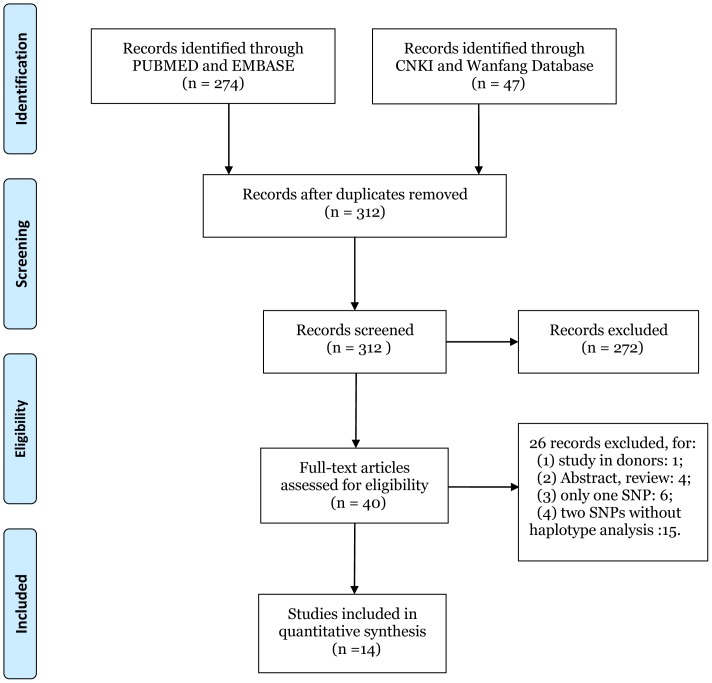
Eligible studies that investigated the haplotypic association between TGFB1 +869 T/C and +915 G/C polymorphisms and AR risk were comprehensively searched in the PUBMED, EMBASE, China National Knowledge Infrastructure, and Wanfang Database. Statistical analyses were performed by using STATA 12.0 and Review Manager 5.0.
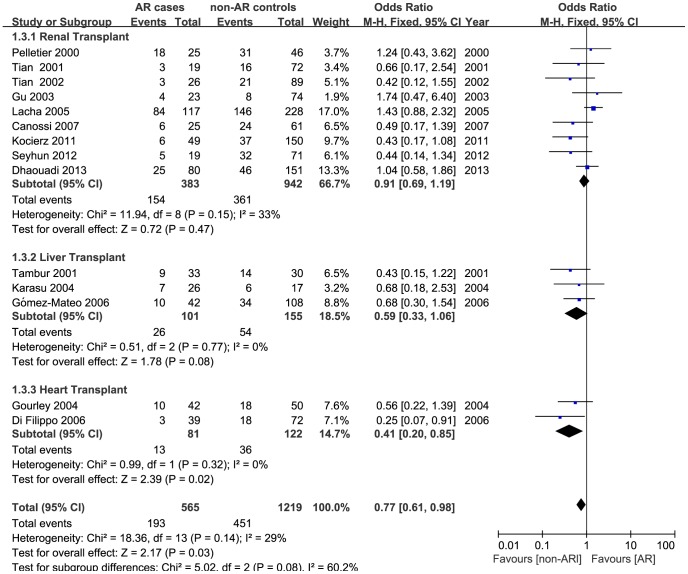
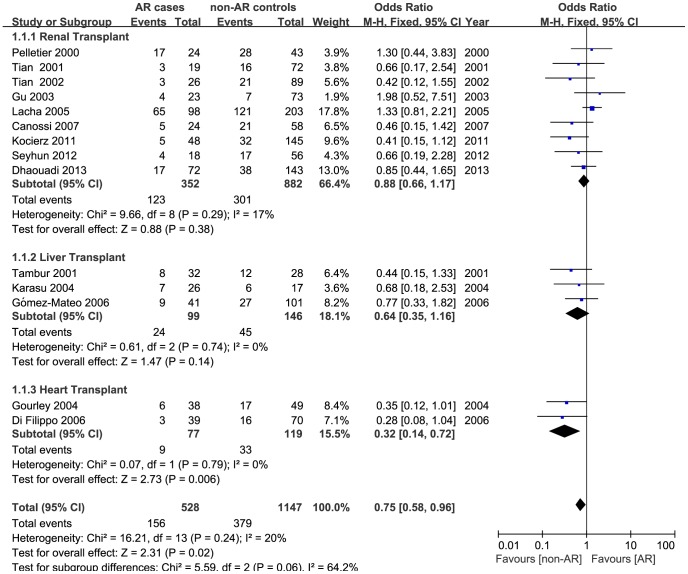
Fourteen eligible studies with 565 AR cases and 1219 non-AR cases were included. Overall, a significantly decreased risk was detected in patients carried with intermediate producer (IP) haplotypes (T/C G/C, T/T G/C, and C/C G/G) and/or low producer (LP) haplotypes (C/C G/C, C/C C/C, T/T C/C, and T/C C/C) compared with high producer (HP) haplotypes (T/T G/G and T/C G/G; IP vs. HP: OR = 0.75, 95% CI, 0.58-0.96, P heterogeneity = 0.238; IP/LP vs. HP: OR = 0.77, 95% CI, 0.61-0.98, P heterogeneity = 0.144). In addition, subgroup analysis by transplant types demonstrated a similar association in patients receiving heart transplant (IP vs. HP: OR = 0.32, 95% CI, 0.14-0.73, P heterogeneity = 0.790; IP/LP vs. HP: OR = 0.41, 95% CI, 0.20-0.85, P heterogeneity = 0.320).
The current meta-analysis and systematic review indicated that recipient TGFB1 HP haplotypes were significantly associated with an increased risk for AR in solid organ transplant recipients, particularly patients receiving cardiac allograft.
转化生长因子-β1(TGF-β1)参与实体器官移植受者急性排斥反应(AR)的发生;已有多项研究探讨了人 TGF-β1 基因(TGFB1)+869 T/C 和 +915 G/C 多态性对 AR 风险的联合影响。然而,结果并不一致。
系统检索 PUBMED、EMBASE、中国知网和万方数据库,纳入探讨 TGFB1+869 T/C 和+915 G/C 多态性与 AR 风险的单体型关联的研究。采用 STATA 12.0 和 Review Manager 5.0 进行统计学分析。
共纳入 14 项研究,包含 565 例 AR 病例和 1219 例非 AR 病例。结果显示,与高生产者(HP)单体型(T/T G/G 和 T/C G/G)相比,中间生产者(IP)单体型(T/C G/C、T/T G/C 和 C/C G/G)和/或低生产者(LP)单体型(C/C G/C、C/C C/C、T/T C/C 和 T/C C/C)的患者发生 AR 的风险显著降低(IP 与 HP:OR = 0.75,95%CI,0.58-0.96,P 异质性=0.238;IP/LP 与 HP:OR = 0.77,95%CI,0.61-0.98,P 异质性=0.144)。此外,按移植类型进行的亚组分析显示,在接受心脏移植的患者中也存在类似的相关性(IP 与 HP:OR = 0.32,95%CI,0.14-0.73,P 异质性=0.790;IP/LP 与 HP:OR = 0.41,95%CI,0.20-0.85,P 异质性=0.320)。
本荟萃分析和系统评价表明,受体 TGFB1 HP 单体型与实体器官移植受者 AR 风险增加显著相关,尤其是接受心脏同种异体移植的患者。