Kim Giyeon, Sellbom Martin, Ford Katy-Lauren
Center for Mental Health and Aging and Department of Psychology, The University of Alabama.
Research School of Psychology, The Australian National University.
Psychol Assess. 2014 Sep;26(3):892-900. doi: 10.1037/a0036431. Epub 2014 Apr 7.
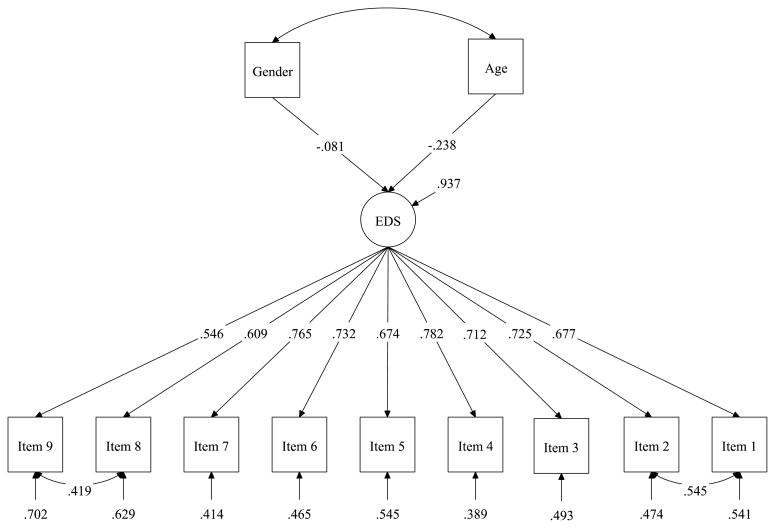
The present study examines the effect of race/ethnicity on measurement equivalence of the Everyday Discrimination Scale (EDS; Williams, Yu, Jackson, & Anderson, 1997). Drawn from the Collaborative Psychiatric Epidemiology Surveys (CPES; Alegría, Jackson, Kessler, & Takeuchi, 2008), adults aged 18 and older from four racial/ethnic groups were selected for analyses: 884 non-Hispanic Whites, 4,950 Blacks, 2,733 Hispanics/Latinos, and 2,089 Asians. Multiple-group confirmatory factor analyses were conducted. After adjusting for age and gender, the underlying construct of the EDS was invariant across four racial/ethnic groups, with Item 7 ("People act as if they're better than you are") associated with lower intercepts for the Hispanic/Latino and Asian groups relative to the non-Hispanic White and Black groups. In terms of latent factor differences, Blacks tended to score higher on the latent construct compared to other racial/ethnic groups, whereas Asians tended to score lower on the latent construct compared to Whites and Hispanics/Latinos. Findings suggest that although the EDS in general assesses the underlying construct of perceived discrimination equivalently across diverse racial/ethnic groups, caution is needed when Item 7 is used among Hispanics/Latinos or Asians. Implications are discussed in cultural and methodological contexts.
本研究考察了种族/族裔对日常歧视量表(EDS;Williams、Yu、Jackson和Anderson,1997)测量等效性的影响。从协作精神疾病流行病学调查(CPES;Alegría、Jackson、Kessler和Takeuchi,2008)中选取了四个种族/族裔群体中18岁及以上的成年人进行分析:884名非西班牙裔白人、4950名黑人、2733名西班牙裔/拉丁裔和2089名亚洲人。进行了多组验证性因素分析。在对年龄和性别进行调整后,EDS的潜在结构在四个种族/族裔群体中是不变的,相对于非西班牙裔白人和黑人群体,第7项(“人们表现得好像他们比你优越”)在西班牙裔/拉丁裔和亚洲群体中的截距较低。在潜在因素差异方面,与其他种族/族裔群体相比,黑人在潜在结构上的得分往往更高,而与白人和西班牙裔/拉丁裔相比,亚洲人在潜在结构上的得分往往更低。研究结果表明,尽管EDS总体上在不同种族/族裔群体中对感知歧视的潜在结构进行了等效评估,但在西班牙裔/拉丁裔或亚洲人中使用第7项时仍需谨慎。在文化和方法背景下对研究结果进行了讨论。