Young Jared W, Ratty Anil, Dawe Gavin S, Geyer Mark A
Department of Psychiatry, University of California San Diego.
Chakra Biotech Pte Ltd.
Behav Neurosci. 2014 Aug;128(4):460-7. doi: 10.1037/a0036425. Epub 2014 Apr 7.
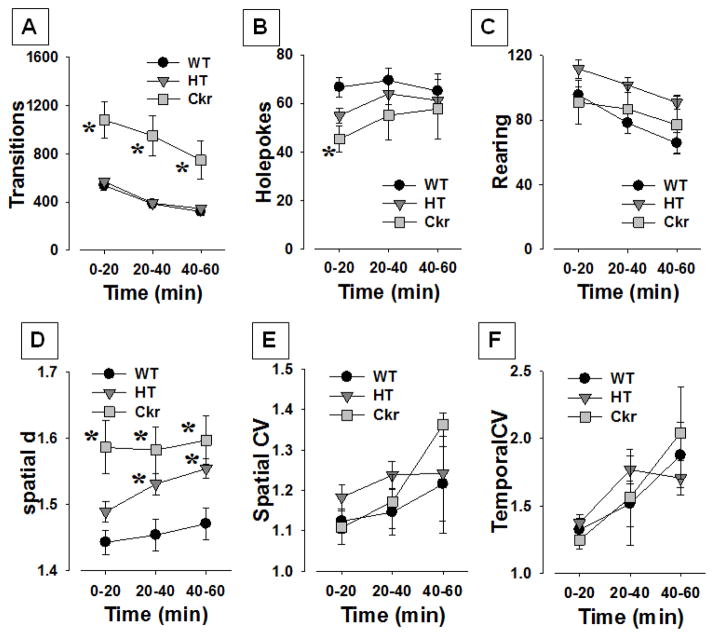
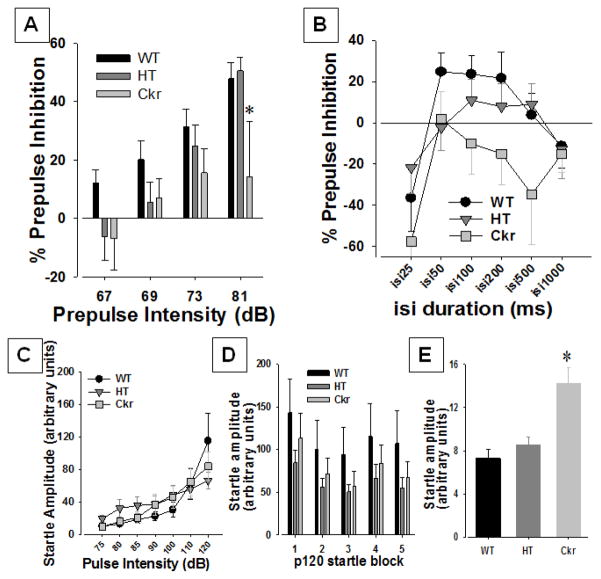
Schizophrenia is a prevalent neurodevelopmental psychiatric disorder with poor prognosis and limited understanding of its etiology. This limited etiological understanding renders developing animal models of schizophrenia difficult. Although attempts are made to recreate putative etiologies in models, these models may only enable the generation of treatments targeted at the mechanisms manipulated. Although the chakragati mouse was not created as a result of a specific gene target, reports to date suggest these mice exhibit behavioral abnormalities that are consistent with some observed in patients with schizophrenia. As an initial screen on the relevance of these mice to schizophrenia, we tested the exploration and sensorimotor gating of male and female chakragati mice in the cross-species tests behavioral pattern monitor (BPM) and prepulse inhibition (PPI), respectively. The chakragati mice exhibited hyperactive yet more meandering/circling movements of exploration compared with wildtype (WT) littermates. Moreover, chakragati mice exhibited impaired PPI compared with WT mice, primarily at high prepulse intensity levels. Thus, chakragati mice share some of the abnormal exploratory and PPI behaviors that are observed in patients with schizophrenia. These behaviors can be used to screen for novel antipsychotics which may be based on novel mechanisms of action. The multivariate abnormal exploration of these mice may also yield further information for treatment effects. Further characterization of these mice in tasks with putative links to negative or cognitive symptoms may further advance the utility of these mice as a screen for novel treatments for schizophrenia.
精神分裂症是一种常见的神经发育性精神障碍,预后较差,对其病因的了解有限。这种对病因的有限了解使得开发精神分裂症动物模型变得困难。尽管人们试图在模型中重现假定的病因,但这些模型可能只能产生针对所操纵机制的治疗方法。尽管chakragati小鼠并非因特定基因靶点而培育,但迄今为止的报告表明,这些小鼠表现出与精神分裂症患者中观察到的一些行为异常一致的行为。作为对这些小鼠与精神分裂症相关性的初步筛选,我们分别在跨物种测试行为模式监测仪(BPM)和前脉冲抑制(PPI)中测试了雄性和雌性chakragati小鼠的探索行为和感觉运动门控。与野生型(WT)同窝小鼠相比,chakragati小鼠表现出过度活跃但更曲折/转圈的探索运动。此外,与WT小鼠相比,chakragati小鼠的PPI受损,主要在高前脉冲强度水平。因此,chakragati小鼠表现出一些在精神分裂症患者中观察到的异常探索行为和PPI行为。这些行为可用于筛选可能基于新作用机制的新型抗精神病药物。这些小鼠的多变量异常探索也可能为治疗效果提供进一步信息。在与阴性或认知症状有假定联系的任务中对这些小鼠进行进一步表征,可能会进一步提高这些小鼠作为精神分裂症新型治疗筛选工具的效用。