Department of Veterinary Anatomy and Animal Behavior, College of Veterinary Medicine and BK21 Plus Project Team, Chonnam National University, Gwangju 61186, South Korea.
Curr Neuropharmacol. 2021;19(5):641-664. doi: 10.2174/1570159X18666200814175114.
Schizophrenia is a serious mental illness that affects more than 21 million people worldwide. Both genetics and the environment play a role in its etiology and pathogenesis. Symptoms of schizophrenia are mainly categorized into positive, negative, and cognitive. One major approach to identify and understand these diverse symptoms in humans has been to study behavioral phenotypes in a range of animal models of schizophrenia.
We aimed to provide a comprehensive review of the behavioral tasks commonly used for measuring schizophrenia-like behaviors in rodents together with an update of the recent study findings.
Articles describing phenotypes of schizophrenia-like behaviors in various animal models were collected through a literature search in Google Scholar, PubMed, Web of Science, and Scopus, with a focus on advances over the last 10 years.
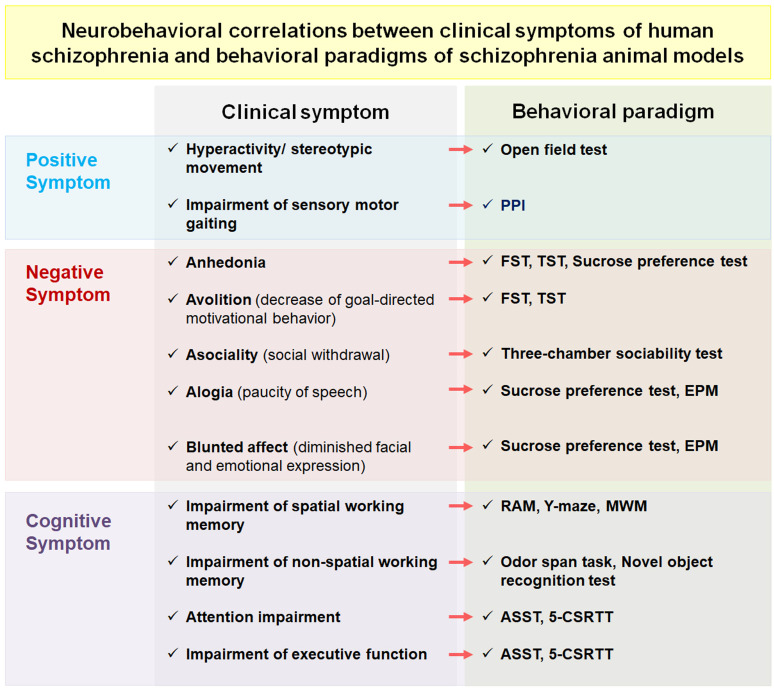
Numerous studies have used a range of animal models and behavioral paradigms of schizophrenia to develop antipsychotic drugs for improved therapeutics. In establishing animal models of schizophrenia, the candidate models were evaluated for schizophrenia-like behaviors using several behavioral tasks for positive, negative, and cognitive symptoms designed to verify human symptoms of schizophrenia. Such validated animal models were provided as rapid preclinical avenues for drug testing and mechanistic studies.
Based on the most recent advances in the field, it is apparent that a myriad of behavior tests are needed to confirm and evaluate the congruency of animal models with the numerous behaviors and clinical signs exhibited by patients with schizophrenia.
精神分裂症是一种严重的精神疾病,影响着全球超过 2100 万人。遗传和环境都在其病因和发病机制中发挥作用。精神分裂症的症状主要分为阳性、阴性和认知症状。识别和理解这些不同症状的主要方法之一是研究一系列精神分裂症动物模型中的行为表型。
我们旨在全面综述常用于测量啮齿类动物类精神分裂症样行为的行为任务,并更新最近的研究发现。
通过在 Google Scholar、PubMed、Web of Science 和 Scopus 中搜索文献,收集描述各种动物模型中类精神分裂症样行为表型的文章,重点关注过去 10 年的进展。
许多研究使用了一系列动物模型和精神分裂症行为范式来开发抗精神病药物,以改善治疗效果。在建立精神分裂症动物模型时,候选模型使用几种用于阳性、阴性和认知症状的行为任务来评估类精神分裂症样行为,以验证精神分裂症患者的人类症状。这些经过验证的动物模型为药物测试和机制研究提供了快速的临床前途径。
根据该领域的最新进展,显然需要进行大量的行为测试来确认和评估动物模型与精神分裂症患者表现出的众多行为和临床症状的一致性。