Department of Clinical Biochemistry, Aalborg University Hospital, Aalborg, Denmark.
Novo Nordisk Foundation Center for Basic Metabolic Research, Faculty of Health and Medical Sciences, University of Copenhagen, Copenhagen, Denmark.
Nutr Diabetes. 2014 Apr 7;4(4):e114. doi: 10.1038/nutd.2014.11.
The recently identified circulating sCD36 has been proposed to reflect tissue CD36 expression, and is upregulated in case of obesity, insulin resistance and hepatic steatosis. The aim of this study was to explore the effect of weight loss secondary to bariatric surgery in relation to sCD36 among morbidly obese individuals. Furthermore, we investigated the levels of sCD36 in relation to obesity-related metabolic complications, low-grade inflammation and fat distribution.
Twenty morbidly obese individuals (body mass index (BMI) 43.0±5.4 kg m(-2)) with a referral to Roux-en-Y gastric bypass were included. Anthropometric measurements and fasting blood samples were collected at a preoperative baseline visit and 3 months after surgery. sCD36 was measured by an in-house assay, whereas insulin sensitivity and the hepatic fat accumulation were estimated by the homeostasis model assessment (HOMA-%S) and liver fat percentage (LF%), respectively.
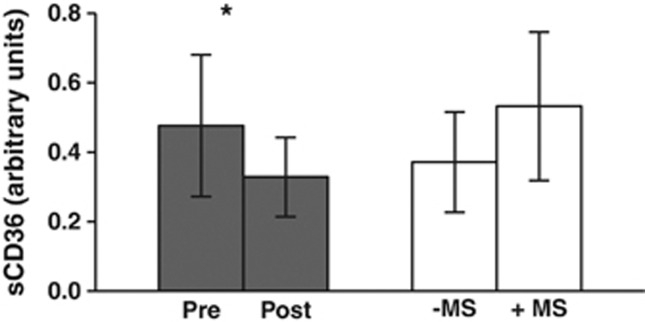
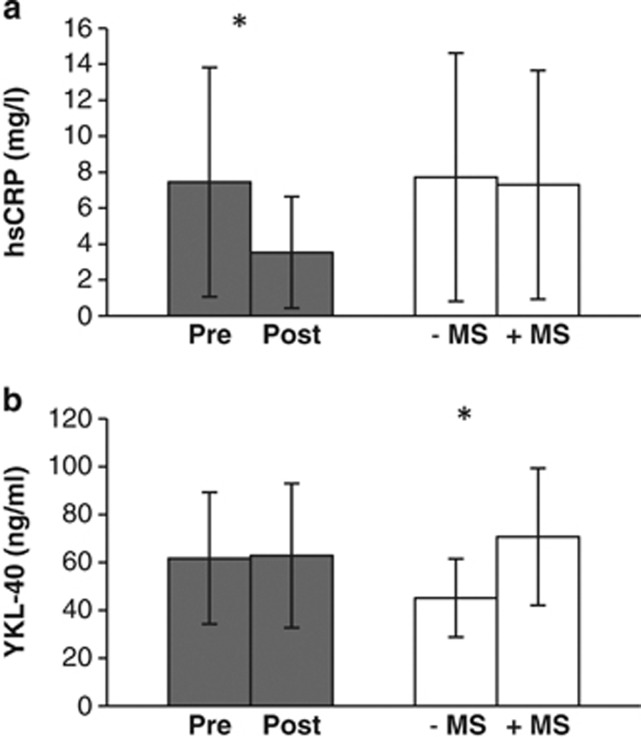
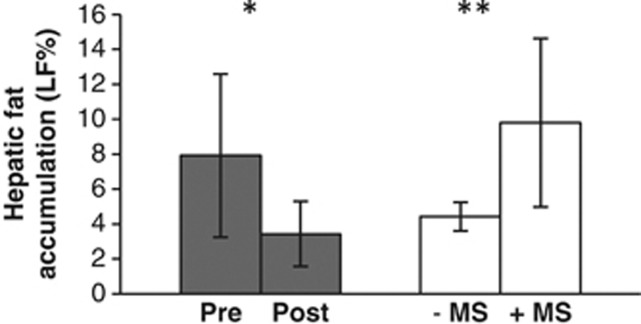
Postoperatively, BMI was reduced by 20% to 34.3±5.2 kg m(-2) (P<0.001). sCD36 was reduced by 31% (P=0.001) and improvements were observed in the amount of fat mass (P<0.001), truncal fat mass (P<0.001), circulating triglycerides (P=0.001), HOMA-%S (P=0.007), LF% (P=0.001) and the inflammatory marker high-sensitive C-reactive protein (P=0.005). sCD36 correlated with triglycerides (ρ=0.523, P=0.001) and truncal fat mass (ρ=0.357, P=0.026), and triglycerides were found to be an independent predictor of sCD36. At baseline, participants with the metabolic syndrome had a higher LF% and higher levels of the inflammatory biomarker YKL-40 (P=0.003 and P=0.014) as well as a tendency towards higher levels of sCD36.
sCD36 was reduced by weight loss and associated with an unhealthy fat accumulation and circulating triglycerides, which support the proposed role of sCD36 as a biochemical marker of obesity-related metabolic complications and risks.
最近发现的循环 sCD36 被认为反映了组织 CD36 的表达,并且在肥胖、胰岛素抵抗和肝脂肪变性的情况下上调。本研究旨在探讨肥胖患者接受减重手术后 sCD36 与体重减轻的关系。此外,我们还研究了 sCD36 与肥胖相关代谢并发症、低度炎症和脂肪分布的关系。
纳入 20 名体质量指数(BMI)为 43.0±5.4kg/m²的病态肥胖患者(BMI),这些患者有接受 Roux-en-Y 胃旁路手术的指征。在术前基线访视和手术后 3 个月时采集人体测量学测量值和空腹血样。采用内部检测法检测 sCD36,通过稳态模型评估(HOMA-%S)和肝脂肪百分比(LF%)分别估计胰岛素敏感性和肝脂肪堆积。
术后 BMI 降低 20%至 34.3±5.2kg/m²(P<0.001)。sCD36 降低 31%(P=0.001),脂肪量(P<0.001)、躯干脂肪量(P<0.001)、循环甘油三酯(P=0.001)、HOMA-%S(P=0.007)、LF%(P=0.001)和炎症标志物高敏 C 反应蛋白(P=0.005)均有所改善。sCD36 与甘油三酯(ρ=0.523,P=0.001)和躯干脂肪量(ρ=0.357,P=0.026)相关,甘油三酯是 sCD36 的独立预测因子。基线时,患有代谢综合征的患者 LF%和炎症生物标志物 YKL-40 水平较高(P=0.003 和 P=0.014),sCD36 水平也有升高的趋势。
sCD36 随体重减轻而降低,与不健康的脂肪堆积和循环甘油三酯有关,这支持了 sCD36 作为肥胖相关代谢并发症和风险的生化标志物的作用。